
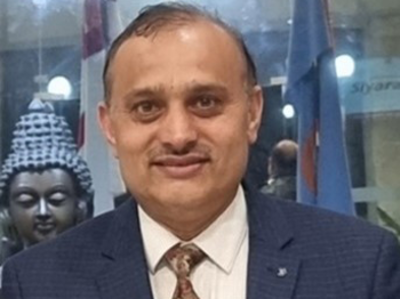
IN-SPACe director Vinod Kumar NEW DELHI: Space promoter and regulator IN-SPACe on Wednesday announced an AI inspired seed fund scheme of Rs 6 crore for startups or people interested in developing AI applications in the space sector.The seed fund initiative is aimed at accelerating AI-driven innovation across India’s private space ecosystem through targeted financial and institutional support. Vinod Kumar, director, promotion directorate, Indian National Space Promotion & Authorization Centre, made the announcement while speaking at a specialised session of the AI Impact Summit in Delhi titled “Beyond Earth: How AI is Powering the Next Era of Space Exploration”.Talking to TOI on the sidelines of the event, Kumar said, “Nowadays, AI applications are being used on ground in the space sector and in orbit. AI is now in every part of the space sector. Keeping this in mind, we have announced this new seed fund for any applicant that can replace any traditional method in the space sector with an AI application. We will invite applications from such startups, companies or even persons, and shortlist such five entities and provide them a grant of Rs 1 crore each for such AI applications. So, a total of Rs 6 crore has been announced.”When asked whether this grant amount will be increased, the director said, “Rs 6 crore is the initial seed fund. Rs 1 crore is sufficient for the application part. When any company’s idea is built up, then we have the technology adoption fund for that purpose, there we will provide the company Rs 35 crore. Even up to Rs 60 crore venture capital fund is available for such companies.” The last date for receipt of applications is March 20.On how prevalent is AI in Isro’s day-to-day work, the INSPACe director said, “AI is used for data analytics like hazard detection, AI is being used for processing data from satellites, and even human robot ‘Vyommitra’ developed for the Gaganyaan mission is also using AI. Even for the ground testing of a satellite we are using AI. For example, checking any crack in thousands of solar cells, we use AI. AI has entered our system.”He also disclosed that “a fully autonomous and advanced version of Vyommitra, based on AI, will be used in the upcoming Bharatiya Antariksh Station that will come up by 2035”.On how INSPACe is helping startups, the director said, “Currently, there are 390 space startups. We have received 850+ applications from startups in various aspects of the space sector, who are seeking our help. There are 12 courses we have designed in the space sector. And, over 58 colleges have added space applications in their curriculum. Many private companies have set up their own space facilities. But where companies are not able to have their own set up, INSPACe or Isro provide them help or do the hand-holding.”The director said, “Both space and AI are burgeoning sectors, and their convergence holds strong potential to transform how we explore and operate in complex and remote environments through autonomous and intelligent decision making. We are keen to see how non-govt entities use this opportunity to develop solutions that serve national priorities over the long term.”End of ArticleFollow Us On Social MediaVideos”Will Simplify Visas And Admin”: Macron’s Big Announcement For Indian StGalgotias University Turns A Robodog Into National Embarrassment, Thrown Out Of AI Summit”Don’t Want To Be Dependent On US Or China…” Macron On AI Innovation’Proud Moment For Humanity!’ Social Media Roasts Galgotias University, China Reacts To Robo Dog Row’India A Major Global Talent Hub’: Says Jaishankar At European Legal Gateway Office LaunchSundar Pichai Unveils ‘India-America Connect’ to Power Massive Subsea Cable ExpansionCCTV Captures Delhi Teen’s Speeding SUV Seconds Before Fatal Dwarka CrashIndia to Add $26 Trillion to Economy, Negotiating FTAs from Strength: Piyush Goyal’Can’t Wait For Trump To Go’: Hillary Clinton Hails India, Pushes Others For Climate Change MovesUS Panel Asks If Trump Needs To Cut Ties With Pakistan To Make India Happy. Here’s What Experts Said123PhotostoriesNithya Menen birthday special: From ‘Thiruchitrambalam’ to ‘Ishq’ – Films to watch on OTT5 snake-related paintings and symbols that are believed to remove negativityExclusive – Elvish Yadav opens up about hosting Engaged Season 2, shares his take on love and confirms he will get married soon10 vegetarian koftas to make your meals extra deliciousFrom Daulat Ki Chaat to Bhutte Ka Kees: 8 rare Indian dishes the world needs to try5 famous embroideries India gifted to the world5 real estate hotspots in Lucknow driving the residential market in 20265 things foreign tourists secretly dislike about travelling in India6 luxury cars with interiors that feel like five-star loungesHow to make Afghani Egg Curry for dinner at home123Hot PicksCigarette price hikeGold rate todayITC shareMadhya Pradesh budget 2026–27Income Tax CalculatorPublic holidays February 2026Bank Holidays februaryTop TrendingRashee Rice LawsuitLarry WheelsRampage JacksonPatrick MahomesSidney Crosby GirlfriendLindsey VonnLogan PaulMick CroninNBA Trade NewsJake Paul Fiance

NEW DELHI: Space promoter and regulator IN-SPACe on Wednesday announced an AI inspired seed fund scheme of Rs 6 crore for startups or people interested in developing AI applications in the space sector.The seed fund initiative is aimed at accelerating AI-driven innovation across India’s private space ecosystem through targeted financial and institutional support. Vinod Kumar, director, promotion directorate, Indian National Space Promotion & Authorization Centre, made the announcement while speaking at a specialised session of the AI Impact Summit in Delhi titled “Beyond Earth: How AI is Powering the Next Era of Space Exploration”.Talking to TOI on the sidelines of the event, Kumar said, “Nowadays, AI applications are being used on ground in the space sector and in orbit. AI is now in every part of the space sector. Keeping this in mind, we have announced this new seed fund for any applicant that can replace any traditional method in the space sector with an AI application. We will invite applications from such startups, companies or even persons, and shortlist such five entities and provide them a grant of Rs 1 crore each for such AI applications. So, a total of Rs 6 crore has been announced.”When asked whether this grant amount will be increased, the director said, “Rs 6 crore is the initial seed fund. Rs 1 crore is sufficient for the application part. When any company’s idea is built up, then we have the technology adoption fund for that purpose, there we will provide the company Rs 35 crore. Even up to Rs 60 crore venture capital fund is available for such companies.” The last date for receipt of applications is March 20.On how prevalent is AI in Isro’s day-to-day work, the INSPACe director said, “AI is used for data analytics like hazard detection, AI is being used for processing data from satellites, and even human robot ‘Vyommitra’ developed for the Gaganyaan mission is also using AI. Even for the ground testing of a satellite we are using AI. For example, checking any crack in thousands of solar cells, we use AI. AI has entered our system.”He also disclosed that “a fully autonomous and advanced version of Vyommitra, based on AI, will be used in the upcoming Bharatiya Antariksh Station that will come up by 2035”.On how INSPACe is helping startups, the director said, “Currently, there are 390 space startups. We have received 850+ applications from startups in various aspects of the space sector, who are seeking our help. There are 12 courses we have designed in the space sector. And, over 58 colleges have added space applications in their curriculum. Many private companies have set up their own space facilities. But where companies are not able to have their own set up, INSPACe or Isro provide them help or do the hand-holding.”The director said, “Both space and AI are burgeoning sectors, and their convergence holds strong potential to transform how we explore and operate in complex and remote environments through autonomous and intelligent decision making. We are keen to see how non-govt entities use this opportunity to develop solutions that serve national priorities over the long term.”


