
In 1999, a dinosaur bone was found on Japan’s Fukushima coast and left unstudied; in 2026, scientists identified it belonged to a 3-metre iguanodontian that lived 90 million years ago

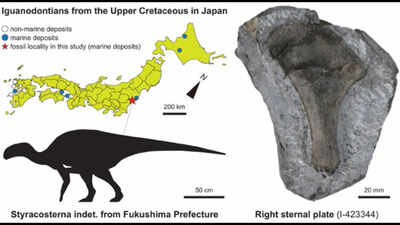
A small dinosaur bone discovered in Fukushima, Japan, more than two decades ago has given scientists a new glimpse into the diversity of ancient life along East Asia’s coast.The fossil, found in 1999 and left largely unexamined for years, has now been identified as part of the breastbone of a plant-eating dinosaur known as an iguanodontian. Based on comparisons with related animals, researchers estimate that the dinosaur was approximately 3 metres long; much smaller than other iguanodontian fossils previously found in the same geological formation.The finding suggests that dinosaurs of different sizes lived in the coastal environments of what is now Fukushima during the Late Cretaceous, around 90 to 88 million years ago. The study titled ‘An iguanodontian sternal plate from the Upper Cretaceous Ashizawa Formation (Futaba Group) of Fukushima Prefecture, Japan’ was published in Paleontological Research in 2026.A fossil hiding in plain sightThe story began when an isolated bone was discovered on the grounds of the Iwaki City Ammonite Center in Fukushima Prefecture. The centre is located within the Ashizawa Formation, a group of rocks formed in a shallow marine environment during the Upper Cretaceous period.At the time, the fossil was tentatively identified as a sternal plate belonging to a hadrosauroid dinosaur. It was then placed in a collection and remained unstudied for more than 20 years.That kind of delay is not unusual in paleontology. Museums and fossil centres often hold thousands of specimens, many of which were collected before modern analytical methods or detailed comparisons were available. A bone that once seemed ordinary can become scientifically important when researchers revisit it with new questions.In this case, scientists examined the fossil’s shape, thickness and distinctive features. Their detailed study showed that it was the right sternal plate of an indeterminate styracosternan, a more advanced group of iguanodontian dinosaurs that includes hadrosauroids.What were iguanodontians?Iguanodontians were a widespread group of herbivorous dinosaurs that lived from the Late Jurassic through the Late Cretaceous. They were found across large parts of the ancient world and included a variety of body shapes and sizes.Some members were relatively small and lightly built, while others became large, powerful plant-eaters. Their teeth and jaws were adapted for processing vegetation, and many species could move on either two or four legs.The group is important to paleontologists because its fossils help explain how herbivorous dinosaurs spread between Asia, Europe and North America. During the age of the dinosaurs, these landmasses were part of the larger northern supercontinent known as Laurasia. Changes in geography, climate and sea level created opportunities for animals to move between regions, influencing how iguanodontians evolved and diversified.A smaller dinosaur in a coastal worldThe Fukushima fossil is important because most of the iguanodontian remains found in Japan are fragmentary. Researchers have recovered isolated teeth, bones and other incomplete remains, making it difficult to determine how many species lived in the region or how large they were.A nearly complete skeleton from Japan has previously been attributed to a much larger iguanodontian measuring approximately 8 metres in length. Other fossils from the same formation also appear to have belonged to animals more than 3 metres long.The newly studied sternal plate, however, points to a dinosaur of approximately 3 metres. That size difference suggests that the ancient coastal ecosystem was home to iguanodontians across a broader range of body sizes than the fossil record had previously shown, according to Phys.org.Researchers caution that the bone alone cannot reveal every detail about the animal’s life. It is difficult to determine whether the dinosaur was a fully grown small species or a younger individual of a larger species. Even so, comparisons with related dinosaurs suggest that the fossil represents a smaller-bodied animal than most other iguanodontians previously identified from Japan’s Upper Cretaceous marine deposits.What was Fukushima like 90 million years ago?Today, Fukushima is known for its modern landscapes, cities and coastline. During the Late Cretaceous, the area looked very different.The rocks containing the fossil were deposited in a shallow marine setting, meaning the bone may have reached the coastal environment after the dinosaur lived on nearby land. It may have been carried by a river, washed by flooding or transported through other natural processes before being buried in sediment.The discovery therefore provides more than evidence of one dinosaur. It also supports the idea that iguanodontians lived along the eastern margin of ancient Asia, close to coastal habitats and shallow seas.The region may have included a mixture of river plains, wetlands, vegetation-rich shorelines and islands. These environments could have supported herbivores of different sizes, along with predators, marine reptiles and other animals whose fossils are found in the wider Futaba Group.Why is body size important? Body size affects how animals eat, move, reproduce and compete for resources. A large herbivore may be able to browse on taller vegetation or be able to travel further to find food while a smaller animal may be able to exploit lower plants, dense undergrowth or places that larger dinosaurs can’t easily reach.If there were several species of iguanodontians of different size living in the same general area, they might have occupied different ecological niches, and their differences in size might have reduced competition and allowed several herbivores to coexist in the same coastal setting.The Fukushima fossil does not prove exactly how these dinosaurs divided their habitat, but it adds an important clue. It suggests that ancient East Asian coastlines may have supported more varied dinosaur communities than the limited fossil record had indicated.A fresh look at Japan’s dinosaur historyJapan’s dinosaur discoveries have expanded significantly in recent decades, but many fossils remain incomplete. Each new bone can help fill gaps in the country’s prehistoric record.The new iguanodontian study is particularly valuable because it links Japan’s fossils to wider questions about dinosaur migration and evolution across Laurasia. Iguanodontians are known from Asia, Europe and North America, and discoveries in Japan help researchers understand how these herbivores moved and changed across different environments.The fossil also demonstrates the value of museum collections and local fossil centres. A specimen collected in 1999 did not need to be newly excavated to change scientific understanding. It only needed to be examined carefully.A small bone with a wider messageThe Fukushima fossil may represent just one part of a small dinosaur, but its implications are much larger. It suggests that the coastal ecosystems of ancient East Asia hosted iguanodontians of different sizes, adding new depth to the picture of dinosaur life during the Late Cretaceous.For scientists, the discovery is also a reminder that the fossil record is incomplete. The most important evidence may not always come from a dramatic skeleton. Sometimes, it is hidden in an isolated bone waiting decades for someone to recognise what it can reveal about a vanished world.


