
In 1965, a mountaineer found a dead seabird high in New Zealand’s mountains. Then, spent next 50 years to save its species from extinction

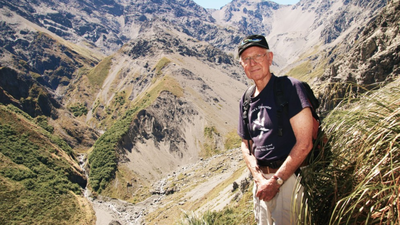
In 1965, Geoff Harrow walked into the Kaikōura mountains following a story about an unusual seabird nesting somewhere high above the valleys. He did not find the colony on his first attempt. The next morning, on a steep deer track, a decomposing bird provided the clue he needed. It was a Hutton’s shearwater, a species whose mountain breeding grounds were barely understood by science at the time. Across the valley, Harrow could see the ground riddled with burrows. He would later discover several more colonies, only to watch most disappear over the following decades. What began as an expedition to identify an elusive bird became a lifelong conservation effort, taking Harrow from remote mountain slopes to predator control, captive transfers and the creation of a protected colony on the Kaikōura Peninsula.
How a dead seabird revealed the Hutton’s shearwater colony to Harrow
Harrow had already spent much of his life around birds and mountains when he first heard about the strange seabirds high above Kaikōura.The information came from Ivan Hislop, a motel owner whose family had encountered what they called muttonbirds during a hunting trip years earlier. The birds appeared to be nesting somewhere in the mountains, but the precise location was unclear. For Harrow, that was enough reason to investigate.In February 1965, he headed towards the head of the Kōwhai Valley. The route was not straightforward. Waterfalls and false tracks slowed his progress, and his first night passed without the discovery he had hoped for. There were wild goats nearby and the occasional call of a kea, but no sign of the seabird colony.While descending a steep deer track, Harrow came across the decomposing body of a shearwater. He collected three dead birds and took them back for identification. The Dominion Museum in Wellington confirmed what he had suspected: they were Hutton’s shearwaters, or tītī.Then he noticed the ground on the opposite side of the valley. It was covered with burrows. There were far more than he had expected. In later visits, Harrow realised the colony was enormous, with hundreds of thousands of nesting burrows spread through the mountains.
PC: New Zealand’s Forest and Bird
The hidden mountain world of New Zealand’s Hutton’s shearwaters
Hutton’s shearwater is an unusual member of New Zealand’s seabird fauna. Unlike most shearwaters, which breed on coastal islands or low-lying ground, this species nests high in the Kaikōura mountains.The birds spend winter in Australian waters before returning to New Zealand in spring. Their arrival can come while snow still covers parts of their breeding grounds. They wait for conditions to improve before clearing their burrows and beginning the breeding season.For generations, Māori had harvested tītī in the Kaikōura mountains, preserving the birds in kelp bags for food and trade. By the time Harrow began investigating the species, however, scientific knowledge of its breeding range was surprisingly limited.The birds were familiar to some local people for another reason. Young shearwaters sometimes became disorientated on misty autumn nights and flew towards lights, occasionally crashing into houses around Kaikōura.
Hutton’s shearwaters fell from nearly two million to 500,000 birds
Harrow did not treat the 1965 discovery as a one-off expedition. Working in pharmaceutical sales, he returned to the Kaikōura mountains repeatedly, often around eight times a year during weekends and holidays. Family members sometimes joined him. Over the years he identified eight Hutton’s shearwater nesting sites.The picture gradually became less reassuring. Within two decades, only two of those colonies were still known to survive: the large colony in Kōwhai Valley and a much smaller one at Shearwater Stream on private land.Harrow had begun with a question about where the birds nested. He was now watching their breeding grounds disappear.At the beginning of his work, he estimated that the areas he knew could have contained close to two million birds. Within roughly 25 years, that number had fallen to about 500,000.The decline forced a change in thinking about what was threatening the species.
The real threat to Hutton’s shearwaters was hiding in plain sight
Stoats were long regarded as the principal danger to the shearwaters. Harrow regularly saw them around the nesting burrows, so the assumption seemed reasonable.Research carried out by British PhD student Richard Cuthbert in the 1990s produced a different explanation. Wild pigs were damaging the colonies by digging into the ground, destroying burrows and eating what they found inside. Their impact could be particularly severe when groups of pigs entered a breeding area.The finding altered the practical approach to protecting the birds. Rather than concentrating only on stoat control, conservation work also had to keep pig numbers down around the mountain colonies. The remaining Hutton’s shearwater populations began showing signs of recovery, although they were still far below the numbers Harrow had encountered during his early visits.
Hutton’s shearwaters needed a new colony beyond the mountains
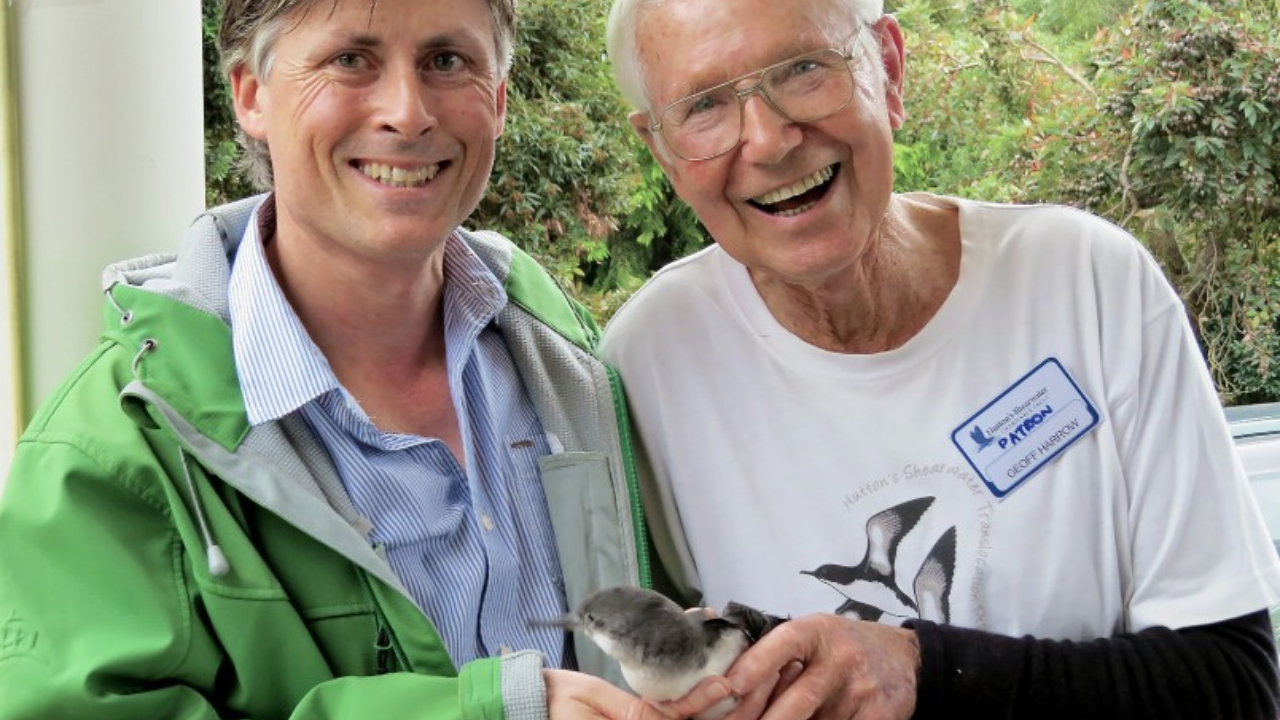
Even if predators could be controlled, relying on two mountain colonies left the species exposed to a single catastrophic event.In 2005, the Department of Conservation began transferring Hutton’s shearwater chicks to a new location on the Kaikōura Peninsula. The intention was to establish a separate population that could act as a safeguard for the birds.The project brought a new set of difficulties. Cats and other predators posed a threat to the young colony, prompting Harrow to push for stronger protection.In 2008, he proposed creating a charitable trust that could raise money for a predator-proof fence. The effort grew beyond fundraising. The trust eventually helped deliver the fence and became involved in managing the new colony alongside the Department of Conservation, Te Rūnanga o Kaikōura and Whale Watch.
The mountaineer who turned his attention to Hutton’s shearwaters
His connection with the Kaikōura birds was not accidental. Harrow had been drawn to mountains and native wildlife since childhood.He joined Forest & Bird in 1936 after visiting his sister in Wellington and seeing native birds around Butterfly Creek near Eastbourne. As a teenager, he cycled to Arthur’s Pass and became increasingly involved in mountaineering.In 1954, Harrow joined a New Zealand expedition to the Himalayas led by Sir Edmund Hillary, only a year after Hillary’s successful ascent of Everest. The expedition was attempting Makalu, then one of the world’s highest unclimbed mountains.The attempt ended before the summit. At about 6,700 metres, Hillary was suffering from malaria and injuries sustained while rescuing a companion from a crevasse. The team abandoned the climb so he could be brought down safely.Harrow and fellow climber Colin Todd later climbed Buruntse, a neighbouring 7,129-metre peak. It was a serious mountaineering achievement, but Harrow’s later work in the Kaikōura mountains would be measured in a different way: not by altitude gained, but by how long the birds could continue to return.
From Antarctic penguins to Hutton’s shearwaters, Harrow kept returning
In 1966, Harrow spent four months in Antarctica helping with research on emperors and Adélie penguins. By then, his interests had already crossed between climbing, exploration and ornithology for years.That combination proved useful when he began following the Hutton’s shearwaters. Finding the colonies required patience and familiarity with difficult terrain, but keeping track of their fortunes required something else: the willingness to return.Again and again. The work stretched from the 1960s into the 21st century, long after the original mystery of where the birds nested had been solved.
After decades of decline, Hutton’s shearwaters begin to recover
Predator control and the protection of breeding areas have since helped the remaining mountain colonies. By the time Harrow was reflecting on his work, the two natural sites were believed to contain more than 100,000 breeding pairs and a total population exceeding 400,000 birds.That recovery needs to be seen against the earlier collapse. The numbers represented progress, but they were still a long way from the abundance Harrow remembered from his first years in the mountains.The species remains nationally endangered. Its natural breeding colonies are restricted to the seaward Kaikōura mountains, making the protection of those sites especially important.The peninsula colony provides another layer of security. If a major event were to devastate the mountain colonies, a separate population would already exist elsewhere.
Harrow spent 50 years helping protect the Hutton’s shearwater
By 2015, when Harrow was 88, he had spent around half a century following the fortunes of the species he first encountered through a carcass on a mountain track.He described himself as obsessive about things that caught his interest. There was no grand plan when he first entered the Kōwhai Valley. He simply kept going back. People who worked with the Hutton’s Shearwater Trust later described Harrow as gentle but determined, with an unusual ability to keep energy behind the cause. His contribution was recognised in 2007 when he received Forest & Bird’s Old Blue award.By then, he was no longer simply the mountaineer who had located a lost seabird colony. He had become a long-standing figure in the effort to keep Hutton’s shearwater in the Kaikōura mountains.


