
How US Navy is turning submarines into multi-domain weapons platforms

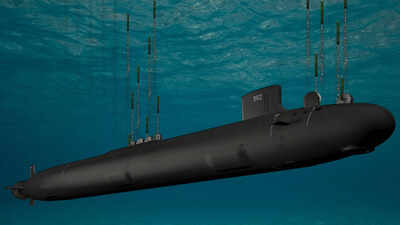
Submarines, long feared as the deadliest hunters of the sea are set to become even deadlier as they get more tools to take on this task. The US Navy has announced payload launcher integration for future attack submarines. This aim is to shift towards multi-domain capabilities. Undersea drones and advanced payloads are expected to play a central role. The US Navy’s Director of Submarine Programs has outlined requirements for launchers capable of supporting a wider variety of payloads than the current fleet. The specifications put forth by the US Navy emphasize the ability of submarines to launch and recover payloads on the go.This development comes as the Navy advances its Next-Generation Attack Submarine programme, SSN(X), alongside modernised Virginia-class boats. The Virginia class, already a cornerstone of US undersea warfare, is being transformed with the addition of the Virginia Payload Module (VPM). Beginning with the USS Arizona, Block V boats will carry up to 40 Tomahawk Land Attack Missiles, a significant increase compared to earlier attack submarines. Although the number of missiles do not match the Ohio-class SSGNs’ massive 154-missile load, distributing the firepower across a much larger number of submarines offers greater flexibility, redundancy and survivability.The Virginia class itself embodies many lessons learnt from operating the Los Angeles and Seawolf classes of submarines. Innovations such as pumpjet propulsion and advanced nuclear reactor designs to enhance stealth, while sonar upgrades and larger lock-out chambers expand operational roles, including the deployment of special forces from a submerged vessel. Designed for littoral as well as deep-sea operations, the Virginias reflect the post-Cold War emphasis on versatility. Integrating payload launchers for unmanned systems now signals an evolution to address the realities of modern warfare.On the other hand, the Indian Navy is aplanning to strengthen its undersea arm. India currently operates 16 conventional diesel-electric submarines across three classes, these are the Kalvari, Sindhughosh and Shishumar. Four Sindhughosh-class boats have already been retired, while the Shishumar class has undergone mid-life upgrades to extend service for another decade. The Kalvari class of submarines is based on the French Scorpène design, it is expected to be fitted with a DRDO developed indigenous Air Independent Propulsion systems, which would enhance underwater endurance and survivability. However, delays in the long-planned Project-75I programme, which envisages six to nine Type-214 submarines with AIP systems, have slowed progress. The Navy had originaly aimed to field 24 conventional submarines by 2030, but this timeline has slipped considerably.The Navy operates three Arihant-class submarines, with a fourth undergoing trials. These submarines are tasked with carrying nuclear armed K-4 and K-5 missiles; they form the sea based leg of India’s nuclear triad, providing credible second-strike capability. Work is underwayto develop and deploy the larger S5 class of submarines, which are expected to deploy K-6 SLBMs with ranges beyond 5,000 km, this will significantly extend India’s second strike capability.


