
How student protests spark ignite national movements and shape politics BENGALURU: In May 2026, the Chief Justice of India made an offhand, dismissive remark about unemployed young Indians being like cockroaches. Ten weeks later, a Union minister had resigned, tens of thousands of protesters had marched on Parliament, and a satirical party named after the insult was the biggest story in the country — not necessarily in that order!Nobody involved in that first remark could have predicted where it would end up. That gap, between how small these things start and how large they end up, is the story of Indian student politics itself. Watch ‘Detaining Activists Is Normal’: JP Nadda Defends Police Crackdown On CJP ProtestersIt is, in fact, the pattern that connects nearly every major student agitation since independence, laid out in the timeline alongside this piece. A hostel mess-fee hike in Ahmedabad brought down a state govt. A poetry reading on a university lawn became a national argument about sedition.A single self-immolation outside a Delhi college reshaped a decade of caste politics. Indian students, again and again, have turned small, local sparks into fires. Not because the sparks themselves were extraordinary, but because they landed on reservoirs of frustration, economic distress, discrimination, corruption, a sense of being unheard, that were already primed to catch. Few groups in Indian public life have intervened so often, so unpredictably, or with such little warning.Why students & why so oftenIndia has one of the youngest populations in the world, and its colleges concentrate huge numbers of young people in one place, with time and energy that older, more encumbered protesters often can’t spare — but it isn’t that students have less at stake.It’s that what’s at stake for them is the future itself: the job market they’re about to enter, the country they’re about to inherit, the fairness of the exam or the quota or the citizenship rule that will decide their next decade.Campuses also come with built-in organising infrastructure: hostels, unions, canteens, and, increasingly, group chats that can turn a local grievance into a national one within hours. Students also carry a kind of moral capital unlike any other in Indian public culture: the idea, inherited from the independence movement itself, that young people protesting is a sign of a healthy conscience rather than a threat to order.But structure alone doesn’t explain the pattern. India has produced at least 13 agitations substantial enough to, in different ways, influence Indian politics since 1947 — from the 1959 Bengal food riots to the Cockroach Movement. Look closely at five of them across seven decades, and a consistent anatomy emerges: the way these movements start, escalate, provoke the state, and either win, lose, or curdle into something else.5 movements that define the patternGujarat, 1974, brought down a govt: In Dec 1973, students at an Ahmedabad engineering college struck over a 20% hike in hostel mess fees. Layered onto soaring food prices and corruption allegations against the state’s chief minister, the strike metastasised within weeks into the Navnirman Andolan. Curfews were imposed in 44 towns; the army was deployed.Facing sustained pressure, chief minister Chimanbhai Patel resigned in Feb 1974, and when the assembly wouldn’t dissolve on its own, veteran leader Morarji Desai’s hunger strike and continued student pressure forced fresh elections anyway. It remains the only instance in independent India’s history of sustained public agitation toppling an elected govt outright — and as per multiple accounts, it directly inspired Jayaprakash Narayan’s (JP) much larger Bihar Movement weeks later, which fed into the political climate that produced both the 1975 Emergency and Congress’ historic 1977 defeat.Assam, 1979–85, became a 6-year war of attrition: After electoral rolls turned up apparent non-citizens, the All Assam Students’ Union launched a movement demanding detection and deportation of illegal immigrants. What followed is among the longest continuous student-led agitations in Indian history: blockades, election boycotts, and periods of horrific ethnic violence, including the 1983 Nellie massacre, in a movement whose overall toll has been estimated above 850 deaths.It ended with the 1985 Assam Accord, which set a cutoff date for citizenship claims and promised cultural safeguards still only partially delivered today. AASU leaders converted the movement into a political party, the Asom Gana Parishad, and won the state election that followed.Delhi & Bihar, 1990, turned a policy fight into public self-immolation: When the govt moved to implement the Mandal Commission’s 27% OBC quota in central jobs, upper-caste students across northern India erupted in protest. On Sept 19, 1990, 19-year-old Delhi University student Rajeev Goswami set himself on fire outside his college; he survived with severe burns but never fully recovered. His act triggered a wave of copycat self-immolation attempts nationwide. The quota was implemented anyway, and VP Singh’s govt fell within months for reasons beyond Mandal alone — proof that a movement can dominate the national imagination for years without reversing the policy that provoked it.Delhi, 2019–20, showed how quickly state force can convert a local protest into a national one: Student-led sit-ins against the Citizenship Amendment Act spread from Jamia Millia Islamia to campuses nationwide, but the defining moment came on the night of Dec 15, 2019, when Delhi Police entered Jamia’s campus, including its library, and used batons and tear gas on students inside. That single raid, captured on phone cameras, played an important role in nationalising the anti-CAA movement than months of organizing had. The law remained on the statute books and was later notified, even though the protests fundamentally reshaped the national debate.Delhi, 2026, moved faster than any of the above: A dismissive remark about unemployed youth being like “cockroaches” was turned into satire by a strategist who founded the Cockroach Janata Party — a parody of the ruling party’s name, with an AI-generated mascot. Fuelled by anger over leaked entrance exams and graduate unemployment near 40%, it grew from an online joke to hundreds of thousands of members within weeks. On July 20, 2026, roughly 20,000 protesters tried to march on Parliament; police used tear gas and batons, injuring nearly 180 people.Rather than back down, the movement camped at Jantar Mantar and spread to a dozen cities. On July 25, education minister Dharmendra Pradhan resigned — the core demand met in about ten weeks, a fraction of the time earlier movements took to win anything at all.8 more that shaped the patternThe five above are the clearest cases, but the other eight matter just as much.Bengal, 1959, gave independent India one its first major student agitations — there had already been other student protests in places like Travancore and Hyderabad — when a famine-level food crisis and police firing on a mass rally pulled students into the streets alongside workers and peasants — establishing, for the first time, that this kind of politics was legitimate in the new republic.Madras, 1965, is the cleanest win on this entire list: Student-led protests against the imposition of Hindi as the sole official language ultimately led the govt to guarantee English would continue indefinitely, and permanently reshaped Tamil Nadu’s politics around the DMK.Telangana, 1969–70, saw students mobilise around regional neglect and job inequities decades before the state itself was created in 2014 — a reminder that some of these movements take generations to pay off, if they ever do.Bihar, 1974–75, is where JP’s “Total Revolution” turned a student agitation against corruption and unemployment into a national coalition; when Indira Gandhi responded by declaring the Emergency in 1975, students — opposition parties, socialists, RSS cadres, trade unions also operated from underground — were among groups that kept organised dissent alive underground until elections finally returned in 1977.Delhi & Mumbai, 2006, saw medical and engineering students protest the extension of OBC quotas to central higher-education institutions. The courts upheld most provisions of the policy in 2008, making this the direct sequel to 1990’s argument, fought with less violence but the same underlying tension.Delhi, 2012, wasn’t organised by any student union — it was a largely leaderless, student-heavy public eruption after the gangrape and murder of a young physiotherapy student (Nirbhaya case), and one of the rare cases here that produced fast legislative change: the 2013 criminal law reforms toughening rape sentencing.Pune, 2015, was smaller in scale but longer in duration: FTII students struck for 139 days over the appointment of a chairman they saw as a political pick, keeping alive the broader argument about political interference in public institutions even though the appointment itself stood.Hyderabad & Delhi, 2016, delivered two separate shocks in one year: Dalit scholar Rohith Vemula’s suicide, after his suspension amid political pressure, reopened a national reckoning over caste discrimination on campus. Weeks later, the arrest of JNU Students’ Union president Kanhaiya Kumar on sedition charges, after a campus event, turned “anti-national” speech into one of the decade’s defining and most polarising arguments.The anatomy: What these movements shareFour patterns recur across all thirteen movements above, not just the five examined in depth.Small triggers, large fuses: As the opening of this piece argued, the size of the spark has never predicted the size of the fire. What decides that is how much pre-existing frustration was already sitting there, waiting for something to ignite it.State response usually determines the trajectory: In case after case, the decisive escalation wasn’t the original grievance but the visible use of force against students: police firing in Calcutta in 1959 and Madurai in 1965, the Jamia library raid in 2019, the tear-gassing at Jantar Mantar in 2026. Violence against students, especially once captured on camera, has repeatedly turned local protests into national ones and made the state’s own response the story.Self-sacrifice is a distinctly Indian repertoire: Self-immolation recurs across this history, most starkly in 1990, as a form of protest with few real parallels in other democracies’ student movements — a sign both of the intensity of feeling involved and of a media culture in which one person’s extreme act can shift public opinion faster than a rally of thousands.Success is rare, and usually narrow: Of the 13 movements above, only Navnirman clearly toppled a govt outright. A handful won specific, bounded concessions — the 1965 language guarantee, the 2013 rape-law reforms, Pradhan’s 2026 resignation. Several others, including Mandal, the JNU sedition case, and Anti-CAA, ended without the underlying policy being reversed at all, even as they reshaped public debate for years.Join conversationView All Comments →Share your thoughts in the commentsInsightfulAgreeDisagreeSkepticalConcerningPromisingWorth ReadingBig DevelopmentPost CommentBe respectful · TOI community guidelinesThe honest lesson of seventy years of student politics is that these movements are far better at forcing a national conversation, or costing one official their job, than at reversing a government’s core commitments. What has changed is speed, not shape. In 1974 and 1990, it took months or years for a local grievance to become a national reckoning, carried by hostel meetings and cyclostyled pamphlets.In 2026, it took ten weeks, carried by a meme and a mascot. The grammar is identical either way: a grievance, a trigger, a confrontation with the state, and an outcome judged by whether it produced a resignation, a repealed law, or just a memory.Get the latest India News and Live updates. Download the TOI app.About the AuthorChethan KumarChethan Kumar is a Senior Assistant Editor with the Times of India. Aside from specialising in Space & Science, he has reported extensively on varied topics, with special focus on defence, policy and data stories. He has covered multiple elections, too. As a young democracy grows out of adolescence, Chethan feels, there are reels of tales emerging which need to be captured. To do this, he alternates between the mundane goings-on of the Common Man and the wonder-filled worlds of scientists and scamsters, politicians and soldiers. In a career spanning nearly 18 years, he has reported from multiple datelines — Houston, Florida, Kochi, Hyderabad, Chennai, Sriharikota (AP), NH-1 (J&K Highway), New Delhi, Ahmedabad, Raichur, Bhatkal, Mysuru, Chamarajanagar, to name a few — but is based out of Bengaluru, India’s science capital that also hosts the ISRO HQ.Read MoreEnd of ArticleFollow Us On Social MediaVideos’Detaining Activists Is Normal’: JP Nadda Defends Police Crackdown On CJP ProtestersWho Is V Kamakoti? IIT Madras Director And Exam Reforms Task Force Member Draws Political FireKhawaja Asif Calls POK Protesters “Enemies Like India” Amid Deadly Crackdown; Statement Sparks StirLok Sabha Passes Anti-Paper Leak Bill Amid Ruckus Over Rahul’s ‘Shooting’ Charge Against Amit Shah’Put Pellets Into Blood Of Our Students,’ Rahul Gandhi’s Attack On Hm Shah In LS Sparks Uproar’Student, Idiot, Andhbhakt’: Rahul Gandhi’s ‘3 Categories’ Remark Sparks Row In Lok SabhaPoJK Burns Amid Violence And Protests: Why The World’s Silence And The Crisis Matter To IndiaFirst Direct Freight Train to Nepal! How One Railway Journey Could Transform India-Nepal TradeDelhi Police Denies ‘Mystery Truck’ Conspiracy Linked To Chalo Sansad ProtestTwo Army Personnel Injured In Suspected Landmine Explosion Near LoC In Uri123PhotostoriesFrom alleging ex-wife Shweta Tiwari’s affair with her Kasautii co-star Cezanne Khan to claiming he Wasn’t allowed to meet their daughter; Raja Chaudhary makes serious allegations6 ways to make hard-boiled eggs easier to peel; Physics explains why one method works best5 psychology-backed lessons every father should teach his son about people and lifePaid menstrual leave to unlimited paid time off: 6 things a female CEO does that men may not imagine!Hollywood celebs who spoke about their ADHD, dyslexia and other mental health issues5 lessons from 80-year-old Canadian fitness influencer, Joan MacDonald, that can get you moving5 Plants you think are attractive, but are actually invasive in natureWhy do Bengali women traditionally tie a key to their saree pallu? The fascinating story behind this ritualHansika Motwani’s ultra-luxurious Mumbai home: Glam dressing room, grand living area and more”Your child is always watching you”: 7 everyday parenting habits that unknowingly shape every Indian child’s future123Hot PicksMCC new rulesJalen HurtsDelhi Lakshmi YojanaTN CM Vijay’s new officeRussian sanctions billCWG 2026 GamesSmartphone exportsTN supplementary resultsNew anti-paper leak billTop TrendingTony RomosJantar Mantar ProtestKarnataka SuicideBJP MLA Yashpal Suvarna ArrestGurgaon Road RageAbhijeet Dipke Marriage ProposalsUGC PG ProgrammeWeather TomorrowPalani Mutt Temple Land CaseStock Market Up

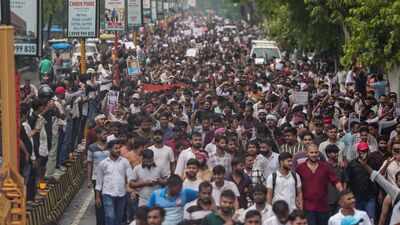
BENGALURU: In May 2026, the Chief Justice of India made an offhand, dismissive remark about unemployed young Indians being like cockroaches. Ten weeks later, a Union minister had resigned, tens of thousands of protesters had marched on Parliament, and a satirical party named after the insult was the biggest story in the country — not necessarily in that order!Nobody involved in that first remark could have predicted where it would end up. That gap, between how small these things start and how large they end up, is the story of Indian student politics itself.It is, in fact, the pattern that connects nearly every major student agitation since independence, laid out in the timeline alongside this piece. A hostel mess-fee hike in Ahmedabad brought down a state govt. A poetry reading on a university lawn became a national argument about sedition.A single self-immolation outside a Delhi college reshaped a decade of caste politics. Indian students, again and again, have turned small, local sparks into fires. Not because the sparks themselves were extraordinary, but because they landed on reservoirs of frustration, economic distress, discrimination, corruption, a sense of being unheard, that were already primed to catch. Few groups in Indian public life have intervened so often, so unpredictably, or with such little warning.
Why students & why so often
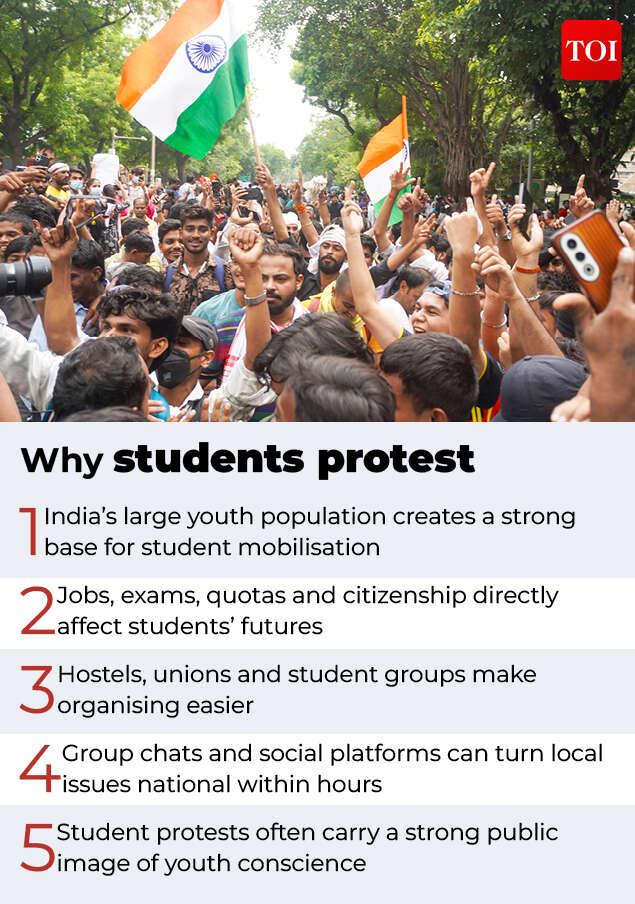
India has one of the youngest populations in the world, and its colleges concentrate huge numbers of young people in one place, with time and energy that older, more encumbered protesters often can’t spare — but it isn’t that students have less at stake.It’s that what’s at stake for them is the future itself: the job market they’re about to enter, the country they’re about to inherit, the fairness of the exam or the quota or the citizenship rule that will decide their next decade.
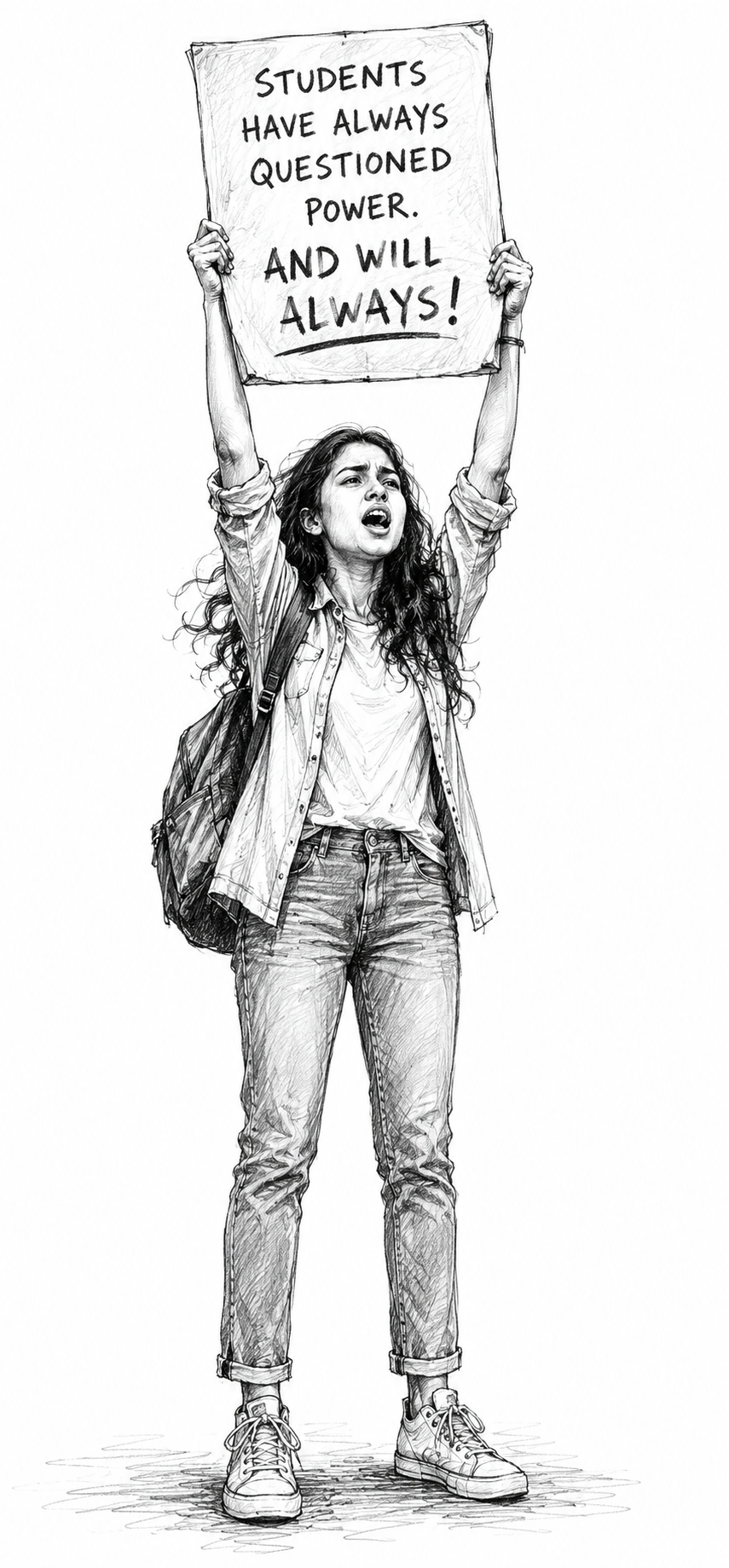
Campuses also come with built-in organising infrastructure: hostels, unions, canteens, and, increasingly, group chats that can turn a local grievance into a national one within hours. Students also carry a kind of moral capital unlike any other in Indian public culture: the idea, inherited from the independence movement itself, that young people protesting is a sign of a healthy conscience rather than a threat to order.But structure alone doesn’t explain the pattern. India has produced at least 13 agitations substantial enough to, in different ways, influence Indian politics since 1947 — from the 1959 Bengal food riots to the Cockroach Movement. Look closely at five of them across seven decades, and a consistent anatomy emerges: the way these movements start, escalate, provoke the state, and either win, lose, or curdle into something else.
5 movements that define the pattern
Gujarat, 1974, brought down a govt: In Dec 1973, students at an Ahmedabad engineering college struck over a 20% hike in hostel mess fees. Layered onto soaring food prices and corruption allegations against the state’s chief minister, the strike metastasised within weeks into the Navnirman Andolan. Curfews were imposed in 44 towns; the army was deployed.Facing sustained pressure, chief minister Chimanbhai Patel resigned in Feb 1974, and when the assembly wouldn’t dissolve on its own, veteran leader Morarji Desai’s hunger strike and continued student pressure forced fresh elections anyway. It remains the only instance in independent India’s history of sustained public agitation toppling an elected govt outright — and as per multiple accounts, it directly inspired Jayaprakash Narayan’s (JP) much larger Bihar Movement weeks later, which fed into the political climate that produced both the 1975 Emergency and Congress’ historic 1977 defeat.Assam, 1979–85, became a 6-year war of attrition: After electoral rolls turned up apparent non-citizens, the All Assam Students’ Union launched a movement demanding detection and deportation of illegal immigrants. What followed is among the longest continuous student-led agitations in Indian history: blockades, election boycotts, and periods of horrific ethnic violence, including the 1983 Nellie massacre, in a movement whose overall toll has been estimated above 850 deaths.It ended with the 1985 Assam Accord, which set a cutoff date for citizenship claims and promised cultural safeguards still only partially delivered today. AASU leaders converted the movement into a political party, the Asom Gana Parishad, and won the state election that followed.
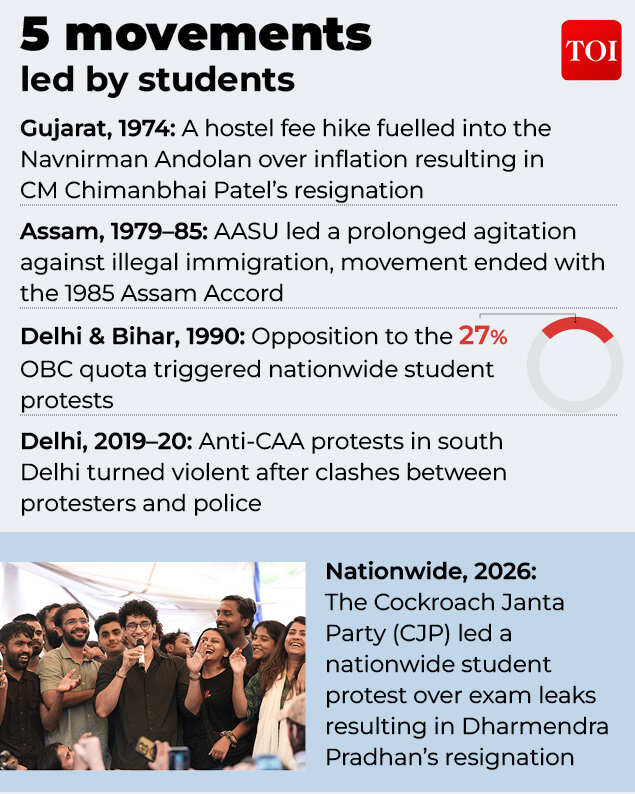
Delhi & Bihar, 1990, turned a policy fight into public self-immolation: When the govt moved to implement the Mandal Commission’s 27% OBC quota in central jobs, upper-caste students across northern India erupted in protest. On Sept 19, 1990, 19-year-old Delhi University student Rajeev Goswami set himself on fire outside his college; he survived with severe burns but never fully recovered. His act triggered a wave of copycat self-immolation attempts nationwide. The quota was implemented anyway, and VP Singh’s govt fell within months for reasons beyond Mandal alone — proof that a movement can dominate the national imagination for years without reversing the policy that provoked it.Delhi, 2019–20, showed how quickly state force can convert a local protest into a national one: Student-led sit-ins against the Citizenship Amendment Act spread from Jamia Millia Islamia to campuses nationwide, but the defining moment came on the night of Dec 15, 2019, when Delhi Police entered Jamia’s campus, including its library, and used batons and tear gas on students inside. That single raid, captured on phone cameras, played an important role in nationalising the anti-CAA movement than months of organizing had. The law remained on the statute books and was later notified, even though the protests fundamentally reshaped the national debate.Delhi, 2026, moved faster than any of the above: A dismissive remark about unemployed youth being like “cockroaches” was turned into satire by a strategist who founded the Cockroach Janata Party — a parody of the ruling party’s name, with an AI-generated mascot. Fuelled by anger over leaked entrance exams and graduate unemployment near 40%, it grew from an online joke to hundreds of thousands of members within weeks. On July 20, 2026, roughly 20,000 protesters tried to march on Parliament; police used tear gas and batons, injuring nearly 180 people.Rather than back down, the movement camped at Jantar Mantar and spread to a dozen cities. On July 25, education minister Dharmendra Pradhan resigned — the core demand met in about ten weeks, a fraction of the time earlier movements took to win anything at all.
8 more that shaped the pattern
The five above are the clearest cases, but the other eight matter just as much.Bengal, 1959, gave independent India one its first major student agitations — there had already been other student protests in places like Travancore and Hyderabad — when a famine-level food crisis and police firing on a mass rally pulled students into the streets alongside workers and peasants — establishing, for the first time, that this kind of politics was legitimate in the new republic.Madras, 1965, is the cleanest win on this entire list: Student-led protests against the imposition of Hindi as the sole official language ultimately led the govt to guarantee English would continue indefinitely, and permanently reshaped Tamil Nadu’s politics around the DMK.Telangana, 1969–70, saw students mobilise around regional neglect and job inequities decades before the state itself was created in 2014 — a reminder that some of these movements take generations to pay off, if they ever do.Bihar, 1974–75, is where JP’s “Total Revolution” turned a student agitation against corruption and unemployment into a national coalition; when Indira Gandhi responded by declaring the Emergency in 1975, students — opposition parties, socialists, RSS cadres, trade unions also operated from underground — were among groups that kept organised dissent alive underground until elections finally returned in 1977.Delhi & Mumbai, 2006, saw medical and engineering students protest the extension of OBC quotas to central higher-education institutions. The courts upheld most provisions of the policy in 2008, making this the direct sequel to 1990’s argument, fought with less violence but the same underlying tension.Delhi, 2012, wasn’t organised by any student union — it was a largely leaderless, student-heavy public eruption after the gangrape and murder of a young physiotherapy student (Nirbhaya case), and one of the rare cases here that produced fast legislative change: the 2013 criminal law reforms toughening rape sentencing.Pune, 2015, was smaller in scale but longer in duration: FTII students struck for 139 days over the appointment of a chairman they saw as a political pick, keeping alive the broader argument about political interference in public institutions even though the appointment itself stood.Hyderabad & Delhi, 2016, delivered two separate shocks in one year: Dalit scholar Rohith Vemula’s suicide, after his suspension amid political pressure, reopened a national reckoning over caste discrimination on campus. Weeks later, the arrest of JNU Students’ Union president Kanhaiya Kumar on sedition charges, after a campus event, turned “anti-national” speech into one of the decade’s defining and most polarising arguments.
The anatomy: What these movements share
Four patterns recur across all thirteen movements above, not just the five examined in depth.Small triggers, large fuses: As the opening of this piece argued, the size of the spark has never predicted the size of the fire. What decides that is how much pre-existing frustration was already sitting there, waiting for something to ignite it.
State response usually determines the trajectory: In case after case, the decisive escalation wasn’t the original grievance but the visible use of force against students: police firing in Calcutta in 1959 and Madurai in 1965, the Jamia library raid in 2019, the tear-gassing at Jantar Mantar in 2026. Violence against students, especially once captured on camera, has repeatedly turned local protests into national ones and made the state’s own response the story.Self-sacrifice is a distinctly Indian repertoire: Self-immolation recurs across this history, most starkly in 1990, as a form of protest with few real parallels in other democracies’ student movements — a sign both of the intensity of feeling involved and of a media culture in which one person’s extreme act can shift public opinion faster than a rally of thousands.Success is rare, and usually narrow: Of the 13 movements above, only Navnirman clearly toppled a govt outright. A handful won specific, bounded concessions — the 1965 language guarantee, the 2013 rape-law reforms, Pradhan’s 2026 resignation. Several others, including Mandal, the JNU sedition case, and Anti-CAA, ended without the underlying policy being reversed at all, even as they reshaped public debate for years.
Share your thoughts in the comments
Be respectful · TOI community guidelines
The honest lesson of seventy years of student politics is that these movements are far better at forcing a national conversation, or costing one official their job, than at reversing a government’s core commitments. What has changed is speed, not shape. In 1974 and 1990, it took months or years for a local grievance to become a national reckoning, carried by hostel meetings and cyclostyled pamphlets.In 2026, it took ten weeks, carried by a meme and a mascot. The grammar is identical either way: a grievance, a trigger, a confrontation with the state, and an outcome judged by whether it produced a resignation, a repealed law, or just a memory.


