
How an eel elevator on Maine’s Penobscot River helped restore millions of fish and brought humpback whales back |

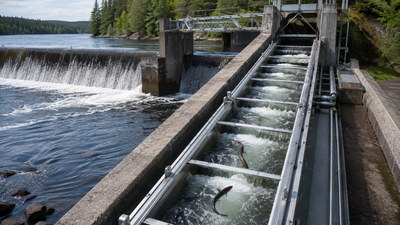
Every spring, millions of migratory fish leave the Atlantic Ocean and swim into freshwater rivers to reproduce, continuing journeys that have existed for thousands of years. On Maine’s Penobscot River, however, hydroelectric dams blocked many of these ancient migrations for more than a century, causing dramatic declines in species such as American shad, river herring, Atlantic salmon and American eel. To reverse the damage, engineers introduced innovative fish passage systems, including a mechanical fish lift and a specialised eel ladder, often called an “eel elevator”, allowing fish to bypass the Milford Dam safely. As fish populations recovered, something remarkable happened downstream: humpback whales began appearing near the mouth of the river to feed on the returning schools. The story, documented by the National Oceanic and Atmospheric Administration (NOAA) in its report Fish Lift Helps Restore Native Sea-Run Fish to Penobscot River, demonstrates how reconnecting a river can restore an entire ecosystem, from freshwater fish to some of the ocean’s largest mammals.
How more than a century of dams interrupted an ancient migration
For thousands of years, the Penobscot River served as one of the northeastern United States’ most important migratory fish rivers. Species including American shad, river herring, Atlantic salmon and American eel spend different stages of their lives in both freshwater and the Atlantic Ocean, making uninterrupted river access essential for survival.That changed with the construction of hydroelectric dams. These barriers prevented adult fish from reaching upstream spawning grounds while making downstream journeys dangerous for young fish. According to NOAA’s report Fish Lift Helps Restore Native Sea-Run Fish to Penobscot River, the loss of connectivity contributed to steep declines in migratory fish populations and affected wildlife throughout the watershed.
How a fish lift and an eel ladder reopened the Penobscot River
Rather than removing every dam, engineers adopted a combination of dam removals and modern fish passage technology.At Milford Dam, they installed a mechanical fish lift that collects migrating fish inside a holding chamber before lifting them over the dam and releasing them upstream. The facility allows large species such as American shad, Atlantic salmon and river herring to continue their migration with minimal stress.American eels required a different solution. Because young eels naturally climb damp surfaces during migration, engineers constructed a specialised eel ladder, commonly known as an “eel elevator”, with textured surfaces and flowing water that encourage the fish to wriggle safely around the dam.The Milford Fish Lift also serves as an important scientific monitoring station, enabling biologists to count, identify and assess the health of nearly every major migratory fish species moving through the river each year.
The return of millions of fish transformed the river ecosystem
The restoration project produced results far beyond expectations. Following improvements to fish passage, millions of river herring and thousands of American shad resumed their annual upstream migrations. Atlantic salmon gained access to substantially larger spawning habitats, while American eels once again travelled inland after decades of interrupted migration.Reconnecting the river restored ecological processes that had been disrupted for generations. Migratory fish transport marine nutrients into freshwater ecosystems, provide food for birds and mammals, and support healthier aquatic habitats throughout the watershed. The recovering fish populations have become one of the clearest indicators of the Penobscot River Restoration Project’s success.
Why humpback whales began appearing near the river mouth
The restoration’s effects extended well beyond the river itself. As enormous schools of migratory fish gathered near the mouth of the Penobscot River during their seasonal runs, humpback whales began returning to the area in greater numbers to feed. Researchers have reported that recovering populations of river herring and other forage fish likely created an increasingly reliable feeding opportunity for marine predators, illustrating how improvements in freshwater ecosystems can influence wildlife in the open ocean.Although the whales were not attracted by the fish lift or eel ladder themselves, they were responding to the abundance of prey made possible by restoring the river’s natural migrations. Their return highlights the far-reaching ecological benefits of reconnecting rivers with the sea.
A restoration project whose benefits reached from freshwater to the Atlantic Ocean
Today, the Penobscot River Restoration Project is recognised as one of North America’s leading examples of balancing renewable hydropower with wildlife conservation. By combining selective dam removals with advanced fish lifts and eel passage systems, engineers restored access to hundreds of kilometres of historic habitat while maintaining electricity generation.The recovery has benefited not only Atlantic salmon, American shad, river herring and American eels but also the broader ecosystem that depends on them. The return of humpback whales near the Penobscot estuary further illustrates an important ecological principle: when migratory fish are allowed to reclaim their ancient routes, the benefits can ripple far beyond the river itself, reaching all the way into the Atlantic Ocean.


