
From swords to Bandis: The story of Army’s post-colonial makeover

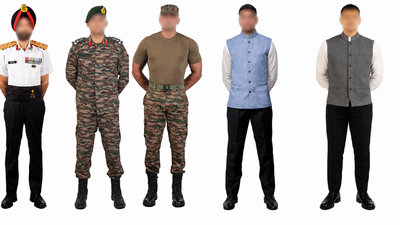
NEW DELHI: For generations of Indian soldiers, military uniforms have represented far more than clothing. Every button, badge, belt, sword, lanyard and ceremonial accessory has carried layers of history, tradition and institutional memory.Many of those traditions, however, were inherited from the British Indian Army.Now, nearly eight decades after Independence, the Indian Army has unveiled one of its most comprehensive efforts yet to align military dress regulations with India’s own identity.Through the newly issued Army Uniforms-2026 booklet, the force has introduced a series of changes that remove several lingering colonial-era customs and symbols while retaining what it describes as the dignity, functionality and enduring traditions of military service.The changes range from the symbolic to the practical. Reviewing Officers will no longer carry swords during parades. The archaic term “Royal” has been removed from military terminology. Indigenous Bandi jackets will become part of officers’ formal civilian attire. A new Battle Jacket will gradually replace the long-serving jersey-based winter dress.The move represents much more than a change in clothing regulations. It reflects a larger transformation underway within one of India’s oldest institutions.
A military identity rooted in independent India
The rationale behind the reforms is clearly stated in the booklet itself.According to the chapter titled Indigenisation and Alignment with National Ethos, the changes are designed to bring military traditions closer to India’s evolving national identity.The manual notes:“In keeping with the nation’s sentiments and evolving sovereign identity, a number of deliberate refinements have been incorporated in this edition of Army Uniforms Pamphlet.”The Army has described the exercise as a careful balancing act between preserving military traditions and removing symbols that no longer reflect modern India.The booklet further states:“Collectively, these refinements represent a progressive review of residual colonial-era vestiges while preserving the dignity, functionality and enduring traditions of the Indian Army.”The message is unmistakable. The objective is not to dismantle military heritage but to ensure that the symbols surrounding it increasingly reflect Indian history rather than imperial legacies.
Why uniforms matter in the military
Military dress regulations are rarely just about appearance.Uniforms establish hierarchy, discipline, identity and cohesion. They reinforce belonging to a regiment, corps and service.Across the world, armies treat uniforms as institutional documents.Every element, from the colour of a beret to the placement of insignia, conveys meaning.This is particularly true in the Indian Army, where regimental traditions often stretch back over a century.As a result, changes to dress regulations are typically approached with caution.The Army Uniforms-2026 booklet therefore represents not merely a clothing update but a deliberate statement about how the institution sees itself in the decades ahead.
The end of the ceremonial sword for reviewing officers
Among the most visible changes is the decision to end the mandatory carriage of swords by Reviewing Officers during military parades.For decades, swords formed part of ceremonial military appearances inherited from European military traditions.Under the new regulations, swords will only be carried by parade commanders, contingent commanders and designated personnel during major ceremonial events.These include Republic Day parades, Independence Day celebrations, Army Day parades and Guards of Honour.The regulations clearly specify:“Reviewing Officers will not carry sword on parade.”The sword itself is not disappearing from Army ceremonies.Rather, its role is being narrowed to specific ceremonial functions where it retains operational and historical relevance.
Enter the Bandi jacket
Perhaps the most visible symbol of indigenisation is the introduction of the Bandi jacket.The closed-neck coat, long associated with Indian formal attire, has now been incorporated into the Army’s approved formal civilian dress for officers.Under the regulations, the jacket will be worn over a full-sleeved shirt with matching formal trousers and closed footwear.While seemingly a small change, the symbolism is considerable.For decades, military formal attire drew heavily from Western dress conventions. The introduction of the Bandi brings a distinctly Indian element into official military appearances outside uniformed duties.The booklet identifies the measure as part of a broader effort to align military customs with contemporary Indian identity.
The battle jacket returns
Not all changes are symbolic. Several have practical implications for serving personnel.The Army has announced the reintroduction of the Battle Jacket as standard winter outerwear for all ranks.The jacket will gradually replace the existing jersey-based Dress 3A winter uniform.Implementation will occur over a three-year period, with full transition expected by June 2029.The move reflects broader efforts to modernise working dress while improving functionality and uniformity across the force.Unlike ceremonial reforms, the Battle Jacket is designed primarily around utility, comfort and operational requirements.
Veterans see continuity amid change
For many retired officers, the latest reforms represent evolution rather than revolution. Maj Gen Jagatbir Singh (Retired) believes changes should be introduced only when they serve a practical purpose.“Periodic dilution of Regimental traditions to include uniforms and acoutrements must only be carried out if change is necessary. For example the introduction of the Combat Dress was long overdue but it also went through many corrections in the manner it was to be worn and it’s design. Doing away with the colour of berets, lanyards and badges on belts for Brigadiers and above are only cosmetic in nature as Regimental ties always endure. What needs to change is the material as in the Army the same cloth is used for both the shirt and trouser in the summer uniform.”His comments underline a reality often overlooked in debates over military traditions: uniforms may evolve, but regimental identity tends to endure.
Personal appearance under sharper focus
The booklet also contains extensive guidelines governing military appearance and conduct.It bars radical hairstyles, unauthorised beards, visible electronic gadgets, body piercings, tattoos and cosmetic make-up while in uniform.The regulations also prohibit personnel from wearing military uniform at political events, religious gatherings, protest demonstrations, weddings, private parties and paid media appearances without authorisation.The emphasis is on maintaining professional military neutrality and preserving the distinct identity associated with the uniform.Even seemingly minor details receive attention.The regulations permit contact lenses but specify that they must closely match the natural colour of the wearer’s eyes.The booklet states that under no circumstances should contact lenses be of a colour other than the individual’s natural eye colour.
Standardisation across a vast institution
One of the less discussed aspects of the new booklet is its effort to standardise dress regulations across the Army.The document spans ceremonial dress, working uniforms, combat clothing, physical training attire, civil dress, medals, decorations, personal appearance and military bearing.It establishes a common numbering system covering everything from ceremonial winter uniforms and mess dress to digital combat clothing and physical training attire.The objective is simplification and consistency across a force that operates in some of the world’s most varied environments, from deserts and jungles to glaciers and high-altitude battlefields.
Part of a larger decolonisation effort
The uniform reforms did not emerge in isolation. They form part of a wider institutional effort to remove colonial-era remnants from military culture.Earlier this year, the Army renamed 246 roads, buildings, colonies and military facilities across cantonments and establishments nationwide.The exercise covered:
- 124 roads
- 77 colonies
- 27 buildings
- 18 other facilities including parks, training areas, sports grounds, gates and helipads
British-era names have steadily been replaced with those honouring Indian military heroes, gallantry award recipients and distinguished commanders.In Delhi Cantonment, Kirby Place became Kenuguruse Vihar. Mall Road was renamed Arun Khetrapal Marg.Elsewhere, Patterson Road Quarters became Dhan Singh Thapa Enclave, while New Horn Line in Mathura was renamed Abdul Hamid Lines.At the Indian Military Academy in Dehradun, Colins Block and Kingsway Block were renamed Nubra Block and Kargil Block.Fort William in Kolkata was also renamed Vijay Durg.These changes reflect a broader attempt to ensure that military spaces commemorate Indian rather than colonial history.
Previous reforms paved the way
The Army’s decolonisation drive has been unfolding gradually.In February 2023, the force discontinued several colonial-era ceremonial practices, including horse-drawn buggies at official functions, ceremonial pull-out events during retirements and the use of pipe bands during dinners.Each step has sought to strike a balance between preserving military traditions and removing customs rooted primarily in colonial administration rather than Indian military heritage.
More than a change of dress
Taken together, the Army Uniforms-2026 reforms signal a broader institutional transition.The changes are not simply about replacing swords, introducing Bandis or modifying winter jackets.They represent an effort to ensure that one of India’s most respected institutions increasingly reflects the values, symbols and historical memory of the nation it serves.As the Army itself notes, the objective is “a deliberate and balanced progression towards standardisation, simplification and modernisation of dress regulations in keeping with the evolving ethos of the Indian Army.”The result is an Army seeking to preserve the discipline and traditions that define military life while gradually ensuring that the symbols surrounding those traditions are unmistakably Indian.


