
From Bal Thackeray’s leadership to a divided house: 10 ways Shiv Sena changed in 60 years | India News

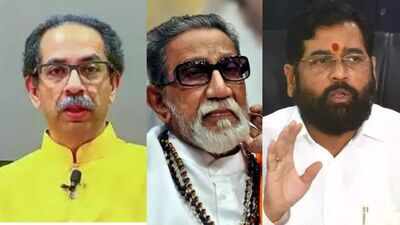
Sixty years after Bal Keshav Thackeray launched the Shiv Sena as a movement to champion the rights of the “Marathi Manoos”, the party that once revolved around one undisputed leader finds itself split into two rival factions, each claiming to be the true political heir to his legacy.The journey from a regional outfit fighting for jobs in Mumbai to leading Maharashtra’s government, embracing Hindutva, becoming the BJP’s closest ally, and eventually fracturing into competing camps mirrors the changing political landscape of both Maharashtra and India.
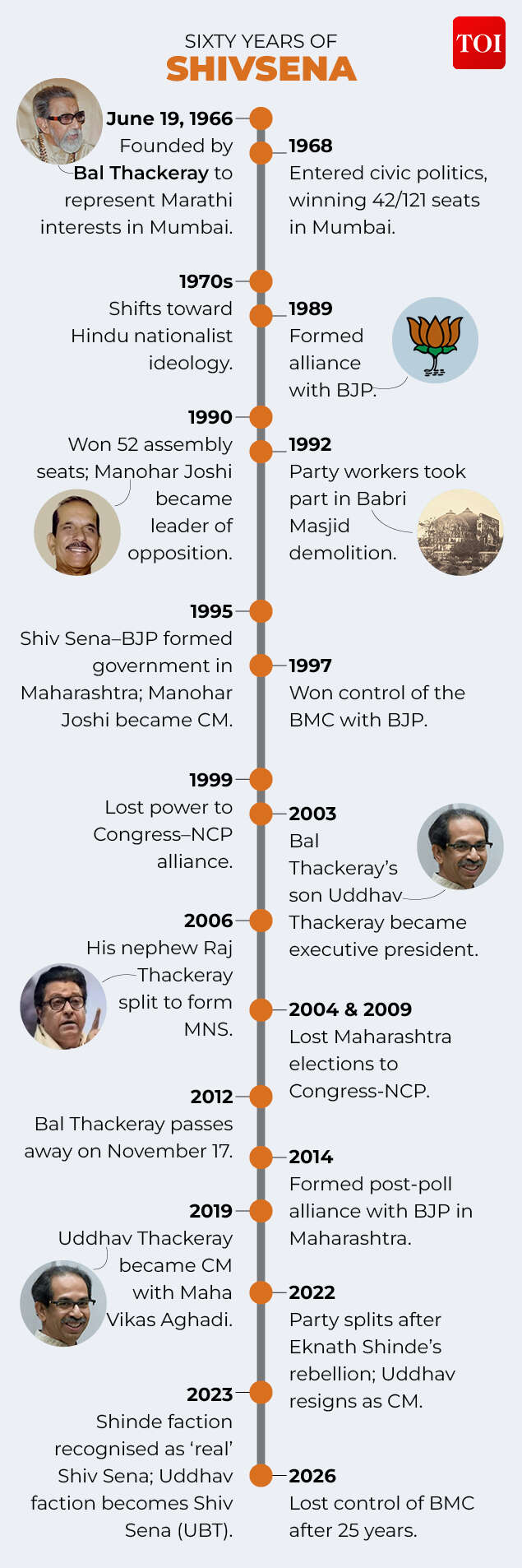
Sixty years of shivsena
As the Shiv Sena completes six decades, its story is no longer just about electoral victories or defeats. It is also about changing ideologies, shifting alliances, family rivalries and the gradual transformation of a personality-driven organisation into a divided political house.1. Voice of ‘Marathi Manoos’When Bal Thackeray founded the Shiv Sena on June 19, 1966, Mumbai was undergoing rapid industrialisation. Thousands of migrants from across the country were arriving in the city, and many Maharashtrians believed they were being pushed out of white-collar jobs.The Sena channelled this sentiment into a powerful political movement centred on the slogan of “sons of the soil”. Bal Thackeray’s fiery speeches, backed by his sharp political cartoons in Marmik, quickly built a loyal grassroots network that distinguished the Sena from traditional political parties.Unlike the Congress, which relied on organisational structures, the Shiv Sena revolved around the charisma of one leader.2. From regional identity to HindutvaBy the late 1980s, the Sena had expanded beyond Marathi identity politics. The Ram Janmabhoomi movement and the BJP’s rise offered Bal Thackeray an opportunity to reposition the party as a champion of Hindutva.The alliance with the BJP fundamentally altered the Sena’s political identity. It was no longer merely a regional force but an important player in the broader Hindutva movement.Bal Thackeray never shied away from the ideological shift. “If Hindutva is called communalism, then we are communal,” he once declared, making it clear that the party would embrace aggressive cultural nationalism despite criticism from its opponents.3. The first taste of powerThe Sena-BJP alliance formed Maharashtra’s government in 1995, ending decades of Congress dominance.Although Bal Thackeray never occupied any constitutional office, his residence, Matoshree, became the state’s real political power centre. Chief minister Manohar Joshi and later Narayan Rane were widely seen as implementing decisions taken by the Sena chief.He had many times claimed that the “remote control” of the government was with him.The period cemented Bal Thackeray’s image as a leader who exercised authority without holding office, reinforcing the personality-centric nature of the organisation.4. From street politics to governanceThe Shiv Sena’s transformation from an agitation-based movement to a ruling party brought new challenges.Running one of India’s largest states required administrative expertise, coalition management and economic policymaking, very different from the confrontational politics that had defined the Sena’s early decades.Even while in government, however, the party retained its street-fighter image, often balancing governance with aggressive political mobilisation.The party was also long associated with the Brihanmumbai Municipal Corporation (BMC), Mumbai’s wealthy civic body with a budget larger than many states, where it first came to power in 1997. That changed in 2022 after the split, and in January this year, in the BMC’s first elections since 2017, the BJP finally ended its former ally’s dominance.5. The family succession changed the partyThe biggest turning point came after Bal Thackeray chose his son Uddhav Thackeray over his charismatic nephew Raj Thackeray as his political successor.The decision eventually led Raj Thackeray to walk away and establish the Maharashtra Navnirman Sena (MNS) in 2006.While Raj inherited much of Bal Thackeray’s oratory and public style, Uddhav represented a quieter, more organisational approach to politics. The split divided the Marathi vote in Mumbai and marked the beginning of a gradual shift in the Sena’s internal power structure.Although the party survived the first family split, it lost one of its most popular mass leaders.6. BJP became the bigger partnerFor decades, the BJP had accepted the Sena’s leadership in Maharashtra. That equation changed dramatically after Narendra Modi’s emergence as the BJP’s national leader and the party’s sweeping victory in 2014.The BJP rapidly expanded across Maharashtra, reducing the Sena’s dominance even in its traditional urban strongholds.The relationship increasingly became one of competition rather than partnership. Seat-sharing disputes, public criticism and repeated confrontations reflected the growing imbalance between the allies.For perhaps the first time, the Shiv Sena was no longer the senior partner in the alliance it had helped build.7. The 2019 break that changed everythingThe 2019 assembly election produced the most unexpected political realignment in Maharashtra.Despite contesting alongside the BJP, Uddhav Thackeray broke away after disagreements over the Chief Minister’s post and formed the Maha Vikas Aghadi government with the Congress and the NCP.The alliance represented a dramatic departure for a party that had spent decades attacking both the Congress and Sharad Pawar’s politics.Supporters viewed it as pragmatic coalition-building. Critics argued that it marked the Sena’s biggest ideological departure since its birth.8. The Shinde rebellionThe defining moment in the party’s 60-year history came in 2022 when senior leader Eknath Shinde led a rebellion with the support of the majority of Shiv Sena MLAs.Unlike Raj Thackeray’s exit in 2006, which created a parallel regional party, the Shinde revolt shifted the legislative majority itself, eventually leading to recognition by constitutional authorities.Justifying the rebellion, Eknath Shinde repeatedly argued: “We have not left Balasaheb’s Shiv Sena; we have left those who abandoned Balasaheb’s Hindutva.”Uddhav Thackeray countered that the party’s identity could not be separated from its founder’s family and ideals. After the Election Commission awarded the Shiv Sena’s name and iconic bow-and-arrow symbol to the Shinde faction, Uddhav remarked, “They can steal the bow and arrow, but they cannot steal Balasaheb’s ideals.”The battle, therefore, became not merely political but symbolic—a contest over who truly represents Bal Thackeray’s legacy.9. Two Shiv Senas, one legacyToday’s Maharashtra has two Shiv Senas.The Eknath Shinde-led Shiv Sena controls the party’s official name and election symbol and remains part of the BJP-led National Democratic Alliance.The Uddhav Thackeray-led Shiv Sena (UBT), meanwhile, has retained much of the original party’s emotional appeal among sections of the traditional cadre and continues to project itself as the ideological successor of Bal Thackeray’s movement.Ironically, both factions invoke the same founder, celebrate the same anniversary and claim to represent the same political philosophy.10. Another Sena split reloading?Four years after the split, Shiv Sena (UBT) could be headed for another division. The Uddhav Thackeray faction says it is facing what it describes as “Operation Tiger”, an alleged effort to get six of its nine Lok Sabha MPs to join the camp of Eknath Shinde.The number involved—two-thirds of the Shiv Sena (UBT)’s Lok Sabha strength—is the exact figure required for the six MPs to form a separate faction.The potential split would be another setback for Uddhav Thackeray, further weakening his faction’s position and influence.


