
For years, environmental CSR in India was largely associated with tree plantation drives, cleanliness campaigns and occasional conservation projects. While those initiatives continue, companies are increasingly directing their CSR efforts towards something far more strategic. They’re strengthening climate resilience, securing water resources, promoting circular use of materials, and helping communities adapt to a warming world.The change reflects a growing realisation that environmental sustainability is no longer just about protecting nature. It is about protecting livelihoods, businesses, and the economy itself.Climate change is already affecting water availability, agriculture, supply chains, and industrial operations. As these risks intensify, Corporate India is beginning to see environmental CSR not as philanthropy but as an investment in long-term resilience.The scale of the challenge is enormous. India’s draft Climate Finance Taxonomy estimates that the country will require around $2.5 trillion (Roughly an estimated Rs 2,50,00,000 crore or Rs 250 trillion) to meet its climate commitments by 2030, while climate adaptation alone could require investments of nearly Rs 56.7 trillion during the same period. These figures underline why resilience has become a business imperative as much as an environmental one.Increasingly, companies are aligning their CSR programmes with this new reality. Water has emerged as one of the biggest priorities.According to the Central Ground Water Board, India extracts 245.6 billion cubic metres (BCM) of groundwater annually, with 751 assessment units already categorised as over-exploited, 206 as critical and another 711 as semi-critical. Agriculture accounts for 87% of groundwater extraction, making water scarcity a concern that extends far beyond farms to industries, cities and supply chains.For CSR programmes, this has meant a shift from isolated water projects towards landscape-level interventions. Infosys, for instance, reports creating 40 lakes across its campuses with a combined rainwater storage capacity of 430 million litres, supported by 409 deep injection wells and complete recycling of wastewater.UltraTech Cement says its operations became 4.9 times water positive during FY2024-25 through rainwater harvesting, groundwater recharge, watershed management and recycling initiatives. Hindustan Zinc reports achieving 3.3 times water positivity while targeting a 50% reduction in freshwater consumption by 2030. ITC, meanwhile, has expanded watershed restoration and river basin stewardship programmes alongside improvements in water-use efficiency.The common thread running through these initiatives is that they benefit both communities and businesses. Restoring watersheds improves groundwater availability for nearby villages while also reducing water-related risks for industrial operations. Wastewater recycling lowers pressure on freshwater resources while helping industries operate more sustainably.The focus is also widening beyond water. Another emerging area for CSR is the circular economy, where companies seek to minimise waste and maximise the productive use of resources. Rather than viewing waste simply as something to be disposed of, businesses are increasingly investing in recycling, reuse and resource recovery.India’s policy framework now covers plastics, batteries, e-waste, waste tyres, construction waste and several other waste streams under Extended Producer Responsibility rules. As of March 2026, registered recyclers had processed 417.6 lakh metric tonnes of waste, generating nearly 342 lakh metric tonnes of EPR certificates. The government has also introduced a Rs 1,500 crore incentive scheme to promote recycling of critical minerals such as lithium, nickel and cobalt.Corporate initiatives are increasingly reflecting this transition. Tata Steel reported recycling around 4.2 million tonnes of scrap during FY2024-25. Infosys diverted 98% of its waste away from landfills, while Hindustan Zinc is working towards achieving near-zero waste to landfill by 2030 through greater reuse and recycling. These examples demonstrate how environmental investments can reduce raw material consumption, lower disposal costs, and improve resource security.CSR is also beginning to support innovation rather than only funding conventional projects. Technology-led solutions are emerging as an important area of investment. Digital Paani, featured in NITI Aayog’s Frontier Tech Repository, uses Internet of Things-based automation to optimise wastewater treatment plants. The platform has been deployed at more than 40 facilities, treating over 90 million litres of wastewater every day.In agriculture, Kheyti’s “greenhouse-in-a-box” model has demonstrated how climate-smart farming can improve resilience. According to the study cited in the report, participating farmers recorded a 73% increase in income, 58% lower crop losses, 67% lower water consumption, and significantly lower fertiliser use. Satellite-enabled platforms such as SatSure are also helping govts, financial institutions and agribusinesses assess climate risks and improve decision-making using artificial intelligence and Earth observation data.The evolution of environmental CSR reflects a broader shift in corporate thinking. Earlier, environmental spending was often evaluated through the number of trees planted or awareness campaigns organised. Join conversationView All Comments →Share your thoughts in the commentsInsightfulAgreeDisagreeSkepticalConcerningPromisingWorth ReadingBig DevelopmentPost CommentBe respectful · TOI community guidelinesToday, companies are increasingly asking whether their investments improve water security, strengthen ecosystems, reduce resource consumption, and help communities withstand climate shocks.The approach also aligns more closely with business priorities. Healthier watersheds mean more reliable water supplies. Circular resource use reduces dependence on virgin materials. Climate-resilient agriculture strengthens rural livelihoods while improving supply-chain stability. Investments in environmental resilience, therefore, generate benefits that extend beyond compliance or corporate reputation.Get the latest India News and Live updates. Download the TOI app.End of ArticleFollow Us On Social MediaVideosExplained: Why Amritpal Singh’s Party Fielded Son of Indira Gandhi’s Assassin In Punjab Elections?Prashant Kishor Promises Jobs For 10,000 Bankipur Youths After Ending BJP’s 30-Year Hold | WatchIndia’s Map Move Rattles China: What Naming 27 Places In Arunachal Means?Air India Phuket-Delhi Pilot’s Confirmatory Dope Test Reportedly Positive For Marijuana, Sources SayTamil Nadu Assembly Passes Anti-NEET Resolution As DMK, AIADMK And PMK Back Abolition DemandDelhi CM Fumes, Rekha Gupta Slams AAP MLA Over Viral Video; Eight AAP MLAs Marshalled OutKashmiri Pandit Employees Sent On Leave After Lashkar-Linked Threat Letter‘Amit Shah Jawab Do’ Vs ‘Rahul Gandhi Bhaago Mat’: NDA, Oppn Face-Off In Parliament’Booked Hotel Room, Strangled Daughters’: Inside Bengaluru Murder Shocker‘Ladakh Is Not Kaziranga’: Snow Leopard Safari Plan Sparks Debate123PhotostoriesInside Jannat Zubair’s opulent Mumbai home: From massive living room, royal interiors and more7 giant dog breeds that are gentle and friendly with kids10 simple ways to leave your comfort zone without disrupting your life and enjoy it moreFrom Kaziranga to Bandipur: Indian forests every elephant lover should know this World Elephant Day7 signs the chemistry is real, but the relationship may not work9 of the most expensive ingredients grown in India6 common mistakes to avoid with pakodas and how to make them crispierFrom Mumbai to Chennai: Indian cities that were renamed and why10 baby names that represent the power and might of Lord ShivaUK Heatwave 2026: Met Office predicts this summer to be the hottest ever; 10 cities and urban areas under extreme heat stress123Hot PicksInternational Youth DayMHT-CET CAP round seat allotmentSlovenia Indian embassyJharkhand protestN ChandrasekaranNEET PG 2026 city slipIran warSBI Clerk RecruitmentUP scholarshipTop TrendingChennai AirportNagpur Rape CaseAir India Phuket-Delhi FlightMumbai Kurla LandslideBengaluru Missing TechieSpiceJet FlightTelangana AccidentAbhijeet DipkeWeather TomorrowShakeel Noorani


For years, environmental CSR in India was largely associated with tree plantation drives, cleanliness campaigns and occasional conservation projects. While those initiatives continue, companies are increasingly directing their CSR efforts towards something far more strategic. They’re strengthening climate resilience, securing water resources, promoting circular use of materials, and helping communities adapt to a warming world.The change reflects a growing realisation that environmental sustainability is no longer just about protecting nature. It is about protecting livelihoods, businesses, and the economy itself.Climate change is already affecting water availability, agriculture, supply chains, and industrial operations. As these risks intensify, Corporate India is beginning to see environmental CSR not as philanthropy but as an investment in long-term resilience.The scale of the challenge is enormous. India’s draft Climate Finance Taxonomy estimates that the country will require around $2.5 trillion (Roughly an estimated Rs 2,50,00,000 crore or Rs 250 trillion) to meet its climate commitments by 2030, while climate adaptation alone could require investments of nearly Rs 56.7 trillion during the same period. These figures underline why resilience has become a business imperative as much as an environmental one.Increasingly, companies are aligning their CSR programmes with this new reality. Water has emerged as one of the biggest priorities.According to the Central Ground Water Board, India extracts 245.6 billion cubic metres (BCM) of groundwater annually, with 751 assessment units already categorised as over-exploited, 206 as critical and another 711 as semi-critical. Agriculture accounts for 87% of groundwater extraction, making water scarcity a concern that extends far beyond farms to industries, cities and supply chains.For CSR programmes, this has meant a shift from isolated water projects towards landscape-level interventions. Infosys, for instance, reports creating 40 lakes across its campuses with a combined rainwater storage capacity of 430 million litres, supported by 409 deep injection wells and complete recycling of wastewater.
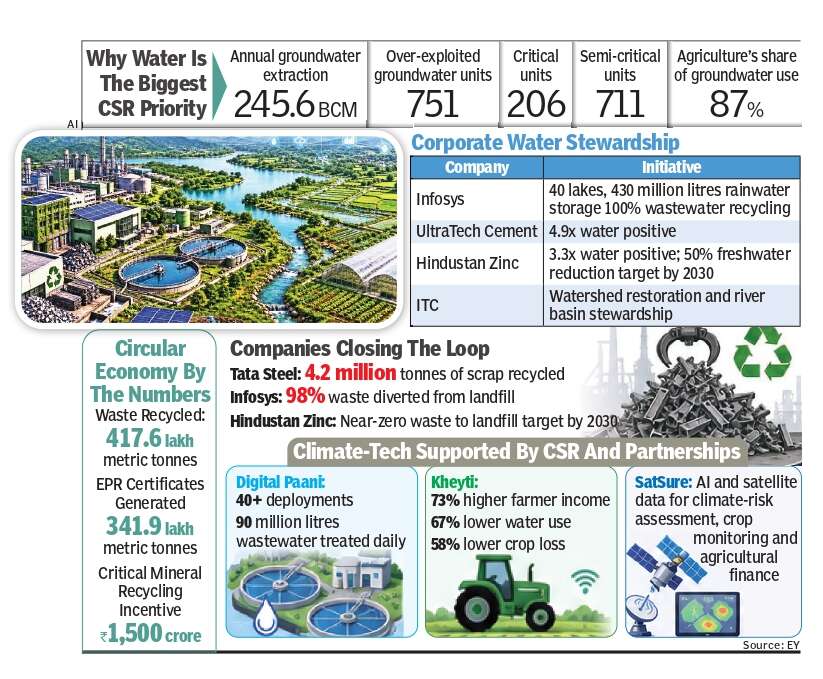
UltraTech Cement says its operations became 4.9 times water positive during FY2024-25 through rainwater harvesting, groundwater recharge, watershed management and recycling initiatives. Hindustan Zinc reports achieving 3.3 times water positivity while targeting a 50% reduction in freshwater consumption by 2030. ITC, meanwhile, has expanded watershed restoration and river basin stewardship programmes alongside improvements in water-use efficiency.The common thread running through these initiatives is that they benefit both communities and businesses. Restoring watersheds improves groundwater availability for nearby villages while also reducing water-related risks for industrial operations. Wastewater recycling lowers pressure on freshwater resources while helping industries operate more sustainably.The focus is also widening beyond water. Another emerging area for CSR is the circular economy, where companies seek to minimise waste and maximise the productive use of resources. Rather than viewing waste simply as something to be disposed of, businesses are increasingly investing in recycling, reuse and resource recovery.India’s policy framework now covers plastics, batteries, e-waste, waste tyres, construction waste and several other waste streams under Extended Producer Responsibility rules. As of March 2026, registered recyclers had processed 417.6 lakh metric tonnes of waste, generating nearly 342 lakh metric tonnes of EPR certificates. The government has also introduced a Rs 1,500 crore incentive scheme to promote recycling of critical minerals such as lithium, nickel and cobalt.Corporate initiatives are increasingly reflecting this transition. Tata Steel reported recycling around 4.2 million tonnes of scrap during FY2024-25. Infosys diverted 98% of its waste away from landfills, while Hindustan Zinc is working towards achieving near-zero waste to landfill by 2030 through greater reuse and recycling. These examples demonstrate how environmental investments can reduce raw material consumption, lower disposal costs, and improve resource security.CSR is also beginning to support innovation rather than only funding conventional projects. Technology-led solutions are emerging as an important area of investment. Digital Paani, featured in NITI Aayog’s Frontier Tech Repository, uses Internet of Things-based automation to optimise wastewater treatment plants. The platform has been deployed at more than 40 facilities, treating over 90 million litres of wastewater every day.In agriculture, Kheyti’s “greenhouse-in-a-box” model has demonstrated how climate-smart farming can improve resilience. According to the study cited in the report, participating farmers recorded a 73% increase in income, 58% lower crop losses, 67% lower water consumption, and significantly lower fertiliser use. Satellite-enabled platforms such as SatSure are also helping govts, financial institutions and agribusinesses assess climate risks and improve decision-making using artificial intelligence and Earth observation data.

The evolution of environmental CSR reflects a broader shift in corporate thinking. Earlier, environmental spending was often evaluated through the number of trees planted or awareness campaigns organised.
Share your thoughts in the comments
Be respectful · TOI community guidelines
Today, companies are increasingly asking whether their investments improve water security, strengthen ecosystems, reduce resource consumption, and help communities withstand climate shocks.The approach also aligns more closely with business priorities. Healthier watersheds mean more reliable water supplies. Circular resource use reduces dependence on virgin materials. Climate-resilient agriculture strengthens rural livelihoods while improving supply-chain stability. Investments in environmental resilience, therefore, generate benefits that extend beyond compliance or corporate reputation.


