
For nearly 250 years, a small notebook kept unnoticed in a French library until archivists realised it contained lost music written by Mozart | World News

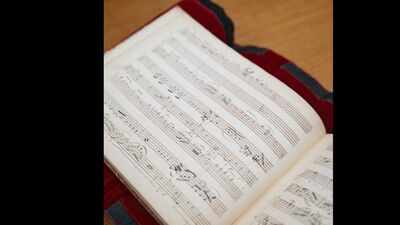
For generations, music historians worked on the assumption that Wolfgang Amadeus Mozart’s surviving manuscripts had been mapped with extraordinary precision. Fresh discoveries were expected to involve forgotten copies, letters or fragments rather than entirely unknown music written in the composer’s own hand. That expectation shifted after an ordinary archival review at France’s National Library uncovered a modest notebook that had sat unnoticed for centuries. Inside were composition lessons, unfinished exercises and a collection of music linked directly to Mozart’s brief stay in Paris in 1778. Instead of revealing a grand symphony or opera, the manuscript offers something arguably rarer: a close look at Mozart teaching composition while creating music alongside one of his pupils.
How Mozart’s 248-year-old notebook was discovered in France
The discovery began in February 2026 when François-Pierre Goy, curator of the pre-1800 collections in the Music Department of the Bibliothèque nationale de France (BnF), examined an untitled late eighteenth-century music notebook. While studying its pages, he recognised handwriting that appeared strikingly familiar.According to the Bibliothèque nationale de France, the manuscript was subsequently examined by musicologist Laurence Decobert, who agreed that the writing matched Mozart’s hand. The notebook was then independently authenticated by Armin Brinzing, director of the Bibliotheca Mozartiana at the Mozarteum in Salzburg, who confirmed both its authenticity and historical importance.The document contains 44 pages and had remained unidentified within the library’s collections despite belonging to one of the world’s largest repositories of Mozart manuscripts outside Salzburg.
What does Mozart’s 248-year-old notebook contain
Rather than being a finished musical work, the notebook records composition lessons Mozart gave between May and July 1778 to Marie-Louise-Philippine de Bonnières de Guînes, the talented daughter of Adrien-Louis de Bonnières, Duke of Guînes.Her father, an accomplished flautist, hoped his daughter would learn to compose substantial sonatas for flute and harp. He had commissioned Mozart’s famous Flute and Harp Concerto (K.299), and the newly identified notebook appears to belong to the same period.According to the BnF, the manuscript contains composition exercises alongside seven pieces written for flute and harp. Six of those pieces survive complete and could now become part of the modern performance repertoire for those instruments.The lessons ended when Mademoiselle de Guînes married on 26 July 1778, leaving the notebook unfinished. Its final exercise stops midway, while the last six pages remain blank.
How Mozart taught composition to his students
One of the notebook’s greatest values lies in what it reveals about Mozart’s working methods. Reportedly, the manuscript preserves the earliest known evidence of how Mozart taught composition. Teacher and student both contributed to many of the pages, sometimes writing side by side and sometimes completing one another’s musical ideas.Some exercises were written entirely by Marie-Louise-Philippine herself, while elsewhere Mozart’s handwriting gradually blends with hers, showing how he corrected, expanded or guided her musical thinking.The notebook also connects closely with a letter Mozart wrote to his father on 14 May 1778, where he described the kinds of exercises he assigned during lessons and complained that his student struggled to produce original musical ideas. Yet the newly discovered pieces suggest her abilities may have been more developed than Mozart’s private remarks implied, since each work grows from ideas introduced by Mozart before being developed collaboratively.
How Mozart’s lost notebook survived for more than 200 years
The notebook’s survival appears to have been shaped by events far removed from Mozart’s lifetime. Matching library ownership marks indicate that this manuscript and an early French copy of the Flute and Harp Concerto probably belonged to two collections of music seized from the Duke of Guînes’ Paris residence during the French Revolution in May 1794. Both eventually entered the National Library’s holdings, where the notebook remained unidentified for more than two centuries.Its rediscovery has already moved beyond the archive. Musicians from the Orchestre Philharmonique de Radio France recorded the newly identified music before presenting it publicly for the first time at the BnF’s Richelieu site. Broadcasts on France Musique introduced listeners to works that had remained unheard since Mozart’s lifetime.Reflecting on the find, BnF president Gilles Pécout described it as “one of the most important” Mozart discoveries of recent decades because it documents the composer’s final stay in Paris while revealing “the daily life of the young Professor Mozart, in dialogue with his student,” according to the Bibliothèque nationale de France.Today, the BnF holds 45 autograph Mozart manuscripts, making it the second-largest collection after Salzburg. Until this notebook was recognised, only one of those manuscripts had originally entered the National Library’s collections. Now a forgotten teaching notebook has joined that small group, offering an unusually personal window into Mozart’s everyday work nearly 250 years after it was written.


