
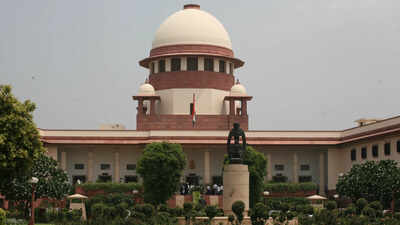
File photo: Supreme Court of India NEW DELHI: Observing that the consequence of a person being declared a foreign national is huge and may lead to detention, deportation, separation from family and even possibly leave them stateless, Supreme Court Monday said determination of citizenship must be carried out through a “fair, lawful and reasonable” process even as it underscored that the government has legitimate and compelling interest in ensuring persons not legally entitled to claim Indian citizenship do not secure such status by misusing the process.A bench of Justices Vikram Nath and Sandeep Mehta found fault with the procedure adopted by Foreigners Tribunals and Guwahati high court in declaring 27 people as foreign nationals, and quashed orders, many of which were passed without hearing those affected. It directed the tribunals to give them a fresh hearing and decide the cases.The bench said Section 9 of Foreigners Act places the burden upon the person to prove he or she is not a foreigner but observed that “the existence of a statutory burden under Section 9 cannot be read to mean a tribunal is relieved of its own obligation to conduct a lawful adjudication”.”Section 9 does not authorise a mechanical declaration,” it said, adding that it “does not exclude the principles of natural justice”.Tribunals must give chance to produce evidence: Supreme CourtThe issue is not whether a tribunal is powerless to proceed ex parte in every case. The narrower and more important question is whether an ex parte or effectively ex parte proceeding can result in a mechanical declaration of foreigner status without a tribunal satisfying itself that the minimum requirements of lawful and fair adjudication have been met, Supreme Court said.It said as per statutory scheme, the person seeking citizenship carries the burden of proving that he or she is not a foreigner and a “tribunal must ensure a fair procedure, meaningful notice, consideration of material, and a reasoned opinion. These features are not in conflict”.“The statutory burden placed upon the proceedee operates only after the proceeding is lawfully initiated and after the proceedee is placed in a position to understand the case against him or her. The burden cannot be shifted in a vacuum. A person cannot be expected to prove the negative without being told, with reasonable clarity, the material basis on which he or she is alleged to be a foreigner,” it said.“The protection of equality before law, equal protection of laws, life and personal liberty is, therefore, available to every person within the territory of India. A person proceeded against before a foreigners tribunal may ultimately fail to establish Indian citizenship, but the process by which such determination is made must still satisfy the constitutional requirements of fairness, reasonableness and non-arbitrariness,” the court said.“The person proceeded against is often required to establish facts relating to ancestry, residence, identity and family linkage through old public documents. Such a person cannot be expected to discharge the statutory burden under Section 9 unless the main grounds of the allegation are disclosed and a meaningful opportunity is afforded to file a response and produce evidence. The opportunity contemplated by Paragraph 3 of the 1964 Order must therefore be an effective opportunity, and not a merely formal one,” it said.Get the latest India news and live updates. Download the TOI App.End of ArticleFollow Us On Social MediaVideos’I Will Bow At Every Door’: Narottam Mishra Gets Emotional, Chokes Up At BJP’s Datia Bypoll Rally“Putin Pays Close Attention To PM Modi”: Poland Highlights India’s Global Power Amid Global CrisesBengal Government Backs Airport Mosque Relocation, Cites Security And Runway Expansion NeedsSuvendu Govt Replaces Mamata’s ‘Khela Hobey Divas’ With ‘Ayushman Divas’Man Claiming To Be Ex-US Navy Officer Held At India-Nepal Border Without Travel Documents’I Am Not Gandhiji’: Kerala Double Murder Convict Shows No Remorse In CourtUS Inmate Matthew Aaron VanDyke Seeks Special Diet, Cooking Permission Inside Tihar JailMission $500 Billion: India, US Push To Deepen Trade Ties As Deal Nears CompletionMission $500 Billion: India, US Push To Deepen Trade Ties As Deal Nears CompletionCDS To Present Theatre Command Roadmap As India Moves Closer To Military Reforms123PhotostoriesFrom opening up about problems in their married life and his battle with anxiety to Yuvika’s emotional breakdown: Prince Narula and Yuvika Chaudhary get candid5 signs you’re not in love; it’s obsessionWhy you can still cringe over something you said 10 years ago… but forget why you walked into the kitchen just seconds laterJanhvi Kapoor’s 24K gold corset to black embroidered lehenga is wedding guest fashion at its boldest10 beautiful baby names that symbolise new life and fresh beginningsAkshay Kumar’s go-to high-protein snack at 58 is packed with fiber and contains no chilliJuly New Moon 2026: Affirmations for your birth dateDo your knees hurt before it rains? Here’s why osteoarthritis pain gets worse during the monsoon, according to doctorsPigeons taking over your balcony? 7 Humane ways to keep them away without causing harmFrom grey saree elegance to embroidered sharara glam: Alia Bhatt masters two bridesmaid looks at Akansha Ranjan Kapoor’s wedding123Hot PicksWWE Raw PreviewRajasthan PG admissionsSouth China SeaITR filingNepal protestLucknow-Kanpur ExpresswayEPFO amnesty schemeTaylor Swift and Travis KelceE20 petrol newsTop TrendingSamantha BuschMadurai AccidentITR filingFIFA World Cup 2026Karnataka Pakistani ArrestedGhaziabad Mall Rape MurderDelhi MurderTG TET 2026 resultGurgaon EncounterIran war

NEW DELHI: Observing that the consequence of a person being declared a foreign national is huge and may lead to detention, deportation, separation from family and even possibly leave them stateless, Supreme Court Monday said determination of citizenship must be carried out through a “fair, lawful and reasonable” process even as it underscored that the government has legitimate and compelling interest in ensuring persons not legally entitled to claim Indian citizenship do not secure such status by misusing the process.A bench of Justices Vikram Nath and Sandeep Mehta found fault with the procedure adopted by Foreigners Tribunals and Guwahati high court in declaring 27 people as foreign nationals, and quashed orders, many of which were passed without hearing those affected. It directed the tribunals to give them a fresh hearing and decide the cases.The bench said Section 9 of Foreigners Act places the burden upon the person to prove he or she is not a foreigner but observed that “the existence of a statutory burden under Section 9 cannot be read to mean a tribunal is relieved of its own obligation to conduct a lawful adjudication”.“Section 9 does not authorise a mechanical declaration,” it said, adding that it “does not exclude the principles of natural justice”.
Tribunals must give chance to produce evidence: Supreme Court
The issue is not whether a tribunal is powerless to proceed ex parte in every case. The narrower and more important question is whether an ex parte or effectively ex parte proceeding can result in a mechanical declaration of foreigner status without a tribunal satisfying itself that the minimum requirements of lawful and fair adjudication have been met, Supreme Court said.It said as per statutory scheme, the person seeking citizenship carries the burden of proving that he or she is not a foreigner and a “tribunal must ensure a fair procedure, meaningful notice, consideration of material, and a reasoned opinion. These features are not in conflict”.“The statutory burden placed upon the proceedee operates only after the proceeding is lawfully initiated and after the proceedee is placed in a position to understand the case against him or her. The burden cannot be shifted in a vacuum. A person cannot be expected to prove the negative without being told, with reasonable clarity, the material basis on which he or she is alleged to be a foreigner,” it said.“The protection of equality before law, equal protection of laws, life and personal liberty is, therefore, available to every person within the territory of India. A person proceeded against before a foreigners tribunal may ultimately fail to establish Indian citizenship, but the process by which such determination is made must still satisfy the constitutional requirements of fairness, reasonableness and non-arbitrariness,” the court said.“The person proceeded against is often required to establish facts relating to ancestry, residence, identity and family linkage through old public documents. Such a person cannot be expected to discharge the statutory burden under Section 9 unless the main grounds of the allegation are disclosed and a meaningful opportunity is afforded to file a response and produce evidence. The opportunity contemplated by Paragraph 3 of the 1964 Order must therefore be an effective opportunity, and not a merely formal one,” it said.


