
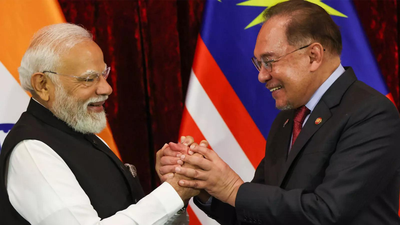
File photo: PM Modi with Malaysian Prime Minister Anwar Ibrahim India’s growing soft-power presence and cultural diplomacy is witnessing a new vigour in Malaysia, one of India’s key economic partners and a historically connected Asean nation in the region.The centuries-old civilizational bond between the two countries, anchored by 2.9 million strong Indian origin diaspora, has been witnessing a spate of events, moments and revelations that further buttress this.The tracing of the Malay Archipelago thread to the Chola Empire’s Anaimangalam Copper Plates that Prime Minister Modi brought home from the Netherlands carries huge symbolism for the cultural and maritime exchange of the 11th century.And in the recent past, Malaysian archaeologist Dr Nasha Rodziadi Khaw’s astounding work unearthing the Hindu-Buddhist artefacts in Bhujang Valley, in the Kedah state, has drawn people back to the ancient ties and Cholas’ mighty presence in this region.The celebrations to mark the 15th anniversary of the Indian Cultural Centre in Kuala Lumpur, together with 77th ICCR Day, on April 9 this year, were an exhibition of these ties and much more.In fact, the deep-rooted Indian cultural influences and traditions have, over the years, transformed into a unique, localised version woven into Malaysian identity.The outgoing Indian high commissioner B N Reddy, who, in his stint, successfully showcased India as a culturally resonant partner in South East Asia, summed up this unique phenomenon in his keynote speech at the ICC event.He said, “The depth and range of the diversity existing in the cultural landscape of Malaysia has led to a remarkable self-sustaining, thriving system, empowered by local artists and Gurus.”The most significant and recent example was the record-breaking Swagatam performance by an 800-strong contingent of Indian and Malaysian dancers for Modi’s welcome event in February this year. The spectacle, led and organised by the Indian High Commission and ICC, earned a place in the Malaysia Book of Records for the largest traditional and folk dance staged in the country.It was unique because nearly 50 local dance schools run by Malaysian Indian teachers and gurus collaborated for this performance.Speakers at the ICC’s 15th anniversary celebration harped on the transmission of heritage, the continuity of culture and the emerging syncretic forms that have brought the people of the two nations together.One of the guest speakers, Padmashree awardee and internationally acclaimed Malaysian artist, Ramli Ibrahim, said, “We are witnessing currents of change; there’s cultural diffusion amongst people, in their day-to-day interactions; acceptance, and curiosity also. What we need now is that powerful cultural connect with India must enable us to project Malaysia at the forefront of multi-racial diversity.”As a Malay Muslim practising and promoting Odissi and Bharatnatyam, Ramli has had a run-in with the conservative elements in the past. But the work of Sutra Foundation, his dance school that attracts even Chinese youth, has not gone unnoticed.“Radhe Radhe! 2.0, Ramli’s Odissi production, based on Radha and Krishna, after successfully touring India, is now staging shows in various cities of Malaysia, with the support of government agencies like JKKN Melaka (National Department of Culture and Arts) led by director Ezlina Alias.Reflecting on his recent cultural tour of India, as ICCR’s Distinguished Visitor, Tunku Zain Al Abidin, member of the Royal family of Negri Sembilan, educationist and cultural thought-leader, said, “When Malaysian and Indian art blend together, they show how tangible and deep our connections are.The puppet shows in Malaysia, Indonesia draw heavily from the Indian sub-continent and today they are symbols of our shared heritage. At another level, during my meetings with think-tanks in India, I realized how similar we are in terms of institutions.”Talking to TOI, Shangita Namasivayam, renowned Bharatnatyam dancer and owner and patron of Kalpana Dance Theatre, KL, whose student portrayed Goddess Lalitha Tripurasundari in the programme, said, “The ICC has become the institutional bridge to our heritage and over the years it has led to a cultural richness that is so varied and so powerful. And also Malaysia is uniquely strengthened because the local communities have maintained this continuity in the traditions of arts.”In Malaysia, ICC was inaugurated by Dr Karan Singh was in the year 2010.Located in the bustling streets of Little India in Kuala Lumpur, the Netaji Subhash Chandra Bose Indian Cultural Centre (thus named by Modi in his previous visit to Malaysia in 2016) has become a focal point of social exchange and a learning centre for Malaysians with an interest in India.Besides Yoga Hindi language classes, local Indian children also learn Kathak and Bharatnatyam dances. The Centre routinely conducts workshops on Ayurveda and various aspects of India-Malaysia heritage.Get the latest India news and live updates. Download the TOI App.End of ArticleFollow Us On Social MediaVideosJio Files DRHP With SEBI | Mukesh Ambani Hands IPO Leadership To Isha, Akash & AnantFrom ‘Brother-in-Ideals’ To A Cold Greeting: Stalin’s Message Exposes DMK-Congress RiftLNG Tanker ‘DISHA’ Reaches Gujarat After Hormuz Crossing, Boosting India’s Energy ConfidenceUP CM Yogi Adityanath Defends SIT Probe In Ram Mandir Donation Row, Says Truth Will Be RevealedCockroach Janta Party Seeks ₹1 Crore Compensation For Families Amid NEET Suicide CrisisEx-PM I.K. Gujral’s Son Duped Of ₹7.8 Crore, Cops Claim ‘Majority’ Of Amount | WatchAnthropic CEO Dario Amodei’s ‘Disorganised’ India AI Summit Remark Triggers Congress-BJP FaceoffTelegram Loses Court Battle As Delhi HC Refuses To Lift Temporary Block | WatchCross-Voting Shock? NDA-Backed Nathwani Wins As India Bloc’s Math Collapses | Watch’Exporting Terror Has Costs’: India Rejects Pakistan’s Claims At UN Human Rights Council123PhotostoriesInside Nia Sharma’s stunning Mumbai home: A luxe bar, breathtaking skyline views and lavish interiorsJanhvi Kapoor’s Kota silk gold zari saree is a fit made for the gods with devotion, heritage, and luxury energyThis Himalayan village is famous for its 32 hairpin bends and ancient silk routeSamantha Ruth Prabhu consumes 100g protein daily at just 50 kg, has banned ‘superfoods’ from diet after myositis diagnosisThings every 90s kid learned that children rarely experience todayJapanese proverb of the day on relationships: “If the fish has a mind, so does…”5 everyday habits to heal and balance your throat chakraSamantha Ruth Prabhu’s fiery red saree sets the stage for an iconic reunion with TN Chief Minister Thalapathy VijayConjunctivitis cases surge during monsoon: Eye doctor shares 10 simple ways to protect your eyes and prevent infectionFather’s Day 2026: 9 things Indian dads rarely say, but show every single day123Hot PicksJesse MarschYuvraj SinghLionel MessiAP SSC resultsKannur University FYUGP TrialShiv SenaJD VanceStrait of HormuzHormoz nuclear power plantTop TrendingBihar gang-rapeUS-Iran Peace DealStock Market LiveFIFA World Cup 2026What is Legacy BadgeBEST bus strikeAIIMS Admit CardMHT CET PCM 2nd attempt resultsGold rate todayIndia-UK FTA

India’s growing soft-power presence and cultural diplomacy is witnessing a new vigour in Malaysia, one of India’s key economic partners and a historically connected Asean nation in the region.The centuries-old civilizational bond between the two countries, anchored by 2.9 million strong Indian origin diaspora, has been witnessing a spate of events, moments and revelations that further buttress this.The tracing of the Malay Archipelago thread to the Chola Empire’s Anaimangalam Copper Plates that Prime Minister Modi brought home from the Netherlands carries huge symbolism for the cultural and maritime exchange of the 11th century.And in the recent past, Malaysian archaeologist Dr Nasha Rodziadi Khaw’s astounding work unearthing the Hindu-Buddhist artefacts in Bhujang Valley, in the Kedah state, has drawn people back to the ancient ties and Cholas’ mighty presence in this region.The celebrations to mark the 15th anniversary of the Indian Cultural Centre in Kuala Lumpur, together with 77th ICCR Day, on April 9 this year, were an exhibition of these ties and much more.In fact, the deep-rooted Indian cultural influences and traditions have, over the years, transformed into a unique, localised version woven into Malaysian identity.The outgoing Indian high commissioner B N Reddy, who, in his stint, successfully showcased India as a culturally resonant partner in South East Asia, summed up this unique phenomenon in his keynote speech at the ICC event.He said, “The depth and range of the diversity existing in the cultural landscape of Malaysia has led to a remarkable self-sustaining, thriving system, empowered by local artists and Gurus.”The most significant and recent example was the record-breaking Swagatam performance by an 800-strong contingent of Indian and Malaysian dancers for Modi’s welcome event in February this year. The spectacle, led and organised by the Indian High Commission and ICC, earned a place in the Malaysia Book of Records for the largest traditional and folk dance staged in the country.It was unique because nearly 50 local dance schools run by Malaysian Indian teachers and gurus collaborated for this performance.Speakers at the ICC’s 15th anniversary celebration harped on the transmission of heritage, the continuity of culture and the emerging syncretic forms that have brought the people of the two nations together.One of the guest speakers, Padmashree awardee and internationally acclaimed Malaysian artist, Ramli Ibrahim, said, “We are witnessing currents of change; there’s cultural diffusion amongst people, in their day-to-day interactions; acceptance, and curiosity also. What we need now is that powerful cultural connect with India must enable us to project Malaysia at the forefront of multi-racial diversity.”As a Malay Muslim practising and promoting Odissi and Bharatnatyam, Ramli has had a run-in with the conservative elements in the past. But the work of Sutra Foundation, his dance school that attracts even Chinese youth, has not gone unnoticed.“Radhe Radhe! 2.0, Ramli’s Odissi production, based on Radha and Krishna, after successfully touring India, is now staging shows in various cities of Malaysia, with the support of government agencies like JKKN Melaka (National Department of Culture and Arts) led by director Ezlina Alias.Reflecting on his recent cultural tour of India, as ICCR’s Distinguished Visitor, Tunku Zain Al Abidin, member of the Royal family of Negri Sembilan, educationist and cultural thought-leader, said, “When Malaysian and Indian art blend together, they show how tangible and deep our connections are.The puppet shows in Malaysia, Indonesia draw heavily from the Indian sub-continent and today they are symbols of our shared heritage. At another level, during my meetings with think-tanks in India, I realized how similar we are in terms of institutions.”Talking to TOI, Shangita Namasivayam, renowned Bharatnatyam dancer and owner and patron of Kalpana Dance Theatre, KL, whose student portrayed Goddess Lalitha Tripurasundari in the programme, said, “The ICC has become the institutional bridge to our heritage and over the years it has led to a cultural richness that is so varied and so powerful. And also Malaysia is uniquely strengthened because the local communities have maintained this continuity in the traditions of arts.”In Malaysia, ICC was inaugurated by Dr Karan Singh was in the year 2010.Located in the bustling streets of Little India in Kuala Lumpur, the Netaji Subhash Chandra Bose Indian Cultural Centre (thus named by Modi in his previous visit to Malaysia in 2016) has become a focal point of social exchange and a learning centre for Malaysians with an interest in India.Besides Yoga Hindi language classes, local Indian children also learn Kathak and Bharatnatyam dances. The Centre routinely conducts workshops on Ayurveda and various aspects of India-Malaysia heritage.


