
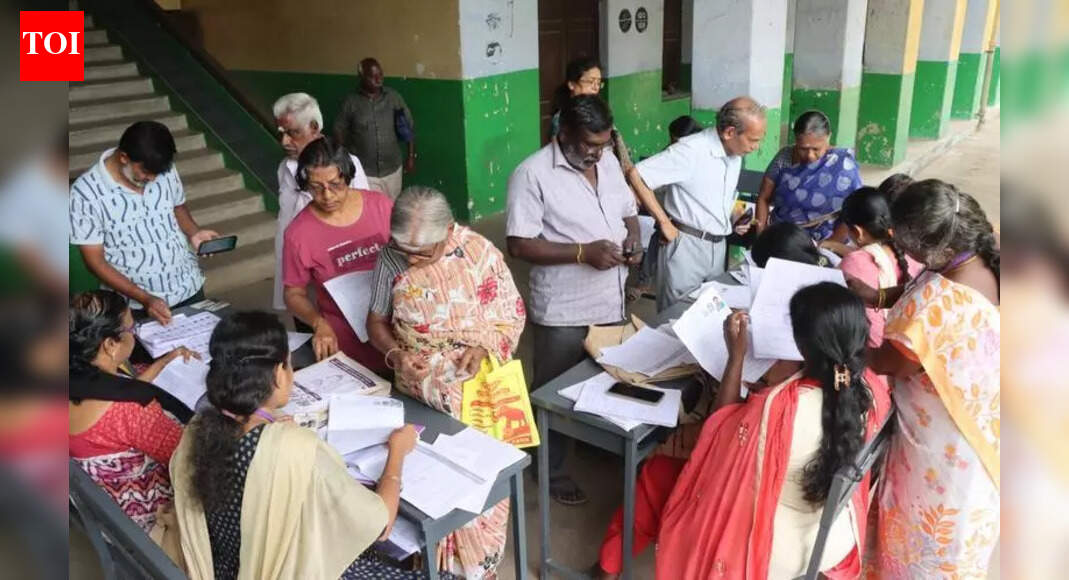
File photo NEW DELHI: Tamil Nadu chief electoral officer Archana Patnaik on Friday said the draft electoral roll, after the Special Intensive Revision (SIR), for the state now includes 5,43,76,755 voters, comprising 2.66 crore women and 2.77 crore men.She said that prior to the SIR, the poll-bound state had around 6.41 crore registered voters, and the exercise led to the deletion of 97,37,832 names from the rolls.According to Patnaik, the deletions included 26.94 lakh voters who had died, 66.44 lakh voters who had permanently shifted or migrated, and 3,39,278 duplicate entries where individuals were found to be registered in more than one place.She added that among those marked as migrated, 66,44,881 persons were found not residing at their registered addresses after three rounds of door-to-door verification conducted across the state.The SIR in the DMK-ruled state was conducted amid vehement opposition by chief minister MK Stalin, whose party filed a petition in the Supreme Court against the major roll-revision exercise in the southern state.“To prevent this anti-democratic move, we convened an all-party meeting and passed a resolution condemning the SIR. The Election Commission’s decision to carry out a full revision of the electoral roll just months before the election is part of a well-planned strategy to delete legitimate voters,” CM Stalin said while criticising the Election Commission’s electoral roll sanitisation exercise.CM Stalin added that the same tactic was used earlier in Bihar, where lakhs of genuine voters were allegedly “removed from the list”. He also pointed out that opposition to this controversial process had first emerged from Tamil Nadu, after which the Congress leader Rahul Gandhi, who also happens to be the Lok Sabha leader of opposition, raised strong objections.“Even after a legal case was filed, the Election Commission did not give a satisfactory explanation,” CM Stalin said.Taking aim at AIADMK general secretary Edappadi K Palaniswami, CM Stalin accused him of “playing a double game” and being “afraid of the Election Commission due to his ties with the BJP.”He added that while migrant workers from Bihar had found livelihood and respect in Tamil Nadu, the Prime Minister was “playing political drama in Bihar for electoral gain.”SIR in BengalOn Tuesday, the Election Commission published a draft list of deleted voters after the SIR of the electoral rolls in West Bengal. The list features voters whose names were included in the state’s electoral rolls in 2025 but were deleted from the draft rolls of 2026.This came after the first phase of the SIR exercise ended on December 11. The second phase, which began after December 16, will involve the filing of claims and objections. The notice phase, which includes issuance, hearings, verification and decisions on enumeration forms, as well as disposal of claims and objections, will be carried out concurrently by Electoral Registration Officers (EROs).Parliament debate on SIRThe SIR issue was also debated and discussed at length during the Winter Session of the parliament, with the Leader of the Rajya Sabha JP Nadda and other key minister in the NDA government urging the opposition parties to come together to back the SIR of the electoral roll, while pointing out how West Bengal has seen a massive spike in its electorate from 4.8 crore to 7.6 crore since the last SIR in 2002.Nadda, citing ECI data during the debate in Rajya Sabha on electoral reforms, said the minimum increase in voters’ list of the 9 West Bengal districts bordering Bangladesh was 70 per cent since 2002, while the maximum had crossed 100 per cent. He shared that Uttar Dinajpur has witnessed the highest spike in electors at 105.5 per cent, Malda at 94.8 per cent, Murshidabad at 87.6 per cent, 24 Parganas at 83.5 per cent and Jalpaiguri at 82.3 per cent. What is SIRThe Election Commission of India (ECI) conducts a Special Intensive Revision (SIR) of electoral rolls to ensure the accuracy and completeness of voter lists ahead of major elections. The exercise involves a detailed door-to-door verification to identify and remove duplicate, shifted or deceased entries while enrolling new and first-time voters.Carried out under the Representation of the People Act, 1950, the SIR aims to maintain the integrity of the electoral rolls by updating demographic details and correcting inaccuracies.During the revision, booth-level officers visit households, verify electors’ details, and facilitate claims and objections. The process is a key part of the Commission’s voter roll management, ensuring that every eligible citizen is included and the rolls reflect the most current and authentic data before elections.About the AuthorTOI News DeskThe TOI News Desk comprises a dedicated and tireless team of journalists who operate around the clock to deliver the most current and comprehensive news and updates to the readers of The Times of India worldwide. With an unwavering commitment to excellence in journalism, our team is at the forefront of gathering, verifying, and presenting breaking news, in-depth analysis, and insightful reports on a wide range of topics. The TOI News Desk is your trusted source for staying informed and connected to the ever-evolving global landscape, ensuring that our readers are equipped with the latest developments that matter most.”Read MoreEnd of ArticleFollow Us On Social MediaVideosExplained: Why Bangladesh’s Fresh Unrest Ahead Of Polls Is One Of India’s Biggest Strategic WorriesWho Was Sharif Osman Hadi, The Anti-India Face Of Bangladesh Whose Death Has Set Dhaka AblazePakistan Embarrassed Globally As Saudi Deports 56000 Beggars Despite No Fly Lists And Warnings’Countries Like Us Must Stick Together’: Jaishankar And Dutch FM On Strengthening India-EU Ties’Can’t Breathe, You Are Killing Me’: Trapped Journalist Cries As Dhaka Protesters Torch Media HousesWinter Session Closes As Lok Sabha Skips Pollution Debate A Day After G RAM G Bill Sparks ChaosMidnight Drama Over VB-G RAM G Bill, Opposition Stage Overnight Protest, Sleep Outside ParliamentMuhammad Yunus Calls For Calm And Patience As Hadi Death Sparks Protests Arson And National MourningHadi Death Triggers Overnight Riots In Bangladesh With Arson And Anti-India Fury, Media Targeted’Abrupt Variation In Chenab River Flow’: Pakistan Cries Over Indus Water Treaty Suspension123PhotostoriesNot Switzerland, not Austria: This Indian destination feels surprisingly alpineHow to manifest your desires tonight on New Moon 2025 as per your date of birth8 animals that can be found only in AustraliaSanskrit baby girl names that means prosperity8 types of Panjiri to enjoy during winter seasonFrom ‘Shrimaan Shrimati’ to ‘Jaane Bhi Do Paro’: ‘Dhurandhar’ star Rakesh Bedi’s most loved tv showsKnow how to release your inner fear according to your birth date5 most expensive jewellery pieces from Amal Clooney’s luxury closetSHE Travels: 8 spiritual destinations to slow down and reset the soulArjun Kapoor’s evolving journey through a few defining films including Ek Villain Returns, Gunday and Singham Again123Hot Picksvb g ram gICICI Prudential AMCUAE RainGold rate todaySilver rate todayPublic Holidays DecemberBank Holidays DecemberTop TrendingTravis Kelce Retirement RumorsAnthony Richardson InjuryCAT ResultWNBASan Francisco GiantsCam SkatteboPuka NacuaJake PaulSidney CrosbyGisele Bndchen
NEW DELHI: Tamil Nadu chief electoral officer Archana Patnaik on Friday said the draft electoral roll, after the Special Intensive Revision (SIR), for the state now includes 5,43,76,755 voters, comprising 2.66 crore women and 2.77 crore men.She said that prior to the SIR, the poll-bound state had around 6.41 crore registered voters, and the exercise led to the deletion of 97,37,832 names from the rolls.According to Patnaik, the deletions included 26.94 lakh voters who had died, 66.44 lakh voters who had permanently shifted or migrated, and 3,39,278 duplicate entries where individuals were found to be registered in more than one place.She added that among those marked as migrated, 66,44,881 persons were found not residing at their registered addresses after three rounds of door-to-door verification conducted across the state.The SIR in the DMK-ruled state was conducted amid vehement opposition by chief minister MK Stalin, whose party filed a petition in the Supreme Court against the major roll-revision exercise in the southern state.“To prevent this anti-democratic move, we convened an all-party meeting and passed a resolution condemning the SIR. The Election Commission’s decision to carry out a full revision of the electoral roll just months before the election is part of a well-planned strategy to delete legitimate voters,” CM Stalin said while criticising the Election Commission’s electoral roll sanitisation exercise.CM Stalin added that the same tactic was used earlier in Bihar, where lakhs of genuine voters were allegedly “removed from the list”. He also pointed out that opposition to this controversial process had first emerged from Tamil Nadu, after which the Congress leader Rahul Gandhi, who also happens to be the Lok Sabha leader of opposition, raised strong objections.“Even after a legal case was filed, the Election Commission did not give a satisfactory explanation,” CM Stalin said.Taking aim at AIADMK general secretary Edappadi K Palaniswami, CM Stalin accused him of “playing a double game” and being “afraid of the Election Commission due to his ties with the BJP.”He added that while migrant workers from Bihar had found livelihood and respect in Tamil Nadu, the Prime Minister was “playing political drama in Bihar for electoral gain.”SIR in BengalOn Tuesday, the Election Commission published a draft list of deleted voters after the SIR of the electoral rolls in West Bengal. The list features voters whose names were included in the state’s electoral rolls in 2025 but were deleted from the draft rolls of 2026.This came after the first phase of the SIR exercise ended on December 11. The second phase, which began after December 16, will involve the filing of claims and objections. The notice phase, which includes issuance, hearings, verification and decisions on enumeration forms, as well as disposal of claims and objections, will be carried out concurrently by Electoral Registration Officers (EROs).Parliament debate on SIRThe SIR issue was also debated and discussed at length during the Winter Session of the parliament, with the Leader of the Rajya Sabha JP Nadda and other key minister in the NDA government urging the opposition parties to come together to back the SIR of the electoral roll, while pointing out how West Bengal has seen a massive spike in its electorate from 4.8 crore to 7.6 crore since the last SIR in 2002.Nadda, citing ECI data during the debate in Rajya Sabha on electoral reforms, said the minimum increase in voters’ list of the 9 West Bengal districts bordering Bangladesh was 70 per cent since 2002, while the maximum had crossed 100 per cent. He shared that Uttar Dinajpur has witnessed the highest spike in electors at 105.5 per cent, Malda at 94.8 per cent, Murshidabad at 87.6 per cent, 24 Parganas at 83.5 per cent and Jalpaiguri at 82.3 per cent. What is SIRThe Election Commission of India (ECI) conducts a Special Intensive Revision (SIR) of electoral rolls to ensure the accuracy and completeness of voter lists ahead of major elections. The exercise involves a detailed door-to-door verification to identify and remove duplicate, shifted or deceased entries while enrolling new and first-time voters.Carried out under the Representation of the People Act, 1950, the SIR aims to maintain the integrity of the electoral rolls by updating demographic details and correcting inaccuracies.During the revision, booth-level officers visit households, verify electors’ details, and facilitate claims and objections. The process is a key part of the Commission’s voter roll management, ensuring that every eligible citizen is included and the rolls reflect the most current and authentic data before elections.


