
File photo NEW DELHI: India is closing long-standing gender gaps in education, with girls now outperforming boys on several fronts. The latest National Statistics Office (NSO) data shows that the transition remains uneven — from near parity in school enrolment to a gradual shift in higher education outcomes.The ‘women and men in India 2025’ report shows female gross enrolment ratio (GER) exceeding male GER at all school stages and women accounting for 51.48% of total higher education pass-outs, even as the overall literacy gender gap remains at 14.4 percentage points.The data underscores a generational shift.While the overall literacy gap remains wide, it narrows sharply to 3.8 percentage points among youth aged 15–24, reflecting faster gains among younger cohorts.This marks a steady progression from earlier decades, with female literacy rising from 30.6% in 1981 to over 70% in recent estimates, though still trailing male literacy levels.At the school level, gender parity has effectively been achieved across primary to higher secondary stages, with girls not only matching, but exceeding boys in enrolment. Under the national education policy (NEP) framework, female enrolment is higher across foundational, preparatory, middle and secondary stages, while adjusted net enrolment rates (ANER) for girls at the secondary level have also surpassed boys in recent years.Dropout rates for both genders have declined between 2022-23 and 2024-25, with sharper reductions at preparatory and middle stages, although secondary-stage dropouts remain comparatively higher.In higher education, the trend is gradually tilting in favour of women. Female GER increased from 28.5% to 30.2%, compared to a smaller rise for males from 28.3% to 28.9% between 2021-22 and 2022-23. Women now account for a marginal majority of total pass-outs, with particularly high representation at advanced levels such as MPhil (76.14%), and over half of undergraduate and postgraduate completions.However, participation remains uneven across disciplines. Women are concentrated in arts, sciences, social sciences and medical streams, while men continue to dominate engineering, technology, IT and management, reflecting persistent segmentation in career pathways.Learning outcomes show a mixed pattern. Girls consistently outperform boys in languages and board examination pass percentages, while boys perform better in mathematics, particularly at higher grades. At the same time, female participation in higher education now spans over half of total enrolments in several disciplines, signalling broader access even as subject choices remain skewed.Despite improvements in access and participation, structural gaps remain. The mean years of schooling for women stands at 7.4 years, compared to an overall average of 8.4 years, indicating earlier drop-off in educational attainment. Spending patterns also reflect disparity, with average annual expenditure higher for boys (Rs 13,901) than for girls (Rs 12,101), pointing to continued differences in investment at household level.About the AuthorManash Pratim GohainManash Pratim Gohain is a seasoned journalist with over two decades at The Times of India, where he has built a rich body of work spanning education policy, politics, and governance. Renowned for his incisive coverage of the National Education Policy (NEP) 2020, accreditation reforms, and skilling initiatives, he has also reported on student politics, urban policy, and social movements. His political reportage—both reflective and news-driven—adds depth to his writing, bridging policy with public impact. Through his 2,500 articles and related outlets, he has emerged as a trusted voice in national discourse, particularly in linking education reform to broader societal change.Read MoreEnd of ArticleFollow Us On Social MediaVideosChanakya Today Exit Poll: BJP Sweep In Bengal, DMK Ahead In TN, Assam Favours NDAUS Hands Back 657 Stolen Antiquities Worth $14 Million To India, Exposes Global Smuggling NetworksNaval Anti-ship Missile : Navy, Drdo Demonstrate Salvo Launch That Can Sink ShipsECI Introduces New QR Code Photo ID Rule To Prevent Unauthorised Entry At Counting CentresCCTV Shows Car Plunging Into Gorge In Una, Himachal | Tyre Burst Suspected, 2 KilledDelhi HC Freezes Sunjay Kapur Assets, Restrains Priya Kapur In High-Stakes Inheritance DisputeLet’s Not Choose For People: Supreme Court Pulls Up Centre Over Minor Rape Survivor’s Pregnancy Case’Sonia Gandhi Takes Decisions’: Congress President Kharge On Karnataka CM Change BuzzHafiz Saeed’s Aides Hunted Down: Lashkar-e-Taiba Loses Commanders to Mysterious KillingsRecord Bengal Turnout at 92.9%, SIR Row and Voter Surge Complicate Poll Reading123PhotostoriesMorning affirmation at 5am: The first thoughts you choose each morning shape everything afterFrom opening up about his troubled childhood and growing up in a violent home to facing bullying at school; Sidharth Bhardwaj recalls his traumatic pastThis Indian street food is crowned Prayagraj’s official signature dish8 South Indian dishes among the Top 100 Pancakes in the WorldVirat Kohli: 7 life lessons to learn from the RCB cricketerTV serials with strong woman leads, ‘Naamkaran’, ‘Neema Denzongpa and others- check the list hereHow to make Rajasthani Gatte Ka Pulao for summer dinner5 most crowded national parks in the USA; what travellers should knowGokuldham society’s plot twists that no one saw coming: From Tapu going bald to Babu Ji going to jailAishwarya Rai Bachchan to Deepika Padukone: The real price of Bollywood’s most expensive sarees explained123Hot PicksExit Poll Result 2026Bengal Election 2026Bengal ElectionPM ModiAjay Pal SharmaBengal Poll RecordHimanta Biswa SarmaTop TrendingPune Gas LeakBengaluru Wall CollapseVande Bharat expressDelhi NewsPawan KheraTripura Madhyamik Result 2026CBSE Class 12th ResultMumbai Police DeathBSE AP SSC Class 10th ResultIPL Orange Cap

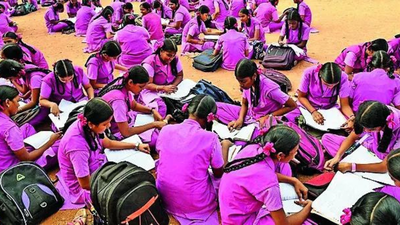
NEW DELHI: India is closing long-standing gender gaps in education, with girls now outperforming boys on several fronts. The latest National Statistics Office (NSO) data shows that the transition remains uneven — from near parity in school enrolment to a gradual shift in higher education outcomes.The ‘women and men in India 2025’ report shows female gross enrolment ratio (GER) exceeding male GER at all school stages and women accounting for 51.48% of total higher education pass-outs, even as the overall literacy gender gap remains at 14.4 percentage points.The data underscores a generational shift.While the overall literacy gap remains wide, it narrows sharply to 3.8 percentage points among youth aged 15–24, reflecting faster gains among younger cohorts.
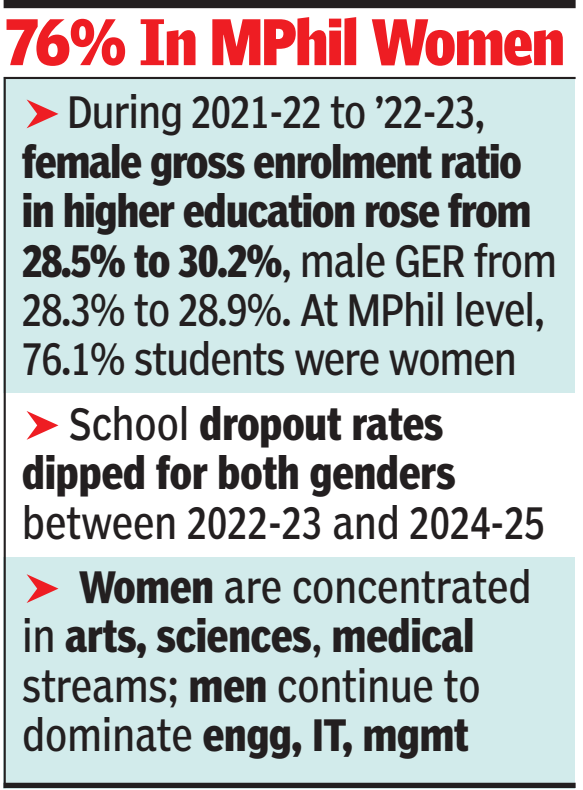
This marks a steady progression from earlier decades, with female literacy rising from 30.6% in 1981 to over 70% in recent estimates, though still trailing male literacy levels.At the school level, gender parity has effectively been achieved across primary to higher secondary stages, with girls not only matching, but exceeding boys in enrolment. Under the national education policy (NEP) framework, female enrolment is higher across foundational, preparatory, middle and secondary stages, while adjusted net enrolment rates (ANER) for girls at the secondary level have also surpassed boys in recent years.Dropout rates for both genders have declined between 2022-23 and 2024-25, with sharper reductions at preparatory and middle stages, although secondary-stage dropouts remain comparatively higher.In higher education, the trend is gradually tilting in favour of women. Female GER increased from 28.5% to 30.2%, compared to a smaller rise for males from 28.3% to 28.9% between 2021-22 and 2022-23. Women now account for a marginal majority of total pass-outs, with particularly high representation at advanced levels such as MPhil (76.14%), and over half of undergraduate and postgraduate completions.However, participation remains uneven across disciplines. Women are concentrated in arts, sciences, social sciences and medical streams, while men continue to dominate engineering, technology, IT and management, reflecting persistent segmentation in career pathways.Learning outcomes show a mixed pattern. Girls consistently outperform boys in languages and board examination pass percentages, while boys perform better in mathematics, particularly at higher grades. At the same time, female participation in higher education now spans over half of total enrolments in several disciplines, signalling broader access even as subject choices remain skewed.Despite improvements in access and participation, structural gaps remain. The mean years of schooling for women stands at 7.4 years, compared to an overall average of 8.4 years, indicating earlier drop-off in educational attainment. Spending patterns also reflect disparity, with average annual expenditure higher for boys (Rs 13,901) than for girls (Rs 12,101), pointing to continued differences in investment at household level.


