
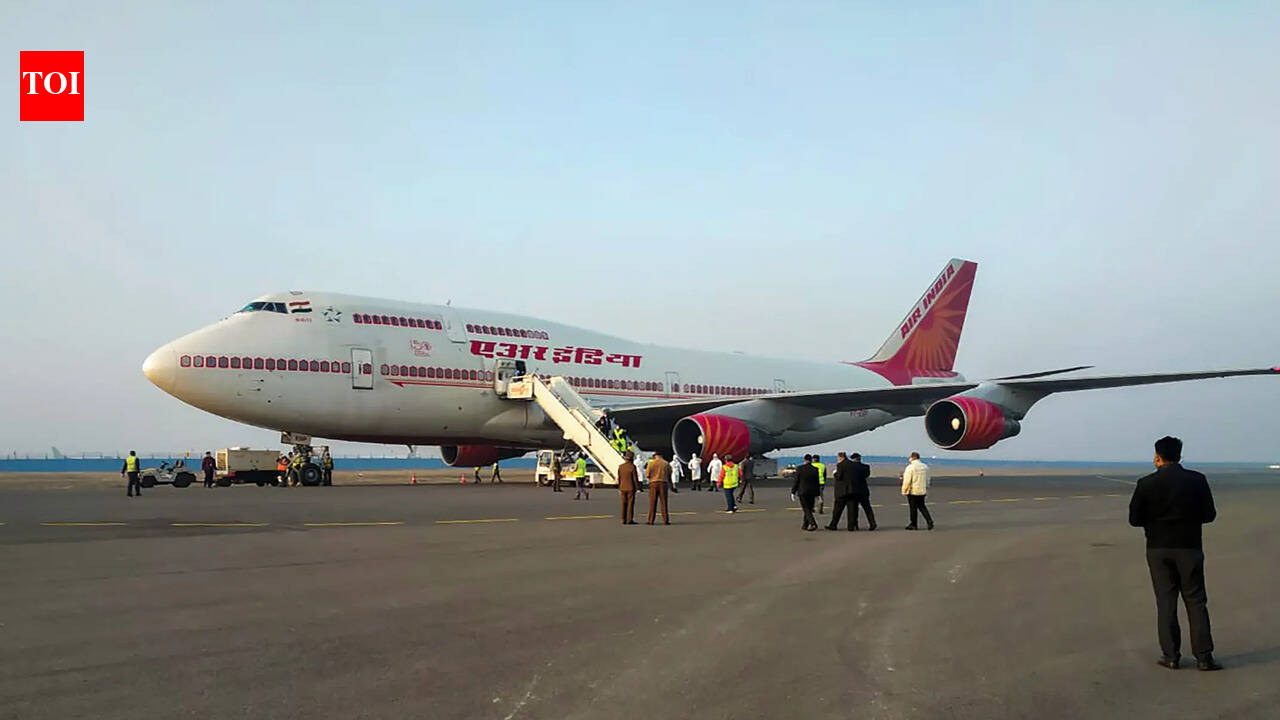
File photo MUMBAI: In a development with direct implications for the investigation into the June 12 fatal Air India Boeing 787 Ahmedabad crash, another Air India Dreamliner saw a fuel control switch move from “run” to “cut-off” after a crew member pressed it to check whether it was locked.The switch moved without the required lift action, suggesting the safeguard meant to prevent fuel supply cut off and inadvertent engine shutdown did not function as designed, sources said. The London incident challenges the controversial narrative that the Ahmedabad crash resulted from a deliberate pilot act, pointing instead to a possible and critical technical flaw in the aircraft’s fuel switch design.The incident occurred on Feb 1 at London Heathrow during engine start of B787 (VT-ANX) operating the 9.05pm Air India flight AI-132 to Bengaluru. The fuel control switches on the 787 require a two-step action: they must be lifted before they can be moved between “run” and “cut-off”. The safety feature is intended to prevent inadvertent fuel shutdown.What happened at Heathrow? “The pilot lightly pushed the left fuel control switch to check if its lock feature was working and found it was not because the switch moved though it was not lifted first,” the source said. It again failed to lock the second time. But the third time the switch stayed locked and did not move without lifting. The aircraft departed at 9.40pm for Bengaluru, where it is currently grounded.India’s Aircraft Accident Investigation Bureau (AAIB), in its preliminary report released last July, said that both fuel control switches on the ill-fated aircraft had moved from “run” to “cut off” seconds after takeoff. The report said one pilot asked the other why did he cut off the fuel, to which the other responded that he did not do so.UK incident challenges claim AI fuel switch movement was manual: ExpertIndia’s Aircraft Accident Investigation Bureau (AAIB), in its preliminary report, added that no technical or design flaw was found with the aircraft so far, implying pilot action. Therafter, the DGCA mandated an inspection of the fuel switch locking system. Air India later announced that it completed these inspections and found no faults. But the London incident brings back to fore the unresolved question around switch design, its locking integrity and the possibility of inadvertent activation, said sources.A senior commander said: “The London incident directly challenges the assumption that fuel switch movement in the Air India crash was manual. Until now, the cut-off transition was treated as near-conclusive evidence of pilot action. The London event shows that uncommanded switch behaviour, through mechanical detent failure, signal corruption or other causes, is a credible failure mode. That places the DGCA’s earlier claim of fleet clearance under sharp scrutiny, as a defect appearing months later suggests inspections may have been visual, non-diagnostic, or incomplete. For the AAIB, the implication is clear: fuel cutoff can no longer be equated with intent, the investigation must widen to fleet-level and component analysis, and attribution of deliberate pilot action without fully eliminating system anomalies is no longer defensible.”Air safety expert Capt Amit Singh said: “The London incident is particularly concerning because in 2018 the US aviation regulator cautioned that fuel control switches on Boeing 787s could malfunction and lead to inadvertent engine shutdown. Occurring after Air India said its fleet’s fuel control switches have been checked, and amid the ongoing June 12 B787 crash investigation, it raises serious questions about inspection adequacy and demands the highest level of regulatory scrutiny.”Air India, in a statement, said: “We are aware that one of our pilots has reported a possible defect on the fuel control switch of a Boeing 787-8 aircraft. After receiving this initial information, we have grounded the said aircraft and are involving the OEM to get the pilot’s concerns checked on a priority basis. The matter has been communicated to the aviation regulator, DGCA. Air India had checked the fuel control switches on all Boeing 787 aircraft in its fleet after a directive from the DGCA, and had found no issues.” Boeing said: “We are in contact with Air India and are supporting their review of this matter”.About the AuthorManju VManju V, senior Editor at the Times of India in Mumbai writes on civil aviation.End of ArticleFollow Us On Social MediaVideosTrump Announces India-US Trade Deal, Reduces Reciprocal Tariffs On Delhi To 18%; PM Modi ReactsAir India Grounds Dreamliner After Pilot Flags Fuel Control Switch Issue in London-Bengaluru Flight’Nonsense, Lies’: BJP Blasts Rahul Gandhi For Citing Ex-Army Chief Naravane’s Memoir, Oppn Hits BackChina Slams Dalai Lama’s Grammy Win, Calls It Political Manipulation Warns Against Anti-China MovesShowdown In Parliament As Rahul Gandhi Quotes Ex-Army Chief Naravane’s Book on China’Arrogant, Liar’: Bengal CM Mamata Banerjee Attacks CEC Gyanesh After SIR Meet In DelhiPak Analyst Rips Munir Over Trump Minerals Pitch And IMF Loans After US Snubs Pakistan On Pax SilicaBalochistan Crisis: Pakistan-Origin Commentator Takes Apart Islamabad, Exposes Lies On India’India Showed…’: Ex-Army Chief Naravane’s Remarks On Galwan Clash Resurface After Lok Sabha Row’Faster Than BrahMos’: DRDO Calls New Hypersonic Anti Ship Missile A Game Changer For India123PhotostoriesHow to make South Indian Beetroot and Paneer Paniyaram for breakfast at home10 best travel ideas for Valentine’s Day 2026 weekend9 comforting amla dishes ideal for winter months10 luxury bikes that blend power, precision, and prestige‘The 50’, ‘Bigg Boss’, ‘Laughter Chef’: Celebrity reality shows that never fail to entertainHrithik Roshan shares his post-workout meal photo and it is plateful of things we all loveKriti Sanon pens a special note for ‘Special Friend’ after Nupur Sanon’s Hindu wedding- See pictures8 ways to experience a different side of DelhiJustin Bieber’s performance to Lola Young’s win: Highlights from the 68th Annual Grammy Awards nightTop 10 countries in the world by GDP (2026 Projections); check India’s position123Hot PicksBudget 2026Gold Silver PricesCigarette Prices HikeIndia US TradeIncome Tax CalculatorPublic holidays February 2026Bank Holidays februaryTop TrendingSuper Bowl HalftimeMLB Trade RumorsFernando MendozaTom BradyTampa Bay LightningNHL Trade RumorsTop YouTube ChannelsRyan ClarkQuinn HughesJoel Embiid
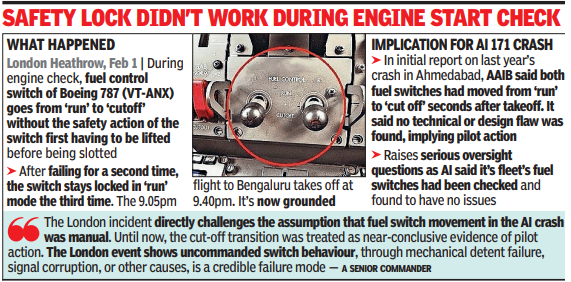
MUMBAI: In a development with direct implications for the investigation into the June 12 fatal Air India Boeing 787 Ahmedabad crash, another Air India Dreamliner saw a fuel control switch move from “run” to “cut-off” after a crew member pressed it to check whether it was locked.The switch moved without the required lift action, suggesting the safeguard meant to prevent fuel supply cut off and inadvertent engine shutdown did not function as designed, sources said. The London incident challenges the controversial narrative that the Ahmedabad crash resulted from a deliberate pilot act, pointing instead to a possible and critical technical flaw in the aircraft’s fuel switch design.The incident occurred on Feb 1 at London Heathrow during engine start of B787 (VT-ANX) operating the 9.05pm Air India flight AI-132 to Bengaluru. The fuel control switches on the 787 require a two-step action: they must be lifted before they can be moved between “run” and “cut-off”. The safety feature is intended to prevent inadvertent fuel shutdown.
What happened at Heathrow?
“The pilot lightly pushed the left fuel control switch to check if its lock feature was working and found it was not because the switch moved though it was not lifted first,” the source said. It again failed to lock the second time. But the third time the switch stayed locked and did not move without lifting. The aircraft departed at 9.40pm for Bengaluru, where it is currently grounded.India’s Aircraft Accident Investigation Bureau (AAIB), in its preliminary report released last July, said that both fuel control switches on the ill-fated aircraft had moved from “run” to “cut off” seconds after takeoff. The report said one pilot asked the other why did he cut off the fuel, to which the other responded that he did not do so.UK incident challenges claim AI fuel switch movement was manual: ExpertIndia’s Aircraft Accident Investigation Bureau (AAIB), in its preliminary report, added that no technical or design flaw was found with the aircraft so far, implying pilot action. Therafter, the DGCA mandated an inspection of the fuel switch locking system. Air India later announced that it completed these inspections and found no faults. But the London incident brings back to fore the unresolved question around switch design, its locking integrity and the possibility of inadvertent activation, said sources.A senior commander said: “The London incident directly challenges the assumption that fuel switch movement in the Air India crash was manual. Until now, the cut-off transition was treated as near-conclusive evidence of pilot action. The London event shows that uncommanded switch behaviour, through mechanical detent failure, signal corruption or other causes, is a credible failure mode. That places the DGCA’s earlier claim of fleet clearance under sharp scrutiny, as a defect appearing months later suggests inspections may have been visual, non-diagnostic, or incomplete. For the AAIB, the implication is clear: fuel cutoff can no longer be equated with intent, the investigation must widen to fleet-level and component analysis, and attribution of deliberate pilot action without fully eliminating system anomalies is no longer defensible.”Air safety expert Capt Amit Singh said: “The London incident is particularly concerning because in 2018 the US aviation regulator cautioned that fuel control switches on Boeing 787s could malfunction and lead to inadvertent engine shutdown. Occurring after Air India said its fleet’s fuel control switches have been checked, and amid the ongoing June 12 B787 crash investigation, it raises serious questions about inspection adequacy and demands the highest level of regulatory scrutiny.”Air India, in a statement, said: “We are aware that one of our pilots has reported a possible defect on the fuel control switch of a Boeing 787-8 aircraft. After receiving this initial information, we have grounded the said aircraft and are involving the OEM to get the pilot’s concerns checked on a priority basis. The matter has been communicated to the aviation regulator, DGCA. Air India had checked the fuel control switches on all Boeing 787 aircraft in its fleet after a directive from the DGCA, and had found no issues.” Boeing said: “We are in contact with Air India and are supporting their review of this matter”.


