
Emperor penguins survive Antarctica’s brutal winters by huddling together, but a maths study reveals the hidden system behind their remarkable teamwork

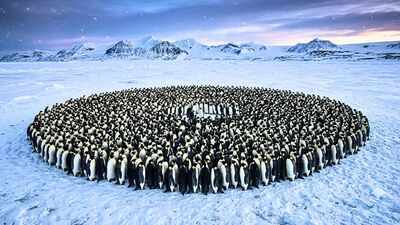
Every winter in Antarctica, emperor penguins gather in large groups called huddles to survive the cold. Temperatures can fall to -40 degrees Celsius, and strong winds make the weather even harsher. Without huddling together, these penguins would not be able to survive.But a penguin huddle is much more than a group of birds standing close together. The penguins keep moving all the time, slowly, so every bird eventually gets a chance to stand in the warmer centre of the group. The study found that this fair sharing happened under different wind strengths, different group sizes and different levels of random movement. The researchers also said that the study does not rule out the possibility that penguins sometimes behave in ways that help the whole group. However, their model shows that such behaviour is not needed to explain why the warmth is shared so evenly among the birds.
How the penguin huddle helps birds survive Antarctica
The study, titled “Modeling Huddling Penguins,” was published in PLOS ONE by Aaron Waters, François Blanchette and Arnold D. Kim from the Department of Applied Mathematics at the University of California, Merced. The researchers built a computer model based on one simple idea: every penguin tries to reduce its own heat loss. The model does not assume that the penguins are trying to help the whole group. Instead, each penguin is simply trying to stay as warm as possible.In the model, the penguins stand close together in a hexagonal pattern, similar to real huddles. The researchers calculated how the wind moved around the huddle and how warm or cold different parts of the group became.Whenever one penguin moved, the shape of the huddle changed. The scientists then calculated the wind and temperature again. The penguin losing the most heat, usually one standing on the outer edge, moved to the safest and warmest place it could find on the sheltered side of the huddle. Penguins in the middle stayed where they were because they were already well protected. The model repeated this process many times to see how the huddle changed over time.
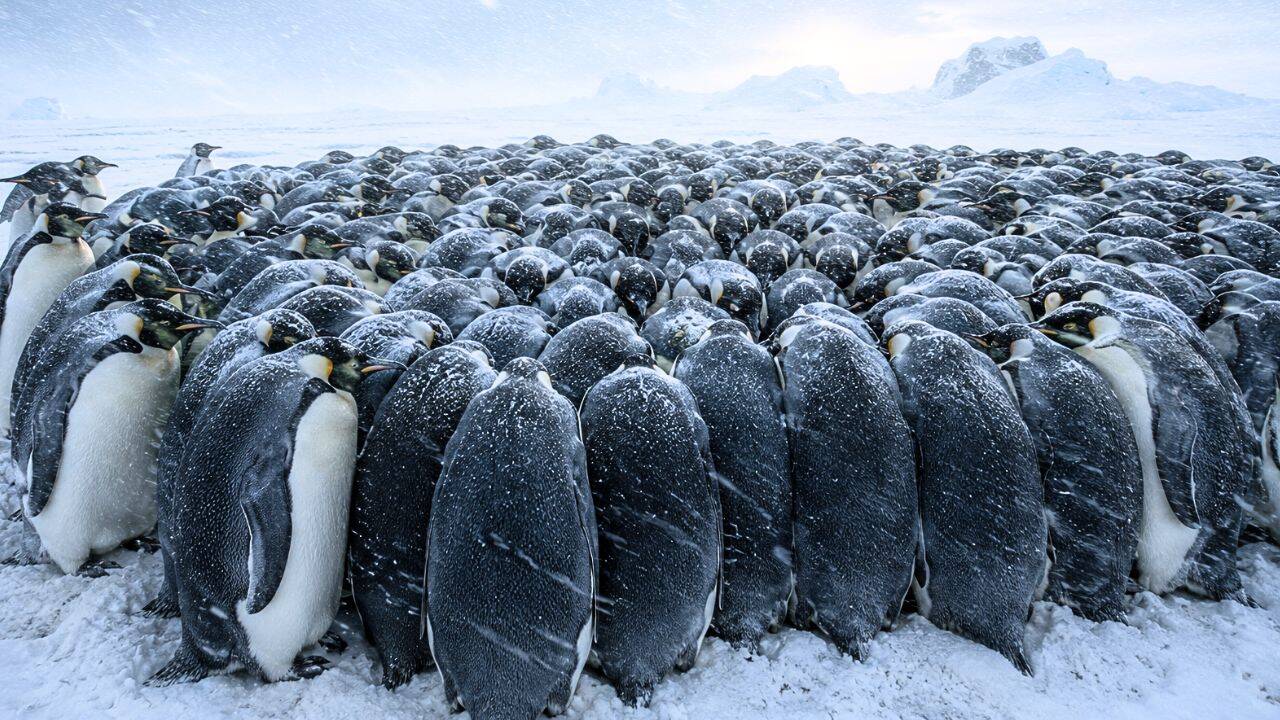
PC: AI Generated
How emperor penguins move inside the huddle
The study found that the penguins standing on the side facing the wind lose the most heat. These penguins slowly move around the outside of the huddle to the sheltered side, where they are better protected from the wind.As this keeps happening, the whole huddle slowly moves in the same direction as the wind. This matches what scientists have seen in real emperor penguin huddles, which are always moving very slowly instead of staying in one place.The strength of the wind also changes the shape of the huddle. When the wind is light, the huddle stays more round. As the wind becomes stronger, the huddle becomes longer and stretches in the direction of the wind.The researchers also added some random movement to make the model more realistic. In real life, penguins cannot always find the warmest place perfectly because of uneven ground, changing winds or small movements inside the group. Adding a small amount of random movement made the computer model look much more like real penguin huddles. Too much random movement, however, produced round huddles that hardly moved at all.
Why every penguin gets a turn in the warm centre
One of the most interesting findings of the study was that every penguin eventually gets a chance to stand in the warm centre of the huddle.Even though each penguin is only trying to keep itself warm, the result is that the warmth is shared quite evenly among the whole group.The researchers measured how long each penguin had to wait before becoming the most exposed bird on the edge and moving again. They found that the waiting times were very similar for all the penguins. This means that, over time, every bird moves between the cold outer edge and the warmer centre.The researchers concluded that when each penguin simply tries to reduce its own heat loss, every penguin ends up getting a similar chance to enjoy the warmth in the middle of the huddle. In other words, the equal sharing of warmth happens naturally because of the way the penguins move, along with the effects of wind and heat.


