
Delhi’s Malviya Nagar fire: Can the owner be charged with culpable homicide?

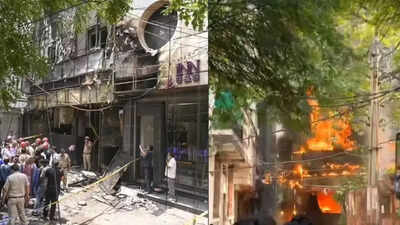
NEW DELHI: The fire at Flourish Stay B&B in south Delhi’s Malviya Nagar that claimed at least 21 lives may trigger a criminal investigation similar to the one seen after the 2022 Mundka fire, where Delhi Police invoked culpable homicide charges against building owners. This time, the FIR has already been filed and the owner is absconding.Flourish Stay B&B was registered under the Delhi government’s Bed and Breakfast scheme, which allowed it to operate six rooms. But it was running 25, including rooms in the basement. The building — a basement, ground floor and five upper floors — had only one entry and exit. It was operating without a fire NOC. The Lemon Green restaurant occupied the ground floor and rest of the building was the hotel.Most of the 21 dead were foreign nationals from Central Asia and Africa — medical tourists staying near Max Hospital in Saket. At least 26 remain critically injured.Delhi Police have registered an FIR under provisions of the Bharatiya Nyaya Sanhita dealing with culpable homicide not amounting to murder and negligent conduct. The owner, identified as Lokesh Bajaj, is absconding.MCD’s standing committee chairperson Satya Sharma said orders have been given for an investigation.“How old is the building, who is the owner — all these details are being collected. Action will be taken against all those responsible for negligence,” she said.In the 2022 Mundka fire that killed 27, Delhi Police booked owners under culpable homicide, alleging they knew of serious fire safety violations but continued operations regardless. The Malviya Nagar case presents an almost identical scenario — unauthorised construction, no fire clearance, a single exit, and mass casualties.Culpable homicide not amounting to murder under Section 105 of BNS requires establishing that the accused knew their actions were likely to cause death, even without an intention to kill. Running an overcrowded, illegally modified building without fire clearances, where guests had no escape route, provides exactly that foundation.What is the legal road aheadThe charge is legally sustainable given what has emerged so far, says Vivek Narayan Sharma, Senior Counsel and Constitutional Expert at the Supreme Court of India.“If the allegations presently emerging from the investigation are found to be correct, this case appears to transcend the realm of mere negligence and enter the domain of criminal culpability under Section 105 of the Bharatiya Nyaya Sanhita. Operating a premises allegedly permitted for six rooms, as a 25-room establishment, including basement occupancy, without a valid fire NOC and other statutory permissions and with only a single exit route, points towards a conscious disregard of known safety risks,” he said.The investigation would likely focus on whether the establishment had a valid eating house licence, a functional fire NOC, and whether occupancy limits were violated. Investigators will scrutinise building sanction plans, fire NOC validity records, inspection reports, and any prior notices issued for violations. If authorities find that notices were issued but never enforced, questions will arise over administrative negligence as well.“Equally important is the examination of regulatory oversight. If violations existed for a prolonged period despite inspections, complaints or official records, questions of administrative accountability will inevitably arise. The tragedy also exposes repeated systemic concerns regarding the monitoring of hotels, guest houses and hospitality establishments operating beyond sanctioned limits,” Sharma said.“The law distinguishes between an unforeseen accident and a disaster that becomes foreseeable because repeated safety norms are knowingly ignored. If the prosecution establishes prior knowledge of the risks and continued operation despite those risks, criminal liability may extend far beyond ordinary negligence,” he further added.Green Residency, located just 100 metres from the fire site, was found to be running 28 rooms on a six-room permit. Its fire NOC is also under the scanner. Both establishments were openly listed on online travel platforms, raising questions about how regulatory agencies failed to act for years, and whether online travel aggregators bear any due diligence responsibility.


