
China Missile Launch: A missile launch, a nuclear message: Why China wanted the US to take notice

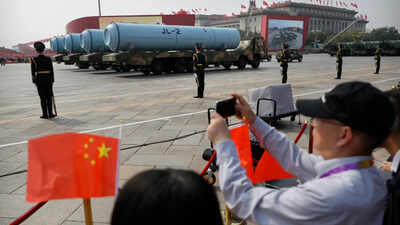
China’s rare launch of a long-range ballistic missile from a nuclear-powered submarine into the South Pacific this week was aimed at sending a strategic message primarily to the United States rather than Pacific nations, according to experts.The test, which drew criticism from the US and several Indo-Pacific countries, highlighted Beijing’s rapidly expanding nuclear capabilities and demonstrated a key milestone in China’s military modernisation.It was China’s second publicly acknowledged long-range missile launch into the Pacific in two years.Although Beijing described the launch as part of routine annual military training, analysts said the missile test underscored China’s growing ability to threaten the US mainland with sea-based nuclear weapons.
A demonstration of China’s nuclear deterrent
Experts cited by news agency AP said that the missile launch showcased the sea-based leg of China’s nuclear triad, the ability to launch nuclear weapons from land, air and sea.“The most important message is the PLA is becoming a powerful military with a very strong strategic nuclear capability,” Tong Zhao, senior fellow with the Nuclear Policy Program at the Carnegie Endowment for International Peace, told AP.The missile was launched from a nuclear-powered ballistic missile submarine, demonstrating what military analysts describe as a second-strike capability, the ability to retaliate with nuclear weapons even after suffering a first nuclear attack.Dominic Meagher, a research fellow at the Crawford School of Public Policy in Australia, said that this means China’s nuclear forces could survive an initial strike because launch platforms can operate from both land and the open ocean.The launch also signals that Beijing is steadily strengthening its sea-based deterrent. AP reported that China has been expanding its fleet of nuclear-powered submarines at a faster pace than the United States over the past five years.K Tristan Tang, a Nonresident Fellow at the National Bureau of Asian Research, said the launch should not be viewed as an isolated event.“I would see this as a systematic move, not an isolated event,” Tang said.
Why the US is concerned
The missile test comes amid intensifying strategic competition between Washington and Beijing.Earlier, US state department spokesperson Tommy Pigott accused China of rapidly expanding its nuclear arsenal while the US was working to curb nuclear proliferation.“At a time when the United States is working harder than ever to prevent nuclear proliferation, China is doing the opposite,” Pigott said.He described Beijing’s “rapid and opaque nuclear weapons buildup” as a matter of concern for both the region and the wider international community, and urged China to participate in meaningful arms control discussions.Analysts cited by news agency AFP said the launch demonstrated China’s growing ability to target the continental United States from waters close to its own coastline, significantly improving the survivability of its nuclear forces.
Pacific nations raise alarm
While experts said the message was primarily directed at Washington, the launch sparked strong reactions across the Pacific, where memories of Cold War-era nuclear testing remain vivid.The missile landed within the South Pacific Nuclear Free Zone, established under the 1986 Treaty of Rarotonga, which prohibits nuclear weapons throughout the region.For many Pacific Island nations, the launch revived painful memories of decades of nuclear testing conducted by the United States, France and the United Kingdom, which caused long-term environmental damage and health problems.“Those tests resulted in outrage and resulted in treaties to prevent future tests,” Meagher told AP.Solomon Islands Prime Minister Matthew Wale criticised the launch, saying: “China is a good friend of Solomon Islands, but this is not something a friend does. This is not … good in our region.”Australia and New Zealand also complained they had received only limited advance notice, while Australian Prime Minister Anthony Albanese described the launch as “a provocative act by China which does destabilize the region.”Japan similarly voiced concern over China’s growing military activities.China, however, defended the launch, saying it had informed relevant countries in advance and that the exercise complied with international law.
Questions remain over the missile
Chinese authorities have disclosed few technical details about the launch.Taiwan’s National Security Council secretary-general Joseph Wu identified the missile as a JL-2 submarine-launched ballistic missile fired from waters off Guangdong province.Chinese state media, however, quoted military experts suggesting it was instead a JL-3, a newer missile with a much longer range capable of striking targets across the Pacific from waters close to China.The uncertainty reflects the limited transparency surrounding China’s military programmes, analysts said.As China’s military capabilities continue to expand, experts believe Beijing will increasingly face the same level of international scrutiny applied to other major nuclear powers.“If China wants to become a major military power, it should be put under the same standards,” Zhao told AP.


