
Cambridge scientists create a living bio-battery that generates electricity around the clock using algae and could replace millions of disposable batteries

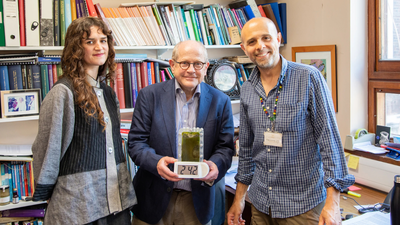
Researchers at the University of Cambridge have developed a living bio-battery that generates electricity continuously using photosynthetic algae, offering a potential alternative to millions of disposable batteries used in everyday electronics. Unlike conventional batteries that gradually run out of stored energy, the experimental device harnesses the natural flow of electrons produced by living cyanobacteria during photosynthesis and respiration, allowing it to produce a steady electrical current around the clock without harming the organisms. Although the technology currently generates only low levels of power, scientists believe it could one day provide a cleaner, longer-lasting energy source for low-power devices while significantly reducing battery waste.
How Cambridge scientists turned algae into a living battery
The project is the result of nearly two decades of research led by Dr Paolo Bombelli and Professor Chris Howe in the University of Cambridge’s Department of Biochemistry. Work on the technology began in 2006, driven by a simple question: could living organisms continuously generate electricity without being damaged?The answer turned out to be yes.“We’ve found a way to tap into a natural process in algae and use it to generate continuous electricity 24/7 without harming the plant at all,” said Dr Bombelli, who leads the scientific research behind the project.Unlike conventional batteries that store a finite amount of energy before running flat, the Cambridge device functions as a biocell, producing electricity continuously as long as the microscopic organisms inside remain alive.
How the living bio-battery works
The “algae” inside the device are actually photosynthetic cyanobacteria, microscopic aquatic organisms that first appeared billions of years ago and helped transform Earth’s atmosphere by producing oxygen through photosynthesis.Like plants, cyanobacteria absorb sunlight, water and carbon dioxide to produce energy for growth. During this process, electrons constantly move through the cells.Rather than allowing all of those electrons to remain inside the organism, the researchers found a way to capture a tiny fraction of them using an electrode without interfering with the bacteria’s normal biological functions. That steady flow of electrons becomes a continuous electrical current capable of powering small electronic devices.
Why the battery keeps producing electricity after sunset
One of the technology’s most surprising features is that it continues generating electricity even in complete darkness.During daylight, cyanobacteria convert sunlight into chemical energy through photosynthesis. At night, they switch to respiration, breaking down the energy they stored during the day to stay alive.That process also releases electrons, allowing the biocell to continue producing electricity around the clock.“Our aim is to get rid of the need for batteries altogether,” Bombelli said. “This is a completely new way to generate electricity that has the capacity to run and run, even when there’s no light at all, making it a much greener, longer-term alternative to traditional chemical batteries.”The team’s longest-running experimental system has now continued operating for more than six years, with the same living microorganisms still producing electricity.
Why researchers believe it could replace millions of disposable batteries
The Cambridge scientists are not trying to compete with lithium-ion batteries used in smartphones, laptops or electric vehicles. Instead, they are targeting the billions of small disposable batteries used every year in low-power electronics.Remote controls, digital clocks, smoke alarms, wireless sensors and Internet of Things (IoT) devices require only tiny amounts of electricity but collectively generate enormous quantities of battery waste.“Disposable batteries, which you just throw away when they stop working, are very bad for the planet and we want to use our biocells as a replacement,” said Professor Chris Howe, principal investigator of the project.“Our technology could replace millions of small disposable batteries with a much cleaner source of energy. That’s a huge environmental benefit and a really exciting prospect.”
Why the technology could be much greener than conventional batteries
Most disposable batteries rely on materials such as lithium, cobalt, nickel and manganese, which require mining and energy-intensive processing before they reach consumers. Their extraction is associated with greenhouse gas emissions, habitat destruction and other environmental impacts.The Cambridge biocell, by contrast, uses living cyanobacteria together with common, inexpensive and largely recyclable materials.Because the organisms continually regenerate their own energy through natural biological processes, the system does not need to be replaced once its stored energy is exhausted in the way conventional batteries do.
From powering clocks to monitoring crops
Although the technology cannot yet power high-energy devices, researchers see enormous potential for low-power applications.One of the team’s best-known demonstrations is an algae-powered digital clock, which has operated entirely using electricity generated by living cyanobacteria.Researchers have also developed a smart plant monitoring system that continuously measures soil moisture, air temperature and surrounding light.“We have sensors measuring light intensity around the plant, air temperature and soil moisture, all powered continuously by our biocell,” explained electrical engineer Lifu Tan.“We can look at this data on a connected phone app to know exactly what the plant needs, for example when to water it, so we can keep it thriving.”The researchers also believe the technology could eventually power environmental monitoring stations that measure water quality, pollution or soil conditions in remote areas where replacing batteries is difficult.
Why it could transform energy access in remote communities
The team believes living bio-batteries could prove particularly valuable in off-grid regions where reliable electricity remains limited.Professor Howe points to parts of sub-Saharan Africa, where mobile phone ownership is widespread but charging infrastructure can be scarce.If future versions of the technology produce higher power outputs, they could help provide sustainable electricity for communication devices, environmental sensors and agricultural monitoring equipment without depending on disposable batteries or constant access to the electrical grid.
From laboratory research to commercial products
Turning an experimental technology into something consumers can buy requires more than scientific discovery.To bridge that gap, the researchers have established the startup company e-Pho, working alongside bio-designer Lucia Giron to transform laboratory prototypes into practical products.“Knowing how the technology works is one thing, but transforming it into a product is a very different ball game,” Bombelli said.Giron, whose background combines art and sustainable design, has created several demonstration systems, including the algae-powered clock and a redesigned biocell aimed at future commercial applications.Since development began, Professor Howe says the team has increased the electrical output of the biocell by more than twenty-fold, making the technology increasingly practical for real-world use.
Inspiring the next generation of scientists
Alongside their commercial work, the Cambridge researchers have developed a Living Toolkit that allows school students to build working algae-powered systems and carry out their own experiments.The educational programme introduces pupils to biology, electronics, renewable energy and sustainable engineering while demonstrating how living organisms can become part of future energy technologies.“My view is that the school plant science curriculum isn’t very inspiring or contemporary,” Howe said. “We want to give schools something that demonstrates the significant applications of plant science in the modern world.”
The importance of the breakthrough
The Cambridge biocell represents a fundamentally different approach to generating electricity. Instead of relying on finite chemical reactions inside disposable batteries, it harnesses the natural metabolism of living microorganisms to produce a continuous trickle of renewable power. While the technology remains unsuitable for energy-intensive devices, it has the potential to transform how millions of low-power electronics are powered in homes, workplaces and remote locations.After nearly twenty years of research, the team’s focus is now shifting from proving the science to scaling the technology for practical use. If successful, living bio-batteries could one day reduce electronic waste, lower dependence on mined battery materials and offer a greener alternative for countless everyday devices that quietly consume disposable batteries today.


