
Brains without borders: US Fed named three PIOs to panels, choosing merit over MAGA hysteria

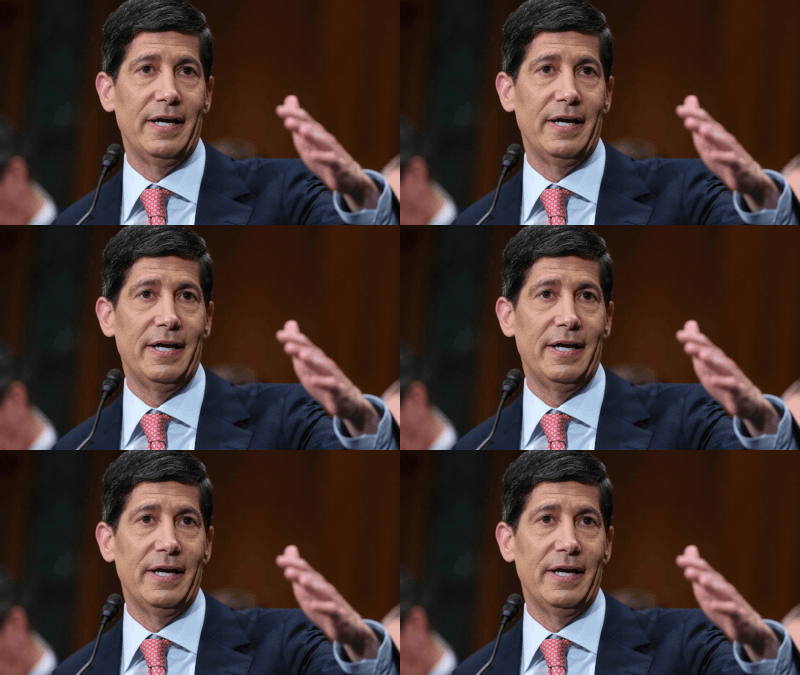
The TOI correspondent from Washington: At a moment when anti-immigrant rhetoric has become a staple of America’s political soundtrack and Indian immigrants have increasingly found themselves in the crosshairs of MAGA hardliners, the US Federal Reserve has delivered an unmistakably different message: when it comes to solving difficult problems, talent trumps tribalism.Fed chairman Kevin Warsh has unveiled the leadership of five high-powered task forces charged with rethinking the central bank’s approach to monetary policy and proposing what he called “transformational changes” to prepare the institution for a rapidly changing economy. Among the economists, former central bankers, academics and corporate executives tapped to lead the effort are three people of Indian origin – former RBI Governor Raghuram Rajan, Harvard economist Raj Chetty, and Microsoft Xbox chief executive Asha Sharma.“The goal is straightforward: To ensure the Fed is best positioned to achieve our objectives in this consequential time,” Warsh said while announcing the appointments. The symbolism is difficult to miss; as political rallies debate who belongs in America, the country’s — and arguably the world’s — most consequential economic institution has assembled a team that reflects where expertise actually comes from.Rajan, arguably the best-known of the trio in global financial circles, will co-chair the task force on Balance Sheet Policy, examining the costs, benefits and institutional implications of the Fed’s balance sheet long before the 2008 financial crisis humbled Wall Street’s brightest minds, the former IMF chief economist famously warned at the Fed’s annual Jackson Hole symposium that banks’ growing appetite for subprime lending posed systemic risks. His caution was dismissed at the time as unduly pessimistic, but history had other ideas.The former governor of India’s central bank and one-time chief economic adviser to the Indian government now serves as the Katherine Dusak Miller Distinguished Service Professor of Finance at the University of Chicago Booth School of Business, remaining one of the world’s most influential voices on finance and globalization.Joining him in the Fed’s intellectual reboot is Raj Chetty, the William A Ackman Professor of Public Economics at Harvard University, whose pioneering research has transformed economists’ understanding of social mobility and inequality. Chetty will serve on the Liquidity Dependence task force alongside former Fed governor Jeremy Stein, former Walmart chief executive Doug McMillon and University of Chicago economist Kevin Murphy. The panel will examine how dependent financial markets have become on central bank liquidity and what reforms may be needed to reduce those vulnerabilities.If Rajan represents central banking experience and Chetty academic rigor, Asha Sharma brings Silicon Valley’s innovation mindset. Born in Wisconsin to Indian immigrants and raised in the US, Sharma, CEO of Microsoft’s Xbox gaming division, will lead the Productivity and Employment task force. Her appointment comes only days after Microsoft announced one of the largest rounds of layoffs in Xbox’s recent history – a reminder that managing productivity in the age of artificial intelligence often means navigating uncomfortable economic trade-offs. Before leading Xbox, Sharma held senior leadership roles at Meta, Instacart, and Home Depot. She will work alongside venture capitalist Marc Andreessen and Stanford economist Chad Jones.The appointments also underscore a broader reality that American politics sometimes obscures. Indian-Americans, who account for little more than one percent of the US population, have become disproportionately represented in leadership positions across finance, technology, medicine, academia, and increasingly, public policy. Their prominence owes less to identity politics than to a decades-long pipeline of highly educated immigrants drawn by American universities and opportunities, many arriving on the now vilified H1b visas.For critics who insist immigrants are taking something away from America, the Fed has offered an inconvenient counterargument: in the business of safeguarding the world’s largest economy, it appears the central bank is less interested in where people were born than in whether they know how to keep inflation low, productivity high and financial crises at bay.


