
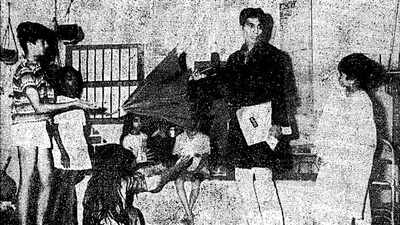
Babban Khan enacting the play In August 1965, when India and Pakistan were engaged in a desperate war on the northern borders, a 22-year-old penniless young man wrote a play in a little over three hours under the street-lights of the old city of Hyderabad. By the time its final curtain came down more than three and a half decades later in 2001, “Adrak Ke Panje’ had been performed more than 10,000 times – often to houseful boards, and occasionally requiring a lathi charge to control crowds – in over 60 countries and in dozens of languages.Babban Khan, who wrote, produced, directed and enacted the central role of a bank clerk in that iconic and blockbuster comedy, passed away after a brief illness at a Hyderabad hospital on Friday night. He was 83.In the 1960s and ‘70s, family planning was the focus of the government’s health policy. The sarkari slogan, “Do ya teen bacche…bas,” was common on billboards and a frequent subject of radio jingles. Later, the catchphrase became a sterner “Ek ya do”. “Adrak Ke Panje” (literally, The Claws of Ginger), addressed the problematic and provocative issue of family planning but in a witty and messy way. Which perhaps was a reason why the play – the title is a metaphor for uncontrolled birth — found the public’s pulse and tickled its funny bone.The protagonist clerk (Ramtoo) has eight kids and a bunch of debtors; from milkman to school master. Yet he never loses his sense of snappy humour and a carefree zest for life. The play’s set was basic. Production cost was minimal. But like a hit Hindi film, ‘Adrak Ke Panje’ would draw huge advance bookings. The actor was even invited to Radio Ceylon’s popular programme, “S Kumar’s ka filmi muqaddama”, generally reserved for Hindi film personalities. In time, the play would also find a place in Guinness Book of Records, and be seen, among others, by film director Francis Ford Coppola, actor Rex Harrison and thriller writer Frederick Forsythe.“Johnny Walker, the film comedian, said that for 15 years he had been making film audiences laugh, but here was a play that made him laugh!,” said a 1970 article in ‘The Illustrated Weekly of India.’Babban was untrained in theatre and had dropped out of college. ‘Adrak Ke Panje’ was born out of real-life experience and characters. His father, who worked in the fire department, died when he was six. “All my siblings died young…I somehow survived to tell the tale,” the playwright told TOI in 2001.Talking to TOI in 1995, the playwright revealed that he had sold his mother’s lone piece of wedding jewelry for Rs 275 to finance the play. “I paid Rs 200 as theatre rent, Rs 30 for printing tickets, Rs 2.50 for an umbrella and Rs 18 on the material for a sherwani, which the tailor stitched in return for a pass to the show,” he said. The first show staged in September 1965 was a flop. But the second wasn’t; it never was thereafter.Analysing the play Bilkiz Alladin wrote in the Weekly, “In the strict sense of the word ‘Adrak Ke Panje’ can hardly be called a play. It has no plot, no tense dramatic situations, and no conflict. It is a string of jokes from beginning to end. Yet one sits through it. Laughing, and one wonders that the end, which is really two hours away, has come so soon. It is very Hyderabadi in essence and flavour, in location, in thought and manner, and in its every little joke. To lovers of old Hyderabad and its Urdu dialects, the play brings a glimpse of the now disappearing, picturesque style of speech.”The play’s super success made Babban a lakhpati in the days when beggars would be happy with a five paisa donation. In a 1979 interview to TOI, Babban Khan admitted to owning three homes in Hyderabad’s swank Banjara Hills, selling off his Mercedes to buy a Volkswagen and decorating his house with Persian carpets, chandeliers and marble statues. By then, he had written another play “Gumbad Ke Kabutar” (Pigeons Of The Dome) which dealt with corruption.In later years, Babban’s home in Shantinagar served as a training centre for upcoming drama artistes and film actors. He personally trained the students. Hundreds of stage lovers and admirers turned up for the funeral on Saturday. Cricket commentator Harsha Bhogle wrote on X, “When we were kids growing up in Hyderabad, Babban Khan’s Adrak ke Panje was a big hit. Sadly, never got to see it and was reminded of it when I read the news of Babban Khan’s death. It ran for over 30 years and I wish now I could catch glimpses of it to celebrate the humour that came naturally to people who speak Dakhni.”(With inputs from Syed Akbar in Hyderabad)About the AuthorAvijit GhoshAvijit Ghosh is an associate editor with The Times of India. He is addicted to films, music, cricket and football—and not necessarily in that order. He is the author of Bandicoots in the Moonlight, Cinema Bhojpuri, 40 Retakes, and now, Up Campus, Down Campus, a novel set in 1980s JNU. He tweets from the handle @cinemawaleghoshRead MoreEnd of ArticleFollow Us On Social MediaVideosNo Fuel Shortage: Govt Assures 100% Domestic Gas Supply As India’s LPG Demand Falls 13% In MarchPM Modi Takes ‘Jhalmuri’ Break, Interacts With Locals In West Bengal’s Jhargram Amid Poll CampaignIndia Warns Iran Of Consequences After Attack On Two Tankers In Strait Of HormuzIndia Expands Export Relief After Hormuz Tensions Adds Egypt & Jordan To Shield Trade RoutesCongress Holds Protest After PM Modi’s Address To The Nation On Women’s Reservation Bill SetbackIndia’s Naval Push In Indo-Pacific: IOS Sagar Departs Phuket After Successful Thailand Port CallManipur Streets Erupt As Security Forces Fire Tear Gas On Protesters | WatchManipur Horror: Retired Soldier Among Two Shot Dead In Ukhrul Highway AttackWhat We Know About Indian Ships Hit In Hormuz Strait By Iran Gunboats And Unknown ProjectilePakistan Clears $2Bn UAE Debt As Saudi Extends $3Bn Deposit Term123Photostories5 style lessons from Amitabh Bachchan’s iconic wardrobeWhy you forget names instantly: It’s not your memory, it’s your attention, and here’s how to fix it5 Horror movies based on real-life events: ‘The Conjuring’, ‘The Exorcist,’ and moreTop 5 sneaker releases of 2026 you shouldn’t missBeautiful Indo-Arabic and Persian baby names quietly used in Indian familiesHe never drank alcohol, yet was diagnosed with severe fatty liver: What this says about modern diets and silent lifestyle risksHow to stop rice flour roti from cracking: 5 proven home tips to make soft and puffed rotiAs Deepika Padukone and Ranveer Singh announce second pregnancy, a look at Bollywood’s cutest pregnancy announcementsInside Cristiano Ronaldo and Georgina Rodríguez’s parenting style: How they’re raising grounded, disciplined teen sons7 factors driving property price growth in Indian metro cities123Hot PicksIran warDelimitation Bill DefeatPurple cap winnerOrange cap winnerIPL Points TablePublic holidays April 2026Bank Holidays AprilTop TrendingIPL Orange Cap 2026VijayPM Modi LiveWorld Largest EconomySue BirdIce SpicePahalgam Pony Wallah StoryWomen Quota BillE Coli Smuggling CaseErika Kirk Event

In August 1965, when India and Pakistan were engaged in a desperate war on the northern borders, a 22-year-old penniless young man wrote a play in a little over three hours under the street-lights of the old city of Hyderabad. By the time its final curtain came down more than three and a half decades later in 2001, “Adrak Ke Panje’ had been performed more than 10,000 times – often to houseful boards, and occasionally requiring a lathi charge to control crowds – in over 60 countries and in dozens of languages.Babban Khan, who wrote, produced, directed and enacted the central role of a bank clerk in that iconic and blockbuster comedy, passed away after a brief illness at a Hyderabad hospital on Friday night. He was 83.In the 1960s and ‘70s, family planning was the focus of the government’s health policy. The sarkari slogan, “Do ya teen bacche…bas,” was common on billboards and a frequent subject of radio jingles. Later, the catchphrase became a sterner “Ek ya do”. “Adrak Ke Panje” (literally, The Claws of Ginger), addressed the problematic and provocative issue of family planning but in a witty and messy way. Which perhaps was a reason why the play – the title is a metaphor for uncontrolled birth — found the public’s pulse and tickled its funny bone.The protagonist clerk (Ramtoo) has eight kids and a bunch of debtors; from milkman to school master. Yet he never loses his sense of snappy humour and a carefree zest for life. The play’s set was basic. Production cost was minimal. But like a hit Hindi film, ‘Adrak Ke Panje’ would draw huge advance bookings. The actor was even invited to Radio Ceylon’s popular programme, “S Kumar’s ka filmi muqaddama”, generally reserved for Hindi film personalities. In time, the play would also find a place in Guinness Book of Records, and be seen, among others, by film director Francis Ford Coppola, actor Rex Harrison and thriller writer Frederick Forsythe.“Johnny Walker, the film comedian, said that for 15 years he had been making film audiences laugh, but here was a play that made him laugh!,” said a 1970 article in ‘The Illustrated Weekly of India.’Babban was untrained in theatre and had dropped out of college. ‘Adrak Ke Panje’ was born out of real-life experience and characters. His father, who worked in the fire department, died when he was six. “All my siblings died young…I somehow survived to tell the tale,” the playwright told TOI in 2001.Talking to TOI in 1995, the playwright revealed that he had sold his mother’s lone piece of wedding jewelry for Rs 275 to finance the play. “I paid Rs 200 as theatre rent, Rs 30 for printing tickets, Rs 2.50 for an umbrella and Rs 18 on the material for a sherwani, which the tailor stitched in return for a pass to the show,” he said. The first show staged in September 1965 was a flop. But the second wasn’t; it never was thereafter.Analysing the play Bilkiz Alladin wrote in the Weekly, “In the strict sense of the word ‘Adrak Ke Panje’ can hardly be called a play. It has no plot, no tense dramatic situations, and no conflict. It is a string of jokes from beginning to end. Yet one sits through it. Laughing, and one wonders that the end, which is really two hours away, has come so soon. It is very Hyderabadi in essence and flavour, in location, in thought and manner, and in its every little joke. To lovers of old Hyderabad and its Urdu dialects, the play brings a glimpse of the now disappearing, picturesque style of speech.”The play’s super success made Babban a lakhpati in the days when beggars would be happy with a five paisa donation. In a 1979 interview to TOI, Babban Khan admitted to owning three homes in Hyderabad’s swank Banjara Hills, selling off his Mercedes to buy a Volkswagen and decorating his house with Persian carpets, chandeliers and marble statues. By then, he had written another play “Gumbad Ke Kabutar” (Pigeons Of The Dome) which dealt with corruption.In later years, Babban’s home in Shantinagar served as a training centre for upcoming drama artistes and film actors. He personally trained the students. Hundreds of stage lovers and admirers turned up for the funeral on Saturday. Cricket commentator Harsha Bhogle wrote on X, “When we were kids growing up in Hyderabad, Babban Khan’s Adrak ke Panje was a big hit. Sadly, never got to see it and was reminded of it when I read the news of Babban Khan’s death. It ran for over 30 years and I wish now I could catch glimpses of it to celebrate the humour that came naturally to people who speak Dakhni.”(With inputs from Syed Akbar in Hyderabad)


