
APJ Abdul Kalam’s legacy lives on in India’s missiles, space programme

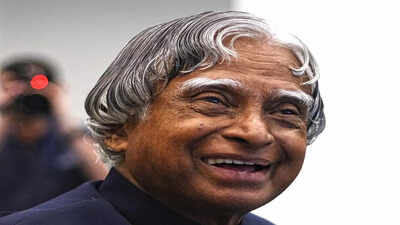
As India marks the death anniversary of former President Dr Avul Pakir Jainulabdeen Abdul Kalam, his contributions to expanding defence and space sectors remain central to his role in nation building. The scientist-statesman, born on October 15, 1931 in Tamil Nadu, Dr Abdul Kalam is remembered for running the country’s missile programme. His role remains a defining chapter in the nation’s quest for strategic autonomy. TheDr Kalam joined the Defence Research and Development Organisation’s (DRDO) aeronautical development establishment soon after graduating from the Madras Institute of Technology in 1960. The former President initiated expandable rocket work at DRDO in 1965 and visited NASA facilities in 1963–64. He then moved to the Indian National Committee for Space Research and worked under Vikram Sarabhai. Kalam joined ISRO in 1969 and became project director of the SLV-III, which successfully placed Rohini in orbit in 1980.As Project Director of the SLV-III, Kalam oversaw the launch of Rohini into near-earth orbit in July 1980, placing India among the select few with indigenous satellite launch capability. His leadership in evolving ISRO’s launch vehicle programme, particularly the PSLV, laid the foundation for India’s space ambitions. In 1982, he was moved to the Defence Research and Development Organisation to head the Integrated Guided Missile Development Programme (IGMDP), conceived by the then PM Indira Gandhi, the then defence minister R Venkataraman and the then DRDO chief VS Arunachalam. The programme sought to build domestic capability in critical missile technologies and under Dr Kalam’s guidance delivered the Agni, Akash, Nag and Prithvi missiles.India’s missile arsenal has since expanded into diverse families capable of roles ranging from anti-satellite missions to different battlefield support weapons. Agni, Pralay and BrahMos today dominate headlines, each representing a different type of missile that offers the country’s defence planners tactical to strategic options. Dr Kalam’s contribution was not merely technical; he built institutional networks to indigenise critical technologies. As the scientific adviser to the defence minister (1992–1999), he oversaw the weaponisation of strategic missile systems and the Pokhran-II nuclear tests, which cemented India’s position as a nuclear weapon state.Beyond defence, Kalam’s vision extended to national development. As chairman of Technology Information, Forecasting and Assessment Council (TIFAC), he led the Technology Vision 2020 exercise, which charted a roadmap to transform India into a developed nation. This panel published roadmaps to develop 16 technology sectors. His tenure as the principal scientific adviser and chairman of the Scientific Advisory Committee to the Cabinet (SAC-C) have also helped shape policies across different sectors. His ability to link scientific progress with national aspirations earned him the title of ‘People’s President’ when he assumed office in 2002.Dr Kalam’s legacy is embedded in India’s strategic autonomy, in the credibility of its deterrent, and in the confidence of its scientific community. On his death anniversary, the nation recalls not just the father of its missile programme, but a visionary who believed that technology, harnessed with purpose, could chart a more autonomous trajectory.


