
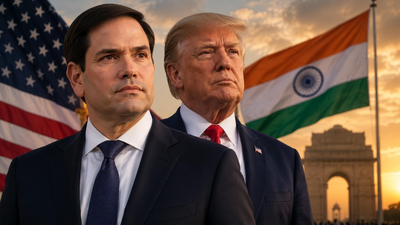
An AI-generated image The world’s most powerful nations aren’t competing over oil fields or trade routes anymore. They’re competing over India.When US Secretary of State Marco Rubio flies into New Delhi this weekend — straight from a NATO summit in Sweden — it tells you everything about where global power is shifting. This isn’t a courtesy call. It’s a recalibration.America Shows Up. But India Has Already Been Busy.US Ambassador Sergio Gor put the numbers plainly: bilateral trade between the US and India has grown from $20 billion to over $220 billion in two decades. An 11-fold increase. And Washington wants more.Rubio said it before boarding his flight: “We want to sell India as much energy as they can buy.” That’s not the language of a strategic alliance. That’s the language of a seller who knows the buyer has options.Because India does. Plenty of them.The queue outside India’s trade ministry is getting longerWhile Washington was preoccupied with tariff wars and geopolitical theatrics, New Delhi was signing deals.India–EU: The biggest Free Trade Agreement in India’s history. Prime Minister Modi called it the “mother of all deals” — covering 25% of global GDP and roughly a third of global trade.India–UK: A Comprehensive Economic and Trade Agreement, described by Britain’s own trade committee as its most economically significant bilateral FTA since Brexit. Bilateral trade already stands at $56 billion, with a target to double it by 2030.India–Oman: Signed in December 2025. Gulf Cooperation Council negotiations are active. Talks with Canada, Israel, and others are underway.America just joined the back of this queue.So what does India have that everyone wants?Three words: Scale. Trust. Talent.India is the world’s most populous nation. Its manufacturing ambitions are backed by real policy. Its technology talent pool stretches from Silicon Valley to semiconductors to pharmaceuticals. Its middle class is the fastest-growing consumer base on Earth.And critically — India keeps its word. When New Delhi signs a deal, it delivers. In a world of unreliable partners, that’s worth more than any tariff concession.The tensions beneath the smilesThis relationship isn’t without friction. After India launched Operation Sindoor — a precise military strike against terrorist infrastructure in Pakistan following the Pahalgam attack that killed 26 civilians — Washington complicated things.President Trump claimed, nearly 80 times, that he “helped settle” the India-Pakistan conflict. India’s response was unambiguous. Prime Minister Modi stated in Parliament that no foreign leader asked India to stop. External Affairs Minister Jaishankar confirmed there was no third-party intervention. No trade conditions. No phone calls between Modi and Trump from April 22nd through June 16th.India defined its operation. India ended it. On its own terms.Then came the optics. Pakistan’s Army Chief was hosted at a two-hour White House lunch. Pakistan nominated Trump for a Nobel Peace Prize. India said nothing. In Indian diplomacy, silence is often the loudest answer.Reliable partner or strategic hedge?The broader question hovering over every meeting in Rubio’s itinerary is simple: Can Washington still be trusted?The US imposed tariffs of up to 50% on Indian exports mid-2025 — 25% reciprocal, plus an additional 25% for India’s continued purchase of Russian oil. A partner that weaponizes trade during a security crisis is a partner you respect — and quietly diversify away from.India has been doing exactly that. Methodically. Brilliantly.What Rubio’s visit really meansRubio called the India-US relationship “the defining relationship of the 21st century.” That’s not rhetoric. That’s a country that looked at the scoreboard and recognized what the rest of the world already knows.India is indispensable.India will listen this weekend. It will engage. It will negotiate hard on energy, trade, defence, and technology. And it will remain exactly what it has always been — strategically autonomous, fiercely sovereign, and very much open for business.Because the most powerful nation today isn’t the one with the most weapons.It’s the one that everyone wants to do business with.About the AuthorDivya KocharEight years in the newsroom and still asking uncomfortable questions politely. She has interviewed politicians, defence experts, celebrities and international affairs specialists (100+ and counting), and somehow made all of them interesting. Believes great news shouldn’t need a dictionary. Travels a lot, reads too much, loves animals unconditionally and thinks peace is always the answer.Read MoreEnd of ArticleFollow Us On Social MediaVideosSuvendu Adhikari Announces New Direct Deportation Policy For Illegal Bangladeshi MigrantsKerala Swearing-In Sees Unity Moments As Rivals Exchange Smiles Inside Assembly Hall Today in KeralaTwisha Sharma Case: Husband Samarth Singh Surrenders In Court, Taken Into Police Custody | WatchWest Bengal: Crude Bombs Recovered In Birbhum’s Kod Village, Area Cordoned OffWest Bengal Begins Border Fencing In Phansidewa Amid Rising Infiltration And Smuggling ConcernsHumayun Kabir’s Cow Slaughter Remarks Trigger Political Row Over Qurbani And Law In West BengalUnion Home Minister Amit Shah Calls For Strong Action To End Illegal Infiltration Across BordersMankind Pharma May Raise Condom Prices As Middle East Conflict Pushes Oil Costs Higher | WatchIndian Army Issues Fake Alert Over AAP-RJD’s Viral Presser, Says They Are Spreading MisinformationMuslim Clerics Across India Appeal For Restraint On Cow Sacrifice Ahead Of Eid-al-Adha123PhotostoriesWhat is Lormalzi? Expert explains how it works and who it’s meant for5 cooling essential oils perfect for stressful summer daysHow to beat heatwave: 5 Himalayan towns in India where summer is pleasantAshish Nehra’s luxurious Goa home is a multi-crore home designed for peaceful family living, away from fast-paced cricketing world5 giant fish that rule the ocean10 subtle mind games people play (And how to spot them)Gym wear to innerwear: How often should you wash your clothesCannes 2026: While others screamed for attention, Diana Penty let butter-yellow elegance do the talking at the French RivieraHow to make Mango Cookie for weekend indulgence5 fiber-rich yellow-colored foods can be the best addition to the daily diet123Hot PicksBandra demolition driveIPL Schedule 2026Vinesh PhogatUP HeatwaveHardoi fireNID DAT counselling 2026TN Ministers ListTop TrendingTN Finance Minister Marie WilsonNID DAT counsellingChristiano RonaldoPM ModiHardik PandyaJEE Advanced Response SheetIPL Orange Cap 2026Conor McGregor Net WorthNEET UG Paper LeakWest Bengal Annapurna Yojana

The world’s most powerful nations aren’t competing over oil fields or trade routes anymore. They’re competing over India.When US Secretary of State Marco Rubio flies into New Delhi this weekend — straight from a NATO summit in Sweden — it tells you everything about where global power is shifting. This isn’t a courtesy call. It’s a recalibration.America Shows Up. But India Has Already Been Busy.US Ambassador Sergio Gor put the numbers plainly: bilateral trade between the US and India has grown from $20 billion to over $220 billion in two decades. An 11-fold increase. And Washington wants more.Rubio said it before boarding his flight: “We want to sell India as much energy as they can buy.” That’s not the language of a strategic alliance. That’s the language of a seller who knows the buyer has options.Because India does. Plenty of them.The queue outside India’s trade ministry is getting longerWhile Washington was preoccupied with tariff wars and geopolitical theatrics, New Delhi was signing deals.India–EU: The biggest Free Trade Agreement in India’s history. Prime Minister Modi called it the “mother of all deals” — covering 25% of global GDP and roughly a third of global trade.India–UK: A Comprehensive Economic and Trade Agreement, described by Britain’s own trade committee as its most economically significant bilateral FTA since Brexit. Bilateral trade already stands at $56 billion, with a target to double it by 2030.India–Oman: Signed in December 2025. Gulf Cooperation Council negotiations are active. Talks with Canada, Israel, and others are underway.America just joined the back of this queue.So what does India have that everyone wants?Three words: Scale. Trust. Talent.India is the world’s most populous nation. Its manufacturing ambitions are backed by real policy. Its technology talent pool stretches from Silicon Valley to semiconductors to pharmaceuticals. Its middle class is the fastest-growing consumer base on Earth.And critically — India keeps its word. When New Delhi signs a deal, it delivers. In a world of unreliable partners, that’s worth more than any tariff concession.The tensions beneath the smilesThis relationship isn’t without friction. After India launched Operation Sindoor — a precise military strike against terrorist infrastructure in Pakistan following the Pahalgam attack that killed 26 civilians — Washington complicated things.President Trump claimed, nearly 80 times, that he “helped settle” the India-Pakistan conflict. India’s response was unambiguous. Prime Minister Modi stated in Parliament that no foreign leader asked India to stop. External Affairs Minister Jaishankar confirmed there was no third-party intervention. No trade conditions. No phone calls between Modi and Trump from April 22nd through June 16th.India defined its operation. India ended it. On its own terms.Then came the optics. Pakistan’s Army Chief was hosted at a two-hour White House lunch. Pakistan nominated Trump for a Nobel Peace Prize. India said nothing. In Indian diplomacy, silence is often the loudest answer.Reliable partner or strategic hedge?The broader question hovering over every meeting in Rubio’s itinerary is simple: Can Washington still be trusted?The US imposed tariffs of up to 50% on Indian exports mid-2025 — 25% reciprocal, plus an additional 25% for India’s continued purchase of Russian oil. A partner that weaponizes trade during a security crisis is a partner you respect — and quietly diversify away from.India has been doing exactly that. Methodically. Brilliantly.What Rubio’s visit really meansRubio called the India-US relationship “the defining relationship of the 21st century.” That’s not rhetoric. That’s a country that looked at the scoreboard and recognized what the rest of the world already knows.India is indispensable.India will listen this weekend. It will engage. It will negotiate hard on energy, trade, defence, and technology. And it will remain exactly what it has always been — strategically autonomous, fiercely sovereign, and very much open for business.Because the most powerful nation today isn’t the one with the most weapons.It’s the one that everyone wants to do business with.


