
America is turning decades-old radioactive waste into strontium-90 power systems that could keep underwater sensors running for decades

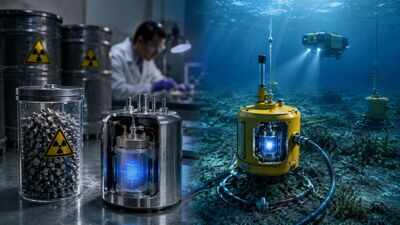
America is quietly building a network of nuclear-powered nodes on the ocean floor that could charge drone submarines for close to three decades without a cable, a support ship or a single resupply run. The fuel behind this project is strontium-90, a radioactive by-product that has sat in government storage for decades, and the Pentagon is betting it can turn a long-standing waste problem into a working underwater power grid. A Washington and Seattle-based company called Zeno Power is leading the effort, and it has already taken possession of material once destined for disposal at Oak Ridge, Tennessee. What began as an environmental cleanup issue is now being reshaped into a source of long-duration power for both defence and space applications.
How BUP-500 strontium-90 radioactive waste from Oak Ridge is being recycled into nuclear power
The material at the centre of this project is not freshly mined strontium. It comes from a radioisotope thermoelectric generator known as the BUP-500, built in the mid-1980s at Oak Ridge National Laboratory but never deployed. It sat in storage for nearly 40 years, and the Department of Energy had expected it would remain there for another 30 before it could be safely disposed of. Instead, under a new partnership, the material has been transported to a commercial nuclear facility out of state, where Zeno Power will recycle it into fuel for its radioisotope power systems.According to the U.S. Department of Energy, the equipment was previously stored at a facility scheduled for demolition, and the transfer accelerates the clean-out of that site while avoiding disposal costs and cutting liability at Oak Ridge. OREM Manager Jay Mullis described the arrangement as “a win-win scenario that’s removing a significant source of radioactivity” at a saving to taxpayers, while also supporting nuclear innovation. The partnership also involved the United Cleanup Oak Ridge contractor, which supported the transport of the generator, along with senior officials from the Department of Energy, the Department of Defence and Nasa, who were present to mark the milestone. Zeno’s Co-Founder and CEO, Tyler Bernstein, said the arrangement allows the company to transform legacy radioactive material into clean energy for future national security and scientific missions, and thanked the officials who helped bring the partnership together.
How the Pentagon’s DEPTHS programme will use strontium-90 for seabed nuclear power
Zeno’s interest in strontium-90 is tied directly to a Pentagon programme awarded several months before the Oak Ridge transfer took place. In October 2023, the company secured a $7.5 million contract from the U.S. Department of Defence to build and demonstrate a radioisotope power system by 2026, one capable of providing resilient, distributed power on the seabed. The funding came through the DoD’s Operational Energy Innovation office and the Office of Naval Research.According to Zeno Power’s official press release, the contract falls under a programme called Distributed Energy Provided Throughout the Seas, or DEPTHS, which aims to develop decentralised nodes for generating and distributing power on the ocean floor. The stated goal is to enable long-endurance sensors and charging stations for autonomous undersea vehicles, reducing the need for cables or repeated servicing trips. The award was Zeno’s third government contract of that year, taking its total funding past $40 million. Admiral John M. Richardson, the retired former Chief of Naval Operations who sits on Zeno’s Advisory Board, linked the programme to wider strategic competition at sea, saying, “ubiquitous access to power in maritime environments is critical to maintaining U.S. leadership.” The DEPTHS team includes Blue Origin and Sunpower, who are developing the Stirling power convertor, alongside PowerLight Technologies and the University of Dayton Research Institute.
The revival of strontium-90 nuclear power technology for seabed and lunar missions
Radioisotope power systems are not new. From the 1960s through the 1980s, the U.S. government used strontium-90 systems in maritime settings to power navigational buoys and undersea sensing equipment, largely through the Atomic Energy Commission’s SNAP programme. Those early units proved reliable but were heavy, which limited how widely they could be deployed at sea.It is reviving this approach with a redesigned strontium-90 heat source paired with Stirling power conversion, a combination intended to improve on the performance of the older systems. The company had already begun work on a related application before the Navy contract was announced, having secured a $15 million Nasa Tipping Point award in July 2023 to develop a similar system with Blue Origin and Sunpower for use on the lunar surface. The overlap between the seabed and lunar programmes has allowed Zeno to share engineering work across both efforts, rather than starting from scratch for each customer. Both rely on the same underlying principle: converting the steady heat released by radioactive decay into a durable and dependable electricity supply for environments where solar power, cables and regular maintenance are not practical options.The Oak Ridge transfer and the Navy contract were announced only months apart, and together they explain why Zeno was able to move from a research contract to a real fuel supply chain relatively quickly. Rather than sourcing new radioactive material, which would involve high cost and regulatory complexity, the company built its supply plan around material the government was already trying to dispose of.For the Department of Energy, the arrangement offered a practical way to clear a facility slated for demolition without paying for conventional disposal. For Zeno, it provided a domestic, government-backed source of strontium-90 at a point when the company needed to demonstrate a working system to the Pentagon within a few years.Officials from four separate federal and commercial organisations, the Department of Energy, Zeno Power, the Department of Defence and Nasa, were involved in marking the transfer, reflecting how the project sits at the intersection of environmental cleanup, defence procurement and space technology. Whether the approach proves commercially viable at scale will depend on how the DEPTHS demonstration progresses over the coming years.
The new strontium-90 supply chain could support long-duration nuclear power systems
The Oak Ridge transfer and the Navy contract were announced only months apart, and together they explain why Zeno was able to move from a research contract to a real fuel supply chain relatively quickly. Rather than sourcing new radioactive material, which would involve high cost and regulatory complexity, the company built its supply plan around material the government was already trying to dispose of.For the Department of Energy, the arrangement offered a practical way to clear a facility slated for demolition without paying for conventional disposal. For Zeno, it provided a domestic, government-backed source of strontium-90 at a point when the company needed to demonstrate a working system to the Pentagon within a few years.Officials from four separate federal and commercial organisations, the Department of Energy, Zeno Power, the Department of Defence and Nasa, were involved in marking the transfer, reflecting how the project sits at the intersection of environmental cleanup, defence procurement and space technology. Whether the approach proves commercially viable at scale will depend on how the DEPTHS demonstration progresses over the coming years.


