
A sharp stone tool cut this early human’s jaw 100,000 years ago, but the healed bone shows he survived

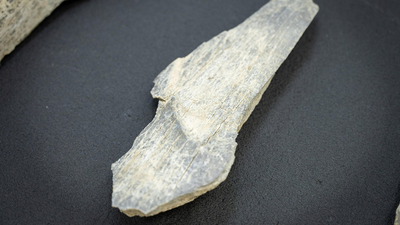
A small mark on an ancient jaw has opened a window into a moment of violence from a time far removed from written history. The remains of an early Homo sapiens individual from Qafzeh Cave in Israel have revealed signs of a serious facial injury, likely caused by a sharp stone tool. What makes the discovery unusual is not only the wound itself, but the evidence that the person survived it. The damaged bone shows signs of healing, suggesting that the injury was not immediately fatal. It also raises questions about conflict, survival and social support among humans living more than 100,000 years ago.
100,000-year-old skeleton offers new evidence from one of the world’s oldest human sites
The study published in the Scientific reports on June 2026, titled, ‘A taphonomic reassessment of Qafzeh 25 and its implications for violence, health and funerary practices’ revealed the Qafzeh Cave, located near Nazareth in northern Israel, has been central to the study of early modern humans for decades. Excavations at the site began in the 1930s and uncovered the remains of dozens of Homo sapiens individuals who lived during the Middle Paleolithic period.Many of these individuals were buried intentionally, offering some of the earliest evidence that humans were engaging in complex social and cultural practices. Alongside human remains, archaeologists discovered stone tools, red ochre and marine shells that may have been used as ornaments.The latest investigation focused on a skeleton known as Qafzeh 25, a young adult male whose remains were excavated in 1979. Earlier examinations had identified damage to parts of the skeleton, but much of it was thought to have occurred after death as the bones were buried and fossilised.A closer look using high-resolution micro-CT scanning revealed something different on the left side of the lower jaw. A narrow cut passed through the mandible and reached one of the premolar teeth. The shape of the mark suggested that it was created by a sharp-edged object rather than by natural damage.
Evidence of a wound that healed
The injury itself tells only part of the story. Inside the damaged area, scientists observed changes in the bone that indicate healing had begun. That detail is important because it means Qafzeh 25 survived the initial trauma. The wound did not appear to have destroyed the inner part of the tooth where nerves and blood vessels are located, potentially reducing the chance of a severe infection. For someone living tens of thousands of years before modern medicine, surviving such an injury would have depended on many factors, including the severity of the wound, access to food and water, and possibly assistance from others.
Did a confrontation leave its mark
The cause of the wound remains uncertain. A stone tool accident cannot be ruled out, and the injury could have happened during activities involving hunting or tool use.However, the location and shape of the cut have led researchers to consider another possibility: an encounter between two people. The injury appears on the left side of the face, a pattern sometimes associated with close-range attacks between right-handed individuals. Modern forensic studies of facial injuries have shown similar patterns in cases involving direct confrontations.Stone tools found at Qafzeh Cave included pointed flint implements capable of creating a wound of this kind. If the interpretation is correct, the jaw represents one of the oldest known examples of possible sharp-force trauma among Homo sapiens.
Life inside Qafzeh Cave
The significance of Qafzeh extends beyond this single injury. The cave provides evidence of a population that was not simply surviving from day to day, but engaging in behaviours often associated with later human societies.The burials at the site suggest deliberate treatment of the dead. Some individuals were placed in specific positions, and the presence of ochre and decorative objects points towards symbolic practices. Qafzeh 25 adds another layer to that picture. The healed injury suggests that early humans experienced violence and accidents, but also that survival sometimes depended on social connections.
A second clue from the teeth
The scanning also revealed another detail hidden within the remains: a cavity inside a rotated premolar.Dental problems are not unusual in ancient populations, but researchers have noted that Qafzeh individuals appear to have had a relatively high frequency of tooth decay compared with some other Paleolithic groups. Several factors may have contributed, including diet, environmental conditions and inherited traits.
A rare record of human behaviour
Ancient bones rarely preserve moments from individual lives. Most archaeological evidence tells broad stories about populations, migrations or technology. A healed injury, however, captures something more personal.The mark on Qafzeh 25’s jaw records a violent event that happened roughly 100,000 years ago. Whether it came from an intentional attack or an accident remains unresolved, but the evidence shows that this person lived through a dangerous encounter.


