
A groundbreaking study reveals kissing predates humans by millions of years, originating with ape ancestors in prehistoric Africa. Researchers define it as non-aggressive mouth-to-mouth contact, observing it across diverse species, particularly primates. This ancient behavior, possibly practiced by Neanderthals, may have evolved for mate assessment or social bonding, offering a glimpse into our deep evolutionary past. BENGALURU: If you think kissing is only about human romance, you’re already missing the story. The first kiss happened long before humans walked the Earth—somewhere in the misty forests of prehistoric Africa, between two ape ancestors, 16.9-21.5 million years ago.As per a new evolutionary study, a kiss is better understood as an ancient, risky mouth-to-mouth gamble that large apes, and probably Neanderthals, started playing millions of years ago. And instead of asking what a kiss means, researchers went after a tougher question: why this odd, germ-sharing behaviour evolved at all in the first place.Researchers from University of Oxford, University College London, and the Florida Institute of Technology began by stripping the sentimentality out of kissing and giving it a cross-species definition: non-aggressive, mouth-to-mouth contact within a species, with some lip or mouth movement and no food transfer.That rules out feeding, “kiss-fighting” and your dog licking your face, but includes everything from human deep kisses to brief pecks between monkeys and apes. As per this definition, they found that kissing occurs in taxa as diverse as ants, birds, and polar bears, but the majority of reports seem to be in the primates.Using this, they sifted through decades of primate fieldwork and video material to classify each Afro-Eurasian monkey and ape species as “kissing observed” or “not observed”.They then mapped the data onto a primate family tree and used statistical methods to estimate when kissing first appeared. Their findings: proper lip-to-lip contact predates humans by a vast margin. The behaviour likely evolved in the common ancestor we share with chimpanzees, bonobos and orangutans, making every romantic clinch a faint genetic echo from deep time.The research, published in Evolution and Human Behavior, also indicates an 84% chance that Neanderthals kissed. It is even possible they kissed modern humans during the period both species coexisted. The clue lies in shared oral microbes that could only have been passed through close mouth-to-mouth contact.Why Kiss At All?Kissing poses an evolutionary puzzle because it offers no obvious survival benefit, while the risk of disease transfer is high. Matilda Brindle from University of Oxford and her colleagues wanted to know why animals persist with it. Using primates, the only group where kissing is well-documented, they traced its evolutionary path.The behaviour appears in most great apes and at least eight Old World monkey species. Gorillas do it, though infrequently. Bonobos engage in what researchers call “prolonged tongue-tongue interaction”. Chimpanzees opt for brief, tense kisses, usually after confrontations.So why kiss at all? Leading explanations suggest it may help assess a mate’s health, increase arousal, strengthen social bonds or even transfer beneficial microbes. The study hints that species with several mating partners are more likely to kiss, pointing to a role in sexual selection.Yet kissing is not universal among humans. It is absent in some societies, raising the possibility of cultural learning rather than pure instinct.The researchers note that scientific records of kissing are sparse because the behaviour is often dismissed as trivial. Still, they argue that their framework offers a starting point for understanding a habit so common that we rarely question it.Next time you kiss someone, remember: you’re participating in a ritual older than us, refined across millions of years of primate evolution. Though whether that makes it more or less romantic is anyone’s guess.About the AuthorChethan KumarChethan Kumar is a Senior Assistant Editor with the Times of India. Aside from specialising in Space & Science, he has reported extensively on varied topics, with special focus on defence, policy and data stories. He has covered multiple elections, too. As a young democracy grows out of adolescence, Chethan feels, there are reels of tales emerging which need to be captured. To do this, he alternates between the mundane goings-on of the Common Man and the wonder-filled worlds of scientists and scamsters, politicians and soldiers. In a career spanning nearly 18 years, he has reported from multiple datelines — Houston, Florida, Kochi, Hyderabad, Chennai, Sriharikota (AP), NH-1 (J&K Highway), New Delhi, Ahmedabad, Raichur, Bhatkal, Mysuru, Chamarajanagar, to name a few — but is based out of Bengaluru, India’s science capital that also hosts the ISRO HQ.Read MoreEnd of ArticleFollow Us On Social MediaVideosIndia And Israel Launch FTA Talks; Piyush Goyal, Nir Barkat Sign Terms Of ReferenceDelhi’s Pollution Forces Australian Foreign Minister Penny Wong To Cough, Stop Her Speech MidwayJaishankar Meets Afghan Commerce Minister Azizi In Delhi; Trade, Connectivity DiscussedMEA Outlines Agenda For PM Modi’s South Africa Visit For G20 Summit In JohannesburgPenny Wong’s Cricket Banter With Jaishankar Highlights Warm, Confident India-Australia PartnershipJaishankar, Penny Wong Send A Strong India-Australia Message To China And The World on Indo-PacificIFFI 2025 Opens With A Surprise As Korean Minister Sings Vande Mataram And Wins Standing OvationPiyush Goyal’s 10 D’s Pitch in Israel Recasts India As Future-Ready for Worldwide InvestmentsDelhi Student Suicide Case: Massive Protest Outside School After Note Alleges Harassment By TeachersPiyush Goyal Links India, Israel Through Shared Adversities, Predicts 7% Percent GDP Growth For FY26123PhotostoriesRekha to Sharmila Tagore: 5 best celebrity-inspired saree styles for the modern mother-in-law10 nuts for kids for brain health and overall growthAkkineni Nagarjuna Rao shaping Telugu cinema with iconic performances and a magnetic presence on screenHow top Bollywood actresses are embracing a life changing new lifestyleFrom better brain function to stronger heart: 5 reasons why backward walking is excellent for youPrincess Diana finally enters the Grévin Wax Museum and yes, she’s wearing the iconic ‘Revenge Dress’Dipika Kakar breaks down after meeting her oncologist amid liver cancer treatment; says, ‘The reports are normal, but there is a constant fear and anxiety’Peripheral Artery Disease: 5 major causes, and ways to prevent it9 must-try street foods in Udaipur5 expert-approved best foods to control diabetes123Hot PicksDelhi AQI TodayBihar Minister List 2025Bihar CM Oath CeremonyGold rate todaySilver rate todayPublic Holidays NovemberBank Holidays NovemberTop TrendingJoel EmbiidSavannah JamesGiannis AntetokounmpoTrevon DiggsKris KnoblauchAdin RossCandace OwensKona TakahashiKatie JohnsonOlivia Dunne
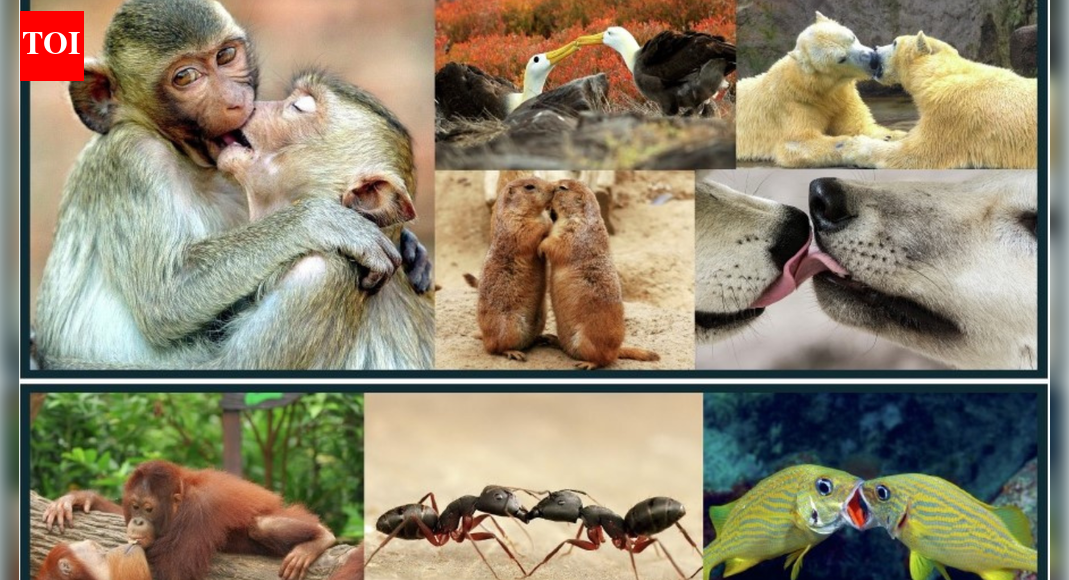
BENGALURU: If you think kissing is only about human romance, you’re already missing the story. The first kiss happened long before humans walked the Earth—somewhere in the misty forests of prehistoric Africa, between two ape ancestors, 16.9-21.5 million years ago.As per a new evolutionary study, a kiss is better understood as an ancient, risky mouth-to-mouth gamble that large apes, and probably Neanderthals, started playing millions of years ago. And instead of asking what a kiss means, researchers went after a tougher question: why this odd, germ-sharing behaviour evolved at all in the first place.Researchers from University of Oxford, University College London, and the Florida Institute of Technology began by stripping the sentimentality out of kissing and giving it a cross-species definition: non-aggressive, mouth-to-mouth contact within a species, with some lip or mouth movement and no food transfer.That rules out feeding, “kiss-fighting” and your dog licking your face, but includes everything from human deep kisses to brief pecks between monkeys and apes. As per this definition, they found that kissing occurs in taxa as diverse as ants, birds, and polar bears, but the majority of reports seem to be in the primates.Using this, they sifted through decades of primate fieldwork and video material to classify each Afro-Eurasian monkey and ape species as “kissing observed” or “not observed”.They then mapped the data onto a primate family tree and used statistical methods to estimate when kissing first appeared. Their findings: proper lip-to-lip contact predates humans by a vast margin. The behaviour likely evolved in the common ancestor we share with chimpanzees, bonobos and orangutans, making every romantic clinch a faint genetic echo from deep time.The research, published in Evolution and Human Behavior, also indicates an 84% chance that Neanderthals kissed. It is even possible they kissed modern humans during the period both species coexisted. The clue lies in shared oral microbes that could only have been passed through close mouth-to-mouth contact.Why Kiss At All?Kissing poses an evolutionary puzzle because it offers no obvious survival benefit, while the risk of disease transfer is high. Matilda Brindle from University of Oxford and her colleagues wanted to know why animals persist with it. Using primates, the only group where kissing is well-documented, they traced its evolutionary path.The behaviour appears in most great apes and at least eight Old World monkey species. Gorillas do it, though infrequently. Bonobos engage in what researchers call “prolonged tongue-tongue interaction”. Chimpanzees opt for brief, tense kisses, usually after confrontations.So why kiss at all? Leading explanations suggest it may help assess a mate’s health, increase arousal, strengthen social bonds or even transfer beneficial microbes. The study hints that species with several mating partners are more likely to kiss, pointing to a role in sexual selection.Yet kissing is not universal among humans. It is absent in some societies, raising the possibility of cultural learning rather than pure instinct.The researchers note that scientific records of kissing are sparse because the behaviour is often dismissed as trivial. Still, they argue that their framework offers a starting point for understanding a habit so common that we rarely question it.Next time you kiss someone, remember: you’re participating in a ritual older than us, refined across millions of years of primate evolution. Though whether that makes it more or less romantic is anyone’s guess.


