
A forgotten American photographer captured one of the earliest clear images of a total solar eclipse 175 years ago; the photograph changed eclipse science | World News

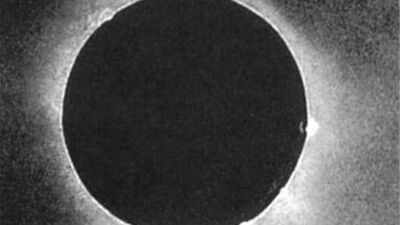
A total solar eclipse is one of nature’s most dramatic sights, but 175 years ago it was also a difficult scientific problem to record. On July 28, 1851, a little-known photographer named Johann Julius Friedrich Berkowski produced what is regarded as the first successful photograph of a total solar eclipse. Working at the Royal Observatory in Königsberg, Prussia, he used a small refracting telescope and an exposure lasting 84 seconds to capture the Moon crossing the Sun. The results marked a turning point. As later eclipse observations became increasingly photographic, scientists gained a lasting way to study the Sun’s faint outer atmosphere, the ‘corona.’ Berkowski’s nearly forgotten image therefore became much more than a historical curiosity, it opened a new chapter in eclipse science for decades.
How did Berkowski capture the historic total solar eclipse
The photograph was taken during the total solar eclipse of July 28, 1851, which was visible across parts of Europe. According to the Smithsonian Magazine, the event attracted major scientific interest and is associated with what became the first full-scale professional eclipse expedition. At the time, photography was still a relatively new technology. The ‘daguerreotype process,’ introduced in the late 1830s, created a single image on a silver-coated copper plate treated with light-sensitive chemicals.Unlike modern photographs, the image could not simply be printed in multiple copies. Berkowski worked at the Royal Observatory in Königsberg, then part of Prussia and now known as Kaliningrad, Russia. The Linda Hall Library explains that he used a small refracting telescope to photograph the eclipse, exposing his daguerreotype plate for 84 seconds. The result was remarkable because photographing the Sun was considerably more challenging than photographing the Moon. Astronomers had already been impressed by a daguerreotype of the Moon displayed at the Great Exhibition of 1851, but capturing a total eclipse presented a much more difficult target. Berkowski managed to record the brief period of totality, when the Moon completely covered the Sun and its faint outer atmosphere became visible.
What made this 1851 eclipse photograph so important
The importance of Berkowski’s image was not simply that it showed an eclipse. It demonstrated that photography could preserve details of a fleeting astronomical event that lasted only minutes. The Linda Hall Library notes that the original daguerreotype showed the Moon as less than 8 millimetres across. Even a surviving second-generation copy at Friedrich Schiller University in Jena is only around 2 by 2.3 inches. Despite its small size and limited detail, the photograph revealed what photography could achieve in astronomy. It gave scientists a permanent record rather than forcing them to depend entirely on drawings or written descriptions made during the few moments when an eclipse was visible.The original photograph eventually disappeared, but its legacy did not. The observatory director had an engraving made in 1854, while photographic copies were also produced in 1891. At least one second-generation daguerreotype survives in Jena, allowing modern viewers to see a version of Berkowski’s pioneering work.
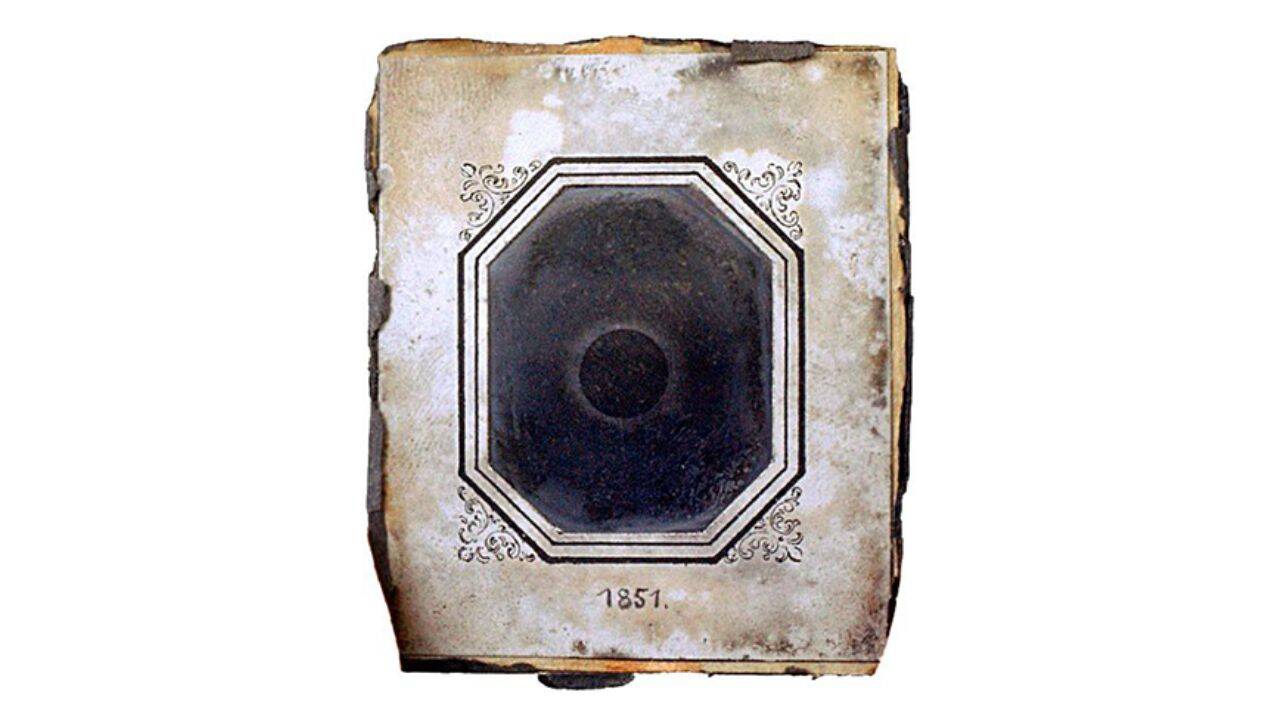
The original Daguerreotype. Image Credit: Fstoppers.com
Why was the Sun’s corona so difficult to study for astronomers
One of the most valuable features of a total solar eclipse is the opportunity to see the Sun’s corona. The corona is the star’s outer atmosphere, made up of extremely hot and thin material extending far beyond the visible surface. Under ordinary conditions, the Sun is so bright that the corona cannot be seen with the naked eye. During totality, however, the Moon blocks the Sun’s bright face and allows the much fainter corona to emerge. The Smithsonian Magazine explains that eclipse photographs have since become important scientific records of this outer atmosphere. Researchers can study the shape and structure of the corona and investigate how material and magnetic fields flow away from the Sun.That matters because activity in the corona is connected with space weather. Charged particles and magnetic fields released by the Sun can interact with Earth’s magnetic environment, producing auroras and, in more serious cases, affecting satellites and other technology. Modern photographs can also be taken using different filters and wavelengths, allowing researchers to investigate properties such as the temperature and speed of material in the corona.
How did Berkowski’s photograph change to eclipse photography
Berkowski’s success encouraged scientists to see photography as a serious tool for eclipse research. By the time of the next major eclipse on July 18, 1860, photographers were better prepared and were using a newer photographic process known as ‘wet collodion.’ The Smithsonian Magazine notes that photography eventually became an important part of eclipse expeditions. What began with Berkowski’s single, fragile daguerreotype developed into a method capable of producing detailed and reproducible records. The change also transformed the way people could study eclipses after the event had ended. An eclipse itself might disappear in minutes, but an image could remain available for researchers to examine years or even generations later. Images can preserve moments that would otherwise be extremely brief. That makes astronomical photography valuable not only for research but also for helping the wider public understand what scientists see.
What can eclipses still teach scientists today
Researchers continue to use totality as a natural opportunity to study the corona, while modern instruments can capture details that were impossible to record in the 19th century. Scientists have even begun creating artificial eclipses in space. The Smithsonian Magazine reports that the European Space Agency’s Proba-3 mission uses two satellites flying in formation, with one positioned to block the Sun from another. This creates an artificial eclipse that can last much longer than natural totality. The contrast with 1851 is striking. Berkowski had only a small telescope, a photographic plate and 84 seconds. Modern researchers can use sophisticated spacecraft and instruments to observe the Sun for extended periods. Yet the basic scientific opportunity remains the same. When the Moon blocks the Sun, a normally hidden part of the star becomes visible.Berkowski was so obscure that, according to the Linda Hall Library, his full name was not identified until a German article appeared in 2013. For decades, the man behind the historic photograph was barely remembered. His photograph, however, survived in copies and historical records. More importantly, the idea behind it endured. A nearly forgotten photographer helped turn total solar eclipses from moments that vanished into darkness into lasting windows on the Sun’s mysterious outer atmosphere.


