
A 2,500-year-old animal bone found in Sicily reveals how ancient people wrote on clay

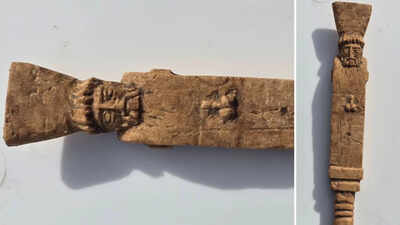
In Gela, on Sicily’s southern coast, archaeologists have uncovered a rare and remarkably well-preserved bone stylus dating to the 5th century BCE, decorated with imagery that appears to connect craftsmanship with the worship of Dionysus. The object measures 13.2 centimetres long and was found intact during preventive archaeological excavations at Orto Fontanelle, an area being investigated ahead of construction of a new cultural centre. Its upper section carries a finely carved male head that experts interpret as probably representing an erma, or herm, of Dionysus, while the central section depicts an erect phallus. Sicily’s regional cultural heritage department described the stylus as an exceptional archaeological find, while Daniela Vullo, superintendent for cultural heritage in Caltanissetta, said its unusual craftsmanship and imagery make it unique for its period. She also suggested that the object was probably intended as an offering to the deity, rather than simply being an ordinary working tool.
Why archaeologists believe the stylus depicts Dionysus
The identification of the figure as Dionysus comes from the object’s distinctive decoration rather than from an inscription naming the god. According to the Sicilian regional government’s official announcement, the upper part of the stylus bears a male head that is verosimilmente un’erma di Dioniso, probably an erma of Dionysus. In ancient Greek art, herms were typically pillars or bust-like representations associated with the head and upper body of a deity or other figure. The regional heritage authorities have therefore treated the Dionysus interpretation as probable rather than absolutely certain.That distinction matters because there is no surviving inscription on the object explicitly identifying the figure. What can be established is that the stylus was deliberately decorated with a male head and an erect phallus, an unusually elaborate combination for an object associated with ceramic production. The refined workmanship also suggests that it was not an ordinary, cheaply made implement.
Why the object may have been intended as a religious offering
The stylus’ unusual decoration has led archaeologists to consider a ritual purpose. Daniela Vullo, the superintendent for cultural heritage in Caltanissetta, said the object was probably used as a gift to the deity, citing its distinctive characteristics and recommending that it eventually be displayed for the public. The official statement does not establish with certainty exactly how the object was used, so its precise function remains an interpretation rather than a settled fact.The phallic imagery is particularly striking to modern eyes, but it should be understood within the visual and religious culture of the ancient Mediterranean rather than treated simply as an unusual joke or decoration. Phallic imagery could carry associations with fertility, protection and religious symbolism in the ancient Greek world. In this case, however, the evidence is not strong enough to say exactly what the carving meant to the person who commissioned or used the stylus. The safest conclusion is that the imagery was deliberate and potentially connected to the object’s proposed devotional role.
What the stylus reveals about craftsmanship in ancient Gela
The discovery came during preventive archaeological work at Orto Fontanelle, where excavations connected with the construction of Gela’s new Palazzo della Cultura have revealed substantial remains of an ancient urban area. The work was ordered by the Superintendency for Cultural and Environmental Heritage of Caltanissetta and carried out under the scientific direction of archaeologist Gianluca Calà, who was appointed by the municipality of Gela.The stylus is particularly valuable because it combines evidence of specialised craftsmanship with unusually sophisticated decoration. Its small size, just 13.2 centimetres, would have made it portable, while its intact condition preserves details that might otherwise have been lost. Other reporting describes the object as having a pointed end for writing or incising and a flatter end used for erasing, although the Sicilian government’s announcement itself focuses primarily on its decoration and archaeological significance. The wider excavation has also revealed a substantial Hellenistic quarter that researchers are still investigating. That means the stylus is not an isolated curiosity but part of a much larger archaeological picture emerging beneath modern Gela, a city whose ancient Greek past continues to produce evidence of the crafts, beliefs and everyday activities of its inhabitants.
Why this small bone object is unusually important
The significance of the find lies less in its size than in the combination of features preserved on it: fine bone carving, an apparent Dionysian figure, an erect phallus and a possible connection to ritual activity. The regional authorities have described the stylus as an unicum, or unique object, within the archaeological landscape of its period. It also shows how difficult it can be to separate practical objects from religious life in the ancient world. The stylus may have been associated with ceramic production, yet its elaborate decoration appears to have carried meanings beyond simple utility. Archaeologists cannot currently say with certainty whether it was made specifically as a votive object, used by a craftsperson before being dedicated, or served another purpose altogether. What is clear is that someone in 5th-century BCE Gela invested considerable skill in turning a small bone tool into an object with powerful visual symbolism and then left it behind for archaeologists to uncover roughly 2,500 years later.


