
. NEW DELHI: Nearly half of the sanctioned positions on pollution control boards and committees across the country remain vacant even as most major cities are reeling under the impact of air pollution, reveals the answer to a recent question in Parliament.The answers to other questions this year show that this has been the case over the last five years. Also, utilisation of funds under the National Clean Air Programme has been particularly poor in the Capital and satellite cities.A question answered in the ongoing session revealed that apart from the Central Pollution Control Board (CPCB), there are 28 state pollution control boards (SPCBs) and 8 pollution control committees (PCCs) that work in the UTs and the NCT of Delhi. Together, their sanctioned strength for scientific and technical posts is 6,932, of which 3,161 or 45.6% were vacant. The vacancy was 16.3% in CPCB as of Nov, 43.8% in PCCs and 47.6% in the SPCBs as of Aug..As for all posts, an answer in March this year showed that of the 11,562 sanctioned positions in the SPCBs and PCCs, there were 5,671 or over 49% vacancies. Vacancies have ranged from 44% to 51% over the last five years.According to the March answer, 12 of the 28 SPCBs had over 50% vacancy. Sikkim topped the list with 100% vacancy and was followed by Jharkhand and Andhra Pradesh, both lacking more than 70% staff. Kerala was the only large state where the vacancy was less than 10%. The vacancy was 9.3% in Goa, while Arunachal Pradesh and Nagaland had no vacancies.Among PCCs, the vacancy was 44.5% in Delhi, while it was 69% in Ladakh and Dadra & Nagar Haveli and Daman and Diu. Lakshadweep had zero vacancies, while only 11.1% of the sanctioned strength of Chandigarh was vacant. We are yet to get a response from the environment ministry on why there are so many vacancies. As and when we do, the story will be updated online.Data from 44 urban agglomerations (UAs) shows that Noida, Delhi and Faridabad were at the bottom of the list when it came to fund utilisation under the National Clean Air Programme. A parliamentary question answered in March showed that of the Rs 42 crore released to the national capital, only 32% was utilised. The proportion was 11.1% for Noida and 39% for Faridabad. In comparison, Surat utilised all of the funds alloted and Chennai 99%, while Kolkata utilised 87%.End of ArticleFollow Us On Social MediaVideosIndian Army Displays Turkish Yiiha Drone Used By Pakistan During Operation SindoorPM Modi Arrives In Jordan, Receives Warm Welcome By Indian Diaspora In AmmanUS Starts Mandatory Social Media Checks For H-1B Visas Leaving Indian Professionals Most ExposedBJP’s Succession Script Repeats: Why Nitin Nabin Is Working President, And Not Nadda’s ReplacementEnd Of MGNREGA? What VB–G Ram G Means For Rural Workers, Farmers And Viksit Bharat PlanFrom Missiles To Torpedoes, DRDO Outlines India’s Big Defence Push For Near-Term Battlefield EdgePM Modi Begins Jordan, Ethiopia, Oman Tour To Boost Ancient Ties, Expand India’s Global South RoleIndian Diaspora Members Prepare Cultural Performances Ahead Of PM Modi’s Jordan VisitFrom Power Cuts To 500 GW Grid, India Emerges As Global Data Centre Hub Under Modi: Piyush GoyalCong’s ‘Modi Teri Kabr Khudegi’ Slogan Sparks Uproar, NDA Seeks Apology As Parliament Grinds To Halt123PhotostoriesDhurandhar, Chhaava, Mom; Challenging roles played by Akshaye Khanna5 adorable pink animals stealing the wildlife spotlight5 beautiful Romeo and Juliet quotes that will steal your hearts‘Damini’, ‘OMG! Oh My God’, ‘Prem Rog’: Bollywood movies that sparked social change and redefined mainstream storytelling5 pet fish that change colour and why it happens6 Traditional egg curries from different parts of the countryAnkita Lokhande and Vicky Jain’s love story: From being close friends to getting remarried in EuropeUttarakhand Govt announces snow leopard tour to boost winter tourism; 5 other Indian spots to see the Big CatMrunal Thakur’s colourful Paithani saree is a bold love letter to Maharashtrian cultureFrom ethnic glam to chic streetwear: ‘Bigg Boss 19’ fame Farrhana Bhatt’s fashion diary123Hot PicksBondi beach attackCorona RemediesJetBlue flight VenezuelaGold rate todaySilver rate todayPublic Holidays NovemberBank Holidays NovemberTop TrendingJaylen Warren InjuryAuston MatthewsVanessa BryantLeBron JamesBukayo Saka and Tolami Benson Net WorthConnor McDavidDylan HollowayLebron JamesAdam FoxBam Adebayo
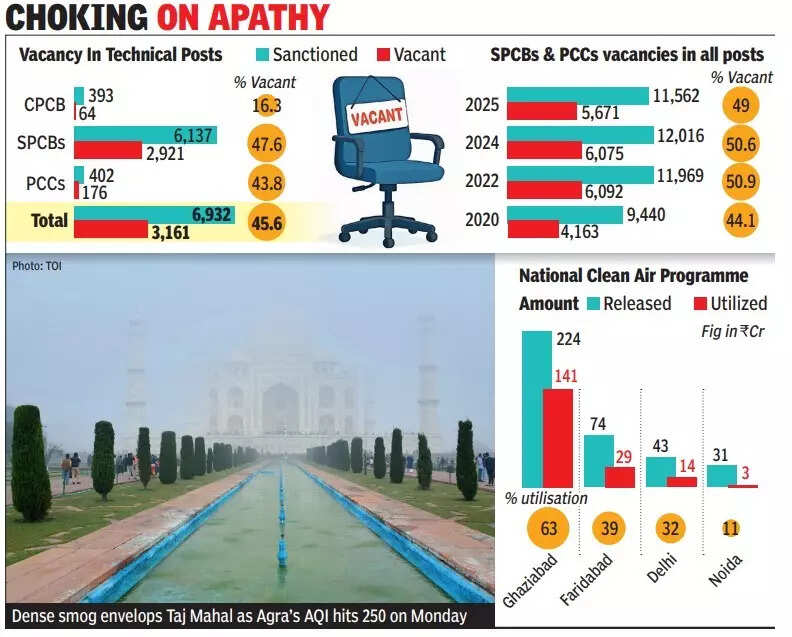
NEW DELHI: Nearly half of the sanctioned positions on pollution control boards and committees across the country remain vacant even as most major cities are reeling under the impact of air pollution, reveals the answer to a recent question in Parliament.The answers to other questions this year show that this has been the case over the last five years. Also, utilisation of funds under the National Clean Air Programme has been particularly poor in the Capital and satellite cities.A question answered in the ongoing session revealed that apart from the Central Pollution Control Board (CPCB), there are 28 state pollution control boards (SPCBs) and 8 pollution control committees (PCCs) that work in the UTs and the NCT of Delhi. Together, their sanctioned strength for scientific and technical posts is 6,932, of which 3,161 or 45.6% were vacant. The vacancy was 16.3% in CPCB as of Nov, 43.8% in PCCs and 47.6% in the SPCBs as of Aug.
.
As for all posts, an answer in March this year showed that of the 11,562 sanctioned positions in the SPCBs and PCCs, there were 5,671 or over 49% vacancies. Vacancies have ranged from 44% to 51% over the last five years.According to the March answer, 12 of the 28 SPCBs had over 50% vacancy. Sikkim topped the list with 100% vacancy and was followed by Jharkhand and Andhra Pradesh, both lacking more than 70% staff. Kerala was the only large state where the vacancy was less than 10%. The vacancy was 9.3% in Goa, while Arunachal Pradesh and Nagaland had no vacancies.Among PCCs, the vacancy was 44.5% in Delhi, while it was 69% in Ladakh and Dadra & Nagar Haveli and Daman and Diu. Lakshadweep had zero vacancies, while only 11.1% of the sanctioned strength of Chandigarh was vacant. We are yet to get a response from the environment ministry on why there are so many vacancies. As and when we do, the story will be updated online.Data from 44 urban agglomerations (UAs) shows that Noida, Delhi and Faridabad were at the bottom of the list when it came to fund utilisation under the National Clean Air Programme. A parliamentary question answered in March showed that of the Rs 42 crore released to the national capital, only 32% was utilised. The proportion was 11.1% for Noida and 39% for Faridabad. In comparison, Surat utilised all of the funds alloted and Chennai 99%, while Kolkata utilised 87%.


