
King Cobra: King Cobra’s terrifying image hides a surprisingly tender secret: The most venomous, longest snake in the world builds a waterproof fortress-like nest like an architect

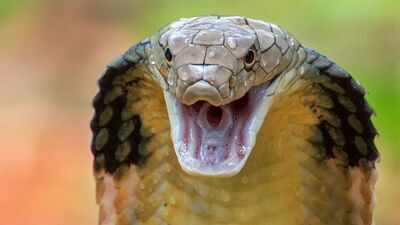
The King Cobra is one of the most venomous species in the world, mostly found in India and Southeast Asia.These slithering reptiles are fearsome species, and spotting one would send chills down a person’s spine, but did you know that these dangerous, long serpents could also be caregivers?In most stories, they are the villain slithering out of the shadows, not the parent quietly building a home. But deep in forests, one snake breaks that stereotype completely.The female king cobra, the world’s longest venomous snake, is the only snake species on Earth known to build a nest for her eggs. Every season, just before the monsoon arrives, she turns from predator to architect, gathering leaves, compacting them into a waterproof dome, and getting in for months of guard duty.Let’s dig in to find out how the mother cobra makes a nest for her young.
She builds where floods and predators can’t reach
She begins building a nest in the dry heat of April, ahead of May’s rains. A study of king cobra habitat in the Western Ghats, led by Chetan Rao and colleagues with the Wildlife Institute of India, found that nest sites are not random. Females favour well-drained ground, often beneath large trees or bamboo clumps, which keeps the site warm, shielded from flooding, and harder for predators to reach through the season’s heavy downpours.
Leaf by leaf, she builds a waterproof fortress
According to a BBC report, she puts in days of exhausting labour, when the female sweeps dead leaves together with her body, coils around the pile to carry it, and stacks it higher over several days. She then crawls over the mound repeatedly, compacting it into a waterproof dome before burrowing in to hollow out a cup-shaped chamber at its centre, where she lays her clutch.
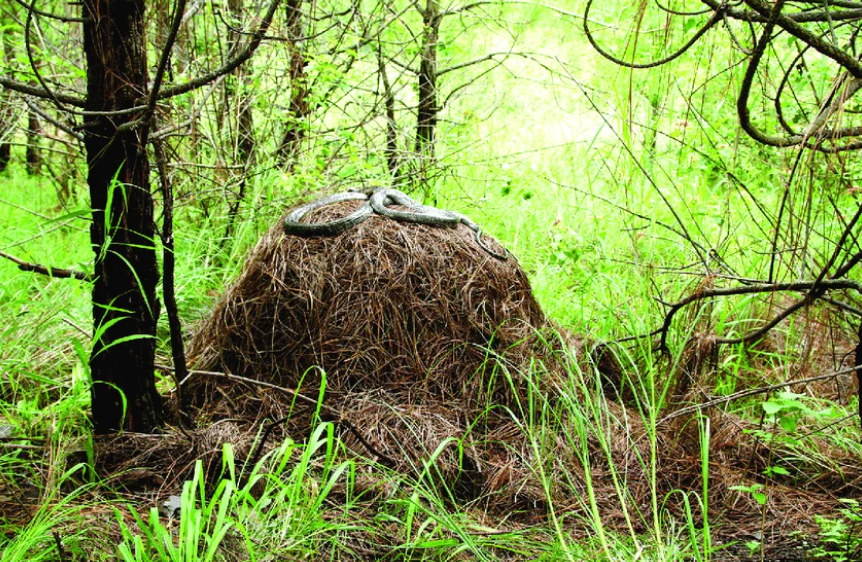
Picture courtesy: K.S. Sajwan/ Herpetology Notes/ ignasu Dolia
The nest is quite huge to be built by a single snake
Completed nests are up to 1.5 metres wide at the base and around 55 centimetres high at the centre, tall enough to hold the eggs and the female’s own coiled bulk.What makes this trait even more special for the snake’s behaviour is that the female stays with her nest through incubation. A 2023 study published in the Journal of Thermal Biology says that the females guard nests for up to two months or more. During this stretch, she eats little, and her coiled presence, hisses, and raised hood are usually enough to keep mongooses, wild pigs, and other predators away.
Once the eggs hatch, she quietly disappears
Her job ends abruptly. The female typically leaves the nest, partly because a hungry mother returning after months of fasting poses a risk to her own hatchlings.The young emerge fully venomous and immediately independent, hunting small snakes on their own, with only a small fraction expected to survive to adulthood.


