
Scientists turn undersea internet cables into giant whale detectors that can track even silent whales through tiny changes in water movement

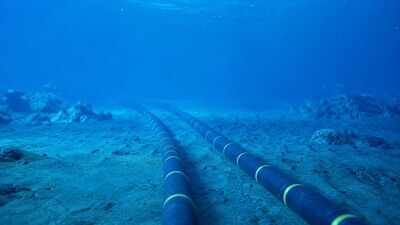
Fibre-optic cables spread across the seafloor have long carried internet traffic between countries, but researchers are discovering another surprising use for this global network; detecting whales. A 2022 study in ‘Frontiers in Marine Science’ showed that existing submarine fibre-optic cables could be turned into vast underwater sensors capable of detecting and locating baleen whales. Now, a 2026 study published in Proceedings of the National Academy of Sciences(PNAS) has taken that idea further. Researchers have shown that the same technology can detect whales even when they are completely silent, by sensing tiny changes in water pressure and movement caused by their swimming. The discovery could give scientists a new way to monitor whales across large areas without installing thousands of dedicated underwater microphones. This offers a powerful tool for studying animals that spend much of their lives hidden beneath the ocean surface.
Detecting whales by the underwater internet cables
The technology behind the discovery is called distributed acoustic sensing(DAS). Instead of requiring a conventional underwater microphone at every monitoring point, DAS uses a laser instrument connected to a fibre-optic cable. The 2022 study demonstrated the approach in Svalbard, Norway. Researchers connected an instrument to an existing submarine telecommunications cable and used light pulses travelling through a spare fibre. Tiny changes in the fibre caused by movement and pressure could then be measured and converted into signals resembling sound. The researchers transformed 120 kilometres of existing fibre into an underwater sensing array, with measurement points roughly every 4 metres. The cable was buried 1–2 metres beneath the seafloor and extended from Longyearbyen through Isfjorden towards the open ocean. This meant that a piece of telecommunications infrastructure already sitting on the seabed could effectively become a long, continuous listening system.
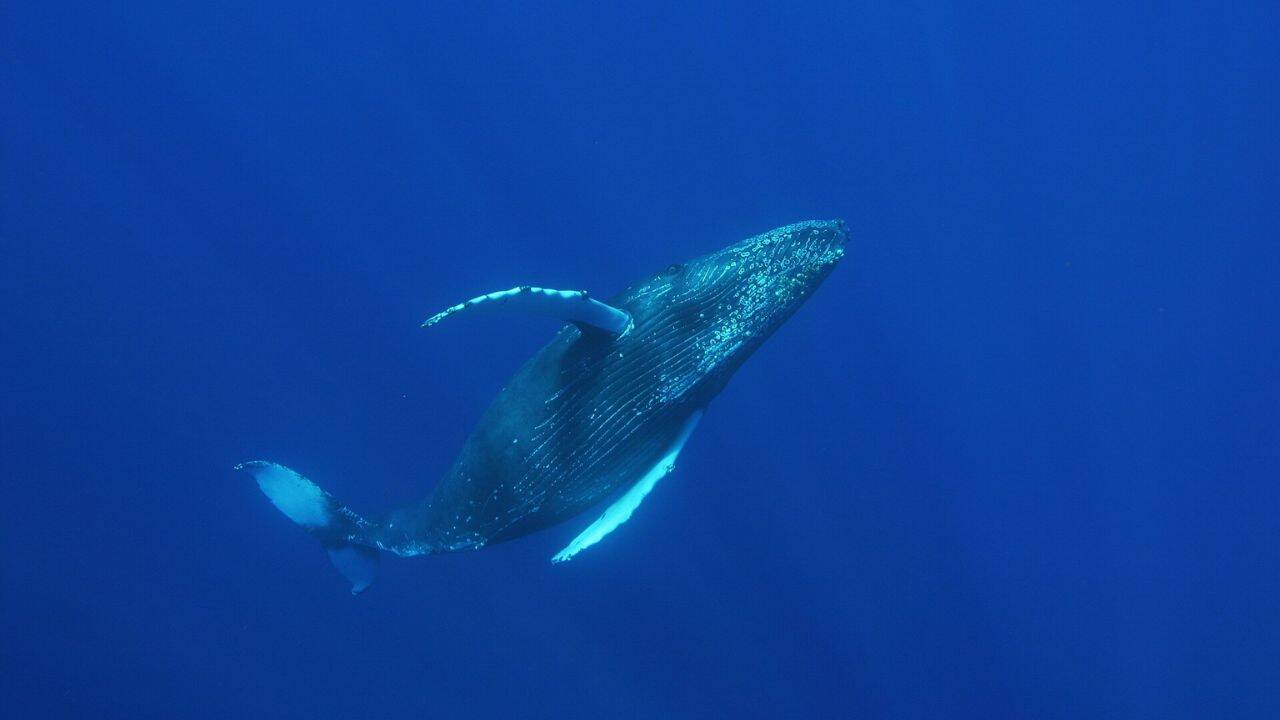
Humpback whales. Image Credit: National Marine Sanctuaries
Unique findings by the two whale-detection experiments
The 2022 study showed that the cable could pick up whale vocalisations over a much larger area than a conventional single-point recorder. During 44 days of observations in summer 2020, the system recorded thousands of kilometres of underwater fibre measurements and detected different baleen whale calls. Researchers identified signals associated with blue whales and also recorded sounds that could have come from fin, humpback and sei whales. The system detected 832 annotated whale calls, with 38% identified as North Atlantic blue whale signals. The researchers also found that whale sounds appeared differently in different parts of the monitored area, offering clues about how the animals used the habitat. The study was important because it showed that DAS could provide observations continuously along the cable rather than at just one fixed location. It also demonstrated the possibility of estimating the position of a calling whale from the signals recorded at different points along the fibre. However, there was an obvious limitation that ‘a whale had to make a sound to be detected.’That limitation is exactly what the new PNAS study addressed. In this 2026 paper, researchers looked beyond the sounds produced by whales. They found that a swimming whale also creates changes in the surrounding water. As a large animal moves through the ocean, its body pushes water aside and creates small pressure and water-movement patterns. These changes can reach the seabed and slightly affect the fibre-optic cable lying beneath it. The researchers developed a way of identifying these low-frequency signals in DAS data. Instead of asking whether a whale was making a call, the method asks whether something large was moving through the water close enough to disturb the surrounding fluid.
How close a silent whale need to be to get detected
The PNAS study found that the method could detect blue whales diving within about 40 metres of the fibre-optic cable. That is a significant difference from the earlier approach. Traditional passive acoustic monitoring depends on an animal producing detectable sound, while the new method could reveal a whale simply because it was swimming nearby. The researchers also found that the signal produced by whale movement becomes weaker rapidly with distance. That means the method is particularly useful for whales passing relatively close to the seabed fibre. The researchers first used ships as test cases because their movements could be independently tracked and compared with the signals recorded by the fibre. They were able to detect hydrodynamic signals from a cruise ship operating in water about 413 metres deep, with signals observed as far as 550 metres from the cable. The much smaller signals from blue whales were detectable at shorter distances.
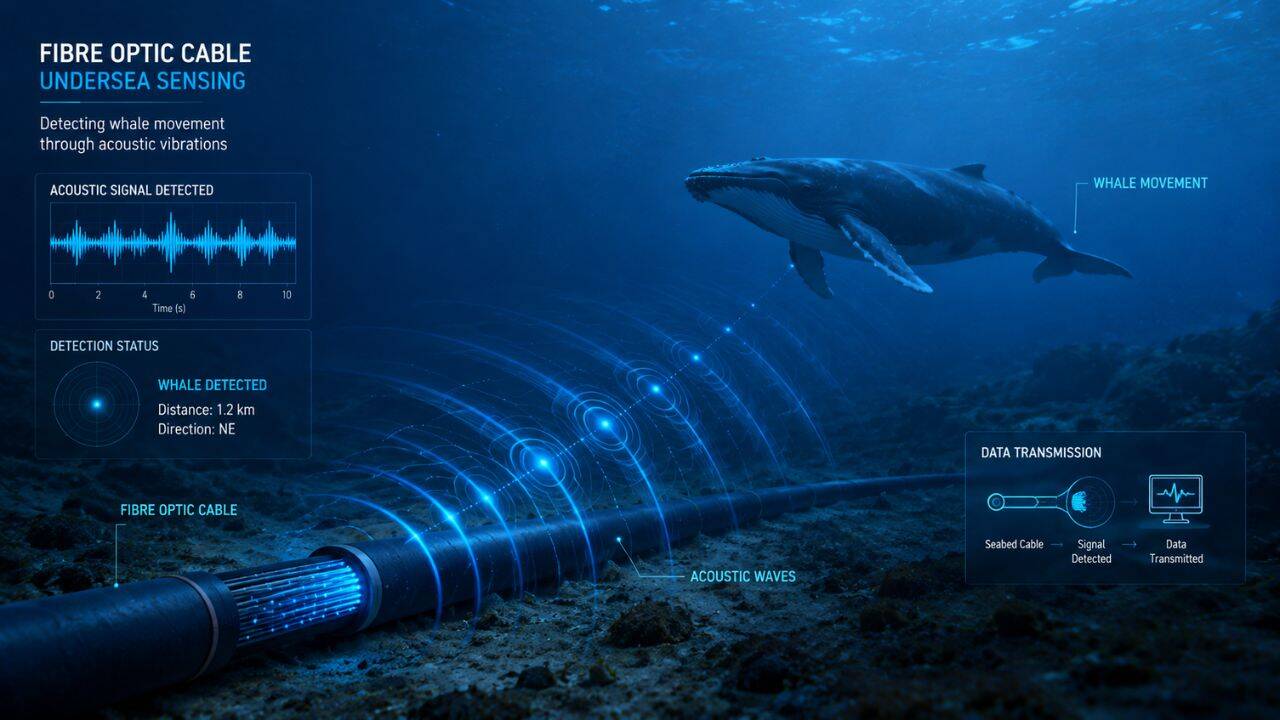
Image Credit: AI generated
Turning existing cables into a global whale-monitoring network
The researchers note that improvements in DAS technology could eventually extend sensing distances. The papers point towards developments involving specialised and existing repeaters that have demonstrated sensing over thousands of kilometres. If similar capabilities can be achieved for the low-frequency signals associated with whale movement, much larger areas of the ocean could potentially be monitored.That does not mean every submarine cable can immediately become a whale detector. The technique still has practical limitations, including the relatively short detection range for blue whales and the challenge of processing enormous amounts of DAS data. Still, the basic idea is remarkably simple. The cables are already there. Sensing technology can use them without interrupting their normal telecommunications role, and the ocean itself provides the signals. For whales, that could eventually mean that a network built to connect people across continents also helps scientists understand some of the largest animals moving through the oceans, even when those animals have nothing to say.


