
Scientists found fire salamanders glow blue-green under ultraviolet light, with their skin glands producing fluorescent secretions

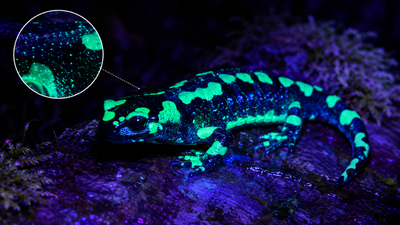
At first glance, the fire salamander appears much as it always has: black skin broken by irregular yellow markings, a pattern long associated with the species’ chemical defences. But under ultraviolet light, that familiar appearance changes. According to the 2026 study published in the Royal Society, titled ‘Glandular biofluorescence in fire salamanders (Salamandra salamandra): first evidence and ecological implications’, scientists found that adult fire salamanders (Salamandra salamandra) can show distinct blue-green fluorescent speckles, particularly across the flanks and underside of the body. The glow was strongest around gland-rich areas, and experiments showed that the salamanders’ own skin secretions fluoresced in cyan and green when exposed to UV light. Some of the secretions continued to glow for more than 24 hours after being released. The researchers traced the fluorescence to glandular tissue and found related signals in the blood, although the exact fluorescent compound has not yet been identified. The discovery raises questions about whether this hidden glow could have a role in communication or other interactions in the dark environments where fire salamanders are active.
How fire salamanders glow blue-green under ultraviolet light through fluorescent skin secretions
The fluorescence was not spread evenly across the animal. When adult fire salamanders were examined under a 365-nanometre ultraviolet light, bright speckles appeared mainly along the flanks and underside, with particularly visible concentrations around the gular region. The researchers recorded this pattern in 10 of 12 specimens examined in Catalonia. Some animals in Germany showed similar fluorescence, while the two S. s. almanzoris specimens examined near Madrid did not. The limited sampling means the differences between populations cannot yet be explained with confidence.The effect was also stronger in yellow parts of the skin than in black areas. That matters because the salamander’s dark pigmentation can interfere with both incoming ultraviolet light and the light emitted back from fluorescent material. The researchers found that the visible speckles corresponded closely with areas where glandular ducts reach the skin surface. In other words, what looks like a scattered pattern of glowing dots is not simply an unusual property of the salamander’s yellow pigment. It is closely tied to what the animal’s glands release.
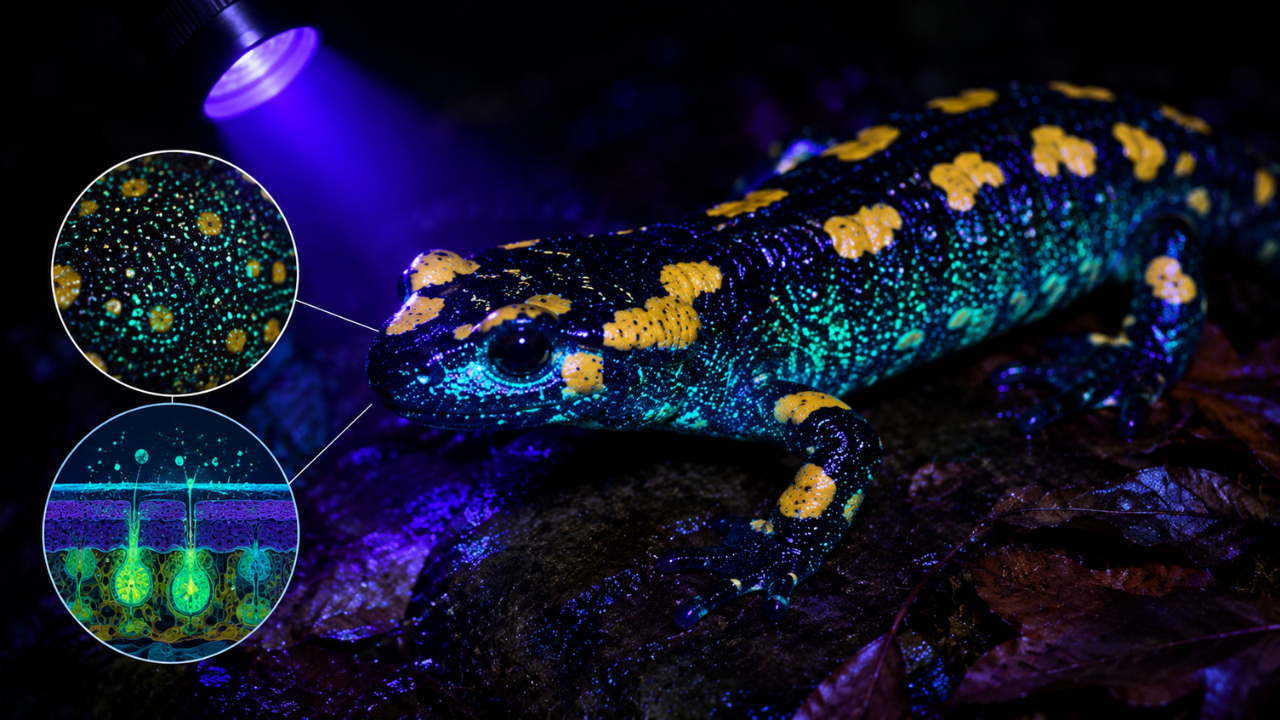
Image AI generated
Glandular secretions produce the fire salamander’s blue-green fluorescence
The researchers tested the glandular material itself rather than relying only on photographs of living animals. After stimulating salamanders to release their secretions, they examined the material under ultraviolet illumination. The secretion produced cyan and green emissions, and the fluorescence could still be seen after the material had been collected on microscope slides. It was not a fleeting flash either: material left on moss retained its fluorescent properties for at least 24 hours.Microscopic examination provided a closer look at where the effect originates. The strongest signals were found in the epidermis, granular glands and parotoid glands, with fluorescence in these regions several times stronger than in surrounding connective tissue. The glandular material itself produced the same broad blue-green part of the spectrum seen from the animal’s exterior. According to the researchers, this evidence identifies glandular secretion as the main source of the macroscopic fluorescence seen on living fire salamanders.The precise chemical responsible, however, remains unknown. The fluorescent compounds in the glands had a fluorescence lifetime similar to compounds present in the blood, raising the possibility that a fluorescent substance may be transported through the circulatory system and later concentrated in the glands. The authors were careful not to treat that as settled fact. Chemical analysis will be needed to identify the molecule and establish exactly how it moves through the animal.
Fluorescence could add another layer to the fire salamander’s warning display
Fire salamanders already have a well-known chemical defence. Their black-and-yellow appearance is associated with aposematism, a warning signal that tells potential predators the animal is not an easy or safe meal. The newly documented fluorescence adds another possible visual layer to that system, although the researchers have not established that predators actually use it. The secretion can be released when the animal is disturbed, which makes the possibility particularly interesting without proving that the glow functions as a deliberate warning.There is also a possible role in communication between fire salamanders themselves. The fluorescent areas occur on the flanks and underside, including the throat region, and males can adopt raised postures during the reproductive season that expose parts of the body where fluorescence is concentrated. The researchers suggest that the pattern could potentially be involved in signalling between individuals. But that remains a hypothesis. The study says behavioural experiments would be needed to establish whether salamanders can see and respond to the fluorescence in natural conditions.
Scientists uncover a hidden blue-green glow in the familiar fire salamander
The finding is striking partly because Salamandra salamandra is hardly an obscure animal. It has been studied for generations, from its ecology and physiology to its toxic skin secretions and distinctive warning colours. Yet the fluorescent property had apparently gone unnoticed until researchers began examining the animals using specialised ultraviolet lighting and imaging techniques. The 2026 paper therefore adds a new feature to a species whose basic biology has been documented for a very long time.Several other salamander and newt species examined opportunistically did not show comparable external fluorescence or fluorescent secretions. That does not establish how unusual the trait is across amphibians, but it does make the fire salamander finding useful for future comparisons. The researchers now need to determine the identity of the fluorescent compound, understand why fluorescence differs between individuals and populations, and test whether the blue-green signal has any genuine role in communication, reproduction or predator avoidance.


