
PM Modi lauds four times production; push for hypersonic tech

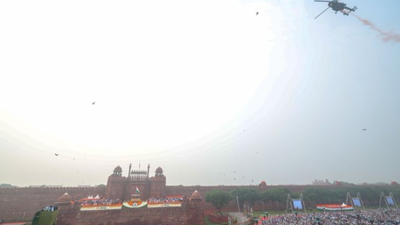
Prime Minister Narendra Modi’s Independence Day address from the Red Fort this year placed defence achievements at the centre of India’s national narrative. In his speech, the Prime Minister highlighted that defence production has grown nearly fourfold in the past twelve years, since his government came to power.“In the last 12 years, defence production has increased by four times. We have to become global supplier by leveraging next generation defence technology,” PM Modi said in his speech from Red Fort.The defence sector is an important pillar of the Atmanirbhar Bharat campaign. This rise in defence production demonstrates how the country is reducing dependence on foreign suppliers and is steadily building capabilities that match its strategic ambitions.PM Modi’s remarks are part of a larger story of high-tech industrial expansion, which is also visible in electronics and mobile phones manufacturing, sectors that have all seen exponential growth. Defence was positioned as both a beneficiary and a driver of this transformation.India’s defence budget has risen from Rs 2.53 lakh crore in 2013–14 to Rs 7.85 lakh crore in the current financial year 2026–27. At the same time the capital expenditure, or the defence procurement budget has more than doubled to Rs 2.19 lakh crore. This investment has gone into strengthening infrastructure, procuring advanced weapon systems, capability enhancement and technological modernisation of the forces.Policy reforms under the Atmanirbhar Bharat project and greater private sector participation have accelerated defence manufacturing, positioning India as an emerging global hub in this sector. Defence exports, another success story, have also surged from Rs 686 crore in 2013–14 to Rs 38,424 crore in 2025–26, a considerable growth of over 5500%. Nearly 65% of defence equipment needed by the armed forces is now produced domestically, significantly reducing dependence on imports.Research and innovation have been a top priority area, the defence R&D allocation has more than doubled to Rs 29,100 crore, with a quarter of the budget now accessible to industry, start‑ups and academia. The Technology Development Fund has supported 80 projects worth Rs 334 crore, with grants of up to Rs 50 crore for critical technologies.DRDO’s Industry Academia Centres of Excellence, now numbering 15, are steering research across 82 verticals. These initiatives reflect a deliberate effort to build a deep‑tech ecosystem that can sustain long‑term military capability. These achievements are part of the larger strategic vision for 2047. The PM also spoke about energy independence as part of national security, citing nuclear energy targets of 100 GW by 2047 as part of a resilience strategy.India is moving from being a major importer to a producer and exporter of defence systems, with indigenous platforms such as Tejas fighters, missile systems and naval assets forming the backbone of this domestically developed capability. This transformation is a message to adversaries and partners alike that India is building a military‑industrial base capable of sustaining its strategic ambitions. PM Modi’s speech reinforces that defence modernisation is central to the journey towards Viksit Bharat, and that the path to 2047 will be defined by self‑reliance and innovation.
Defence manufacturing and self-reliance
PM Modi identified defence power as the fifth ‘Shakti’ of the Saptadhara and said India must move from being a defence market to becoming a global supplier of military equipment.“The fifth strength of the Saptadhara is defence power. It is important for us to become self-reliant in defence,” PM Modi said.
Hypersonic technology
PM Modi specifically called for India to take leadership in hypersonic defence technologies.“When the world is thinking about itself, India cannot remain merely a market for the world. We have to become global suppliers. We have to take leadership in hypersonic defence technologies,” said Modi in his 13th consecutive Independence Day speech as prime minister.This was one of the clearest technology-specific defence priorities in his Independence Day address.
Drones and counter-drone systems
PM Modi also underlined the importance of developing expertise in drones and counter-drone systems, linking these capabilities to India’s broader next-generation defence technology push.The emphasis was on developing indigenous capabilities in emerging military technologies rather than relying on foreign suppliers.
Sudarshan Chakra air defence system
PM Modi referred to the Sudarshan Chakra, an indigenous air defence system announced by him previously, saying work on the project was progressing rapidly.The system is intended to strengthen India’s ability to protect critical military and civilian installations against aerial threats.
Defence exports
PM Modi said India should move beyond meeting its own defence requirements and become a global supplier of military equipment.The second copy also states that he said India’s defence exports had increased 50 times, with Indian military hardware and equipment being supplied to nearly 100 countries.This was presented as part of India’s broader transition towards becoming a defence manufacturing and exporting power.PM Modi said India’s defence production had increased fourfold over the past 12 years.The broader figures depict domestic defence production reaching Rs 1.78 lakh crore in FY 2025-26, compared with Rs 46,000 crore in 2014.
Defence as part of ‘Shakti Ki Saptadhara’
PM Modi’s defence push forms the fifth stream of the seven-part ‘Shakti Ki Saptadhara’ framework for Viksit Bharat.For defence, the focus is on self-reliance, next-generation technology, domestic production, exports and global leadership.
Manufacturing and defence technology
There is also a broader manufacturing quote from PM Modi that is relevant to defence manufacturing:“We must build a complete value chain. From design to manufacturing, India must establish itself as a trusted global supply chain partner for the world.We must rise to global standards of cost, quality and scale.” PM said.This applies to his wider manufacturing vision, but it is relevant to the defence manufacturing push because PM Modi placed defence production within the larger objective of building complete domestic manufacturing capabilities.
Technology and defence
PM Modi also connected India’s defence ambitions with his broader technology agenda, particularly next-generation communications and advanced technologies:“We have proven our mettle in UPI and digital public infrastructure.Now India has to take digital public technologies to every corner of the world. India has to lead in Next Generation Communication Technology. Made in India 6G should reach every corner–this should be our goal,” PM added.


