
A Florida homeowner covered an entire lawn with cardboard. What happened next turned it into a haven for bees and butterflies

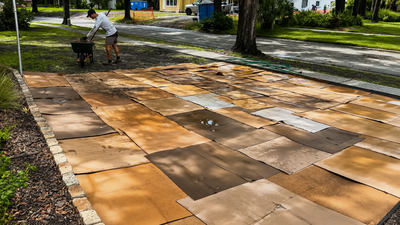
A Florida homeowner took an unconventional approach to transforming a front lawn, covering the existing grass with cardboard before turning the space into a native pollinator garden. What initially looked like a yard buried under layers of discarded packaging was actually the first stage of a deliberate landscaping project designed to replace conventional turf with plants that could support bees, butterflies and other wildlife.The transformation was reported by Food Forest Florida, while a video documenting the project shows how the homeowner approached the process and worked towards creating a more wildlife-friendly landscape. The method may look simple, but it reflects a broader movement among homeowners who are replacing resource-intensive lawns with gardens that offer greater ecological value.
How an ordinary lawn became the starting point for a very different kind of garden
The cardboard was not intended to remain permanently in the garden. Instead, it was being used as a form of sheet mulching, a technique that suppresses existing grass and weeds by cutting off their access to sunlight.The University of Florida’s Institute of Food and Agricultural Sciences (UF/IFAS) recommends sheet mulching as one way to establish new garden beds without having to remove every section of turf. Layers of cardboard or newspaper can be placed over existing vegetation, thoroughly moistened and covered with organic material such as compost or mulch. As the layers break down, the underlying vegetation is suppressed and organic matter is added to the soil.That makes the approach particularly appealing to homeowners who want to replace a lawn without relying heavily on digging or chemical weed control.
The goal was not simply to remove grass, but to bring wildlife back
Once the lawn was suppressed, the larger goal was to create a native pollinator garden rather than simply replace grass with ornamental plants.Pollinator gardens provide flowers, shelter and other resources for bees, butterflies and other insects. The National Park Service’s Southeast pollinator planting guidance, which includes Florida, recommends using regionally appropriate native plants and creating a mixture that can provide floral resources across different seasons.That matters because a lawn dominated by a single grass species offers relatively little food or habitat compared with a diverse planting of flowering plants, shrubs and grasses.UF/IFAS also notes that residential yards can play an important role in supporting pollinators, particularly as urban development fragments natural habitats.
Florida’s native bees need more than flowers
A pollinator-friendly garden is not simply about planting the brightest flowers available. The plants need to be suited to the local environment and provide resources at different times of the year.Florida has more than 315 native bee species, according to UF/IFAS Extension, including species found nowhere else. Many native bees are solitary rather than living in large colonies, and a substantial proportion nest in the ground. Providing suitable flowering plants alongside nesting opportunities can therefore make a garden considerably more useful to them.UF/IFAS also recommends using a mixture of native species that flower throughout the year when establishing pollinator habitat. This creates a more dependable supply of nectar and pollen rather than concentrating resources into one short flowering period.
A front-yard garden can become a small patch of habitat
Replacing a lawn may seem like a small change when viewed from a single property, but residential gardens collectively occupy a substantial amount of land. That makes them potentially valuable pieces of fragmented habitat, particularly in urban and suburban areas.Research involving 1,598 Florida residents titled ‘How can residents protect and promote pollinators? The diffusion of residential pollinator-friendly gardening’ found that interest in pollinator-friendly gardening was relatively high, although actual adoption remained limited. The researchers also identified perceived complexity and neighbourhood or homeowners’ association rules as some of the barriers that can discourage people from making the change.A visible project such as this one can therefore serve another purpose: showing other homeowners that a pollinator garden does not necessarily require an elaborate landscape redesign from the beginning.
The cardboard will disappear, but the garden can keep growing
Sheet mulching is ultimately a transition rather than the finished landscape. The cardboard gradually decomposes, while mulch and organic matter become part of the developing soil. What remains is the vegetation planted above it and, if the garden is managed well, an increasingly established habitat for insects.The homeowner’s project shows how a familiar material that would normally be thrown away can temporarily serve a practical purpose in changing a landscape. More importantly, it challenges the assumption that a front yard has to remain a closely mown stretch of grass.With suitable native plants, a former lawn can become a place where bees forage, butterflies find food and other insects find shelter. The cardboard is only the beginning; the real transformation happens when the lawn gives way to a living, diverse garden.


