
The Centre for Policy Research and Governance (CPRG) on Thursday launched its Governance Dialogue series with a multi-stakeholder discussion on “District Led Development: Grassroots Stories, National Outcomes” NEW DELHI: The Centre for Policy Research and Governance (CPRG) on Thursday launched its Governance Dialogue series with a multi-stakeholder discussion on “District Led Development: Grassroots Stories, National Outcomes”, bringing together senior bureaucrats, policymakers, industry representatives, academics and media professionals to deliberate on strengthening governance through district-level administration.Addressing the inaugural session at the India International Centre, Tata Institute of Social Sciences (TISS) vice chancellor prof. Badri Narayan stressed the need to bridge the gap between grassroots aspirations and policymaking.”There is a real gap between how grassroots communities articulate their needs and how policy is conceptualised at the top, the language of the margins, the district and the policymaker are often very different, and what is needed is translation between them. That is precisely the gap platforms like CPRG can help bridge, by working from the bottom up,” he said, adding: “Grassroots aspirations are changing rapidly, precisely because government schemes have succeeded in meeting basic necessities, and as development changes people’s lives, it also changes what they aspire to next. The district is where this change must be understood, as it is not merely an administrative unit but a socio-cultural one, closest to the people at the margins.”Delivering the keynote address, joint secretary in the Department of Land Resources, Ministry of Rural Development, Parikipandla Narahari (IAS), said: “There is often a gap between people’s felt needs and their real needs, and closing it is at the heart of good governance. More often than not, the disconnect lies not in policy itself but in implementation, how a policy is carried out on the ground is what matters most for a policymaker. Once implementation is strengthened at the district level, the policies we design naturally come closer to the people they are meant to serve.”Major General K. Narayanan, programme director (Security and Strategic Affairs) at NITI Aayog, who attended as the chief guest, said: “The soul of India lives in its villages, and the district is our basic unit of governance. It is here that policy becomes people, budgets become schools, roads and hospitals, and governance acquires a humane face. For a developed India, policies cannot be made in Delhi alone, they must be shaped from Leh to Lakshadweep. Real innovation happens at the grassroots, and development at that level rests on a few simple principles: trust the district administration, celebrate innovation, measure outcomes rather than expenditure, and learn from one another, for diversity is our strength. In the end, development is about people, and even the smallest village or a single woman entrepreneur can be a force to be reckoned with.”PollVote & Share your viewDo you believe that grassroots participation is essential for effective governance?YesNo3k+ users shared opinion today 5k+ users already voted today 3k+ users shared opinion today Share OpinionThe first panel discussion featured Jalna District Collector Ashima Mittal, Indian Oil Corporation Executive Director (CSR) Bibhuti Ranjan Pradhan and The Economic Times Senior Editor Anubhuti Vishnoi. Panellists highlighted community participation in district development, the use of artificial intelligence in policymaking, and the need to move beyond infrastructure indicators towards quality-of-life outcomes.Join conversationView All Comments →Share your thoughts in the commentsInsightfulAgreeDisagreeSkepticalConcerningPromisingWorth ReadingBig DevelopmentPost CommentBe respectful · TOI community guidelinesThe second panel, comprising NTPC Executive Director (HR) Premlata, National Centre for Disease Control Deputy Director Dr. Avinash Sunthlia, CNN-News18 Senior Associate Editor Madhuparna Das and CPRG Senior Resident Fellow Banuchandra, discussed integrating government schemes, strengthening grassroots healthcare systems and promoting citizen participation in governance.CPRG said the Governance Dialogue series will continue in the coming months to foster sustained engagement among government, industry, academia and the media on public policy and governance issues.Get the latest India News and Live updates. Download the TOI app.About the AuthorTOI News DeskThe TOI News Desk comprises a dedicated and tireless team of journalists who operate around the clock to deliver the most current and comprehensive news and updates to the readers of The Times of India worldwide. With an unwavering commitment to excellence in journalism, our team is at the forefront of gathering, verifying, and presenting breaking news, in-depth analysis, and insightful reports on a wide range of topics. The TOI News Desk is your trusted source for staying informed and connected to the ever-evolving global landscape, ensuring that our readers are equipped with the latest developments that matter most.”Read MoreEnd of ArticleFollow Us On Social MediaVideosJharkhand’s ‘Sonam Wangchuk 2.0′ Devendra Nath Mahato Enters Day 5 Of Indefinite Hunger Strike Fast’Not Enemies’: Rijiju Meets Rahul Gandhi Over Sansad Logjam, Reacts To Amit Shah Statement DemandAtiq Ahmed’s Youngest Son Abaan Dies In Jhansi Road Accident, Conflicting Accounts Emerge Over Crash‘Youth Wants CJP To Become Political Party’: Dipke, Saurav Das Announce ‘Kya Bolti Public’ CampaignBombay HC Convicts Tehelka Founder Tarun Tejpal In 2013 Sexual Assault Case; Reverses 2021 AcquittalThe Bankipur Effect: How One Bypoll Has Put BJP’s Upper-Caste Strategy Under The SpotlightSupreme Court Frees Man After 22 Years In Jail, Overturns Wrong ConvictionJPSC-JSSC Protesters Hold Tiranga March In Ranchi Ahead Of Aug 10 Assembly Gherao Over Leak RowKanpur-Lucknow Expressway Toll Suspended After Road Slippage, NHAI Acts Against Contractor’It’s My Moral Call To Be Here’: Author Nilotpal Mrinal Joins Ranchi Student Protest123PhotostoriesRakul Preet Singh and Jackky Bhagnani look straight out of modern-day ‘Ramayan’ in regal Gopi Vaid ensembles10 trendy three-letter baby names with beautiful meaningsYour 50s could decide how many years you live without dementia: Study says controlling 3 midlife health risks may add up to 12.6 healthy brain yearsJacqueline Fernandez proves charcoal is the new black in a show-stopping Manish Malhotra ensembleNo parenting book can prepare you for this: 7 powerful lessons every parent only learns through experienceNot everything you were taught was meant to set you free: 8 beliefs every woman needs to unlearn to finally live life on her own terms5 simple ways to reheat pizza so it tastes fresh again: Which method works best and why5 subtle signs the universe is preparing you for a new beginningInside Nagma Mirajkar’s dreamy Mumbai home: A massive living room, a balcony with stunning views and more10 money habits you should learn in your 20s to build long-term wealth123Hot PicksSaurav DasDelhi rainAbhijeet DipkeRRB ALP CBT 2 answer keyTN Agriculture BudgetTASMAC OnlineAnkur WarikooUPI transactionsGold rate todayTop TrendingAkhilesh YadavNagpur Rape CaseAbhijeet DipkeTasmac Liquor Online PurchaseJPSC ProtestNagpur Rape CaseDelhi Wife MurderAkhilesh YadavTamil Nadu BudgetPraveen Nettaru Murder Case

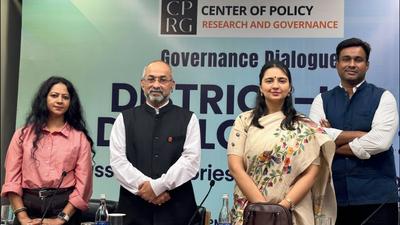
NEW DELHI: The Centre for Policy Research and Governance (CPRG) on Thursday launched its Governance Dialogue series with a multi-stakeholder discussion on “District Led Development: Grassroots Stories, National Outcomes”, bringing together senior bureaucrats, policymakers, industry representatives, academics and media professionals to deliberate on strengthening governance through district-level administration.Addressing the inaugural session at the India International Centre, Tata Institute of Social Sciences (TISS) vice chancellor prof. Badri Narayan stressed the need to bridge the gap between grassroots aspirations and policymaking.“There is a real gap between how grassroots communities articulate their needs and how policy is conceptualised at the top, the language of the margins, the district and the policymaker are often very different, and what is needed is translation between them. That is precisely the gap platforms like CPRG can help bridge, by working from the bottom up,” he said, adding: “Grassroots aspirations are changing rapidly, precisely because government schemes have succeeded in meeting basic necessities, and as development changes people’s lives, it also changes what they aspire to next. The district is where this change must be understood, as it is not merely an administrative unit but a socio-cultural one, closest to the people at the margins.”Delivering the keynote address, joint secretary in the Department of Land Resources, Ministry of Rural Development, Parikipandla Narahari (IAS), said: “There is often a gap between people’s felt needs and their real needs, and closing it is at the heart of good governance. More often than not, the disconnect lies not in policy itself but in implementation, how a policy is carried out on the ground is what matters most for a policymaker. Once implementation is strengthened at the district level, the policies we design naturally come closer to the people they are meant to serve.”Major General K. Narayanan, programme director (Security and Strategic Affairs) at NITI Aayog, who attended as the chief guest, said: “The soul of India lives in its villages, and the district is our basic unit of governance. It is here that policy becomes people, budgets become schools, roads and hospitals, and governance acquires a humane face. For a developed India, policies cannot be made in Delhi alone, they must be shaped from Leh to Lakshadweep. Real innovation happens at the grassroots, and development at that level rests on a few simple principles: trust the district administration, celebrate innovation, measure outcomes rather than expenditure, and learn from one another, for diversity is our strength. In the end, development is about people, and even the smallest village or a single woman entrepreneur can be a force to be reckoned with.”
Do you believe that grassroots participation is essential for effective governance?
3k+ users shared opinion today
5k+ users already voted today
3k+ users shared opinion today
Share Opinion
The first panel discussion featured Jalna District Collector Ashima Mittal, Indian Oil Corporation Executive Director (CSR) Bibhuti Ranjan Pradhan and The Economic Times Senior Editor Anubhuti Vishnoi. Panellists highlighted community participation in district development, the use of artificial intelligence in policymaking, and the need to move beyond infrastructure indicators towards quality-of-life outcomes.
Share your thoughts in the comments
Be respectful · TOI community guidelines
The second panel, comprising NTPC Executive Director (HR) Premlata, National Centre for Disease Control Deputy Director Dr. Avinash Sunthlia, CNN-News18 Senior Associate Editor Madhuparna Das and CPRG Senior Resident Fellow Banuchandra, discussed integrating government schemes, strengthening grassroots healthcare systems and promoting citizen participation in governance.CPRG said the Governance Dialogue series will continue in the coming months to foster sustained engagement among government, industry, academia and the media on public policy and governance issues.


