
The world’s largest waterfall isn’t on land. It is hidden beneath the ocean, where billions of litres of water plunge every second | World News

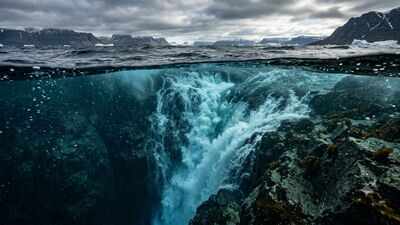
For most people, the world’s largest waterfall brings to mind towering cliffs, crashing water and famous landmarks such as Niagara or Angel Falls. Yet Earth’s biggest waterfall is nowhere to be seen. It lies hidden deep beneath the ocean between Greenland and Iceland, where an extraordinary natural process has been taking place for thousands of years. Every second, billions of litres of icy, dense seawater sink beneath warmer Atlantic waters, creating a vast underwater cascade that dwarfs any waterfall on land. Although invisible from the surface, this remarkable phenomenon plays a crucial role in the movement of ocean currents and the global climate system. Here’s how this hidden giant forms, why it exists and why scientists continue to study it so closely.
The unusual science behind a waterfall beneath the ocean
The Denmark Strait sits between Greenland and Iceland, connecting the Nordic Seas with the North Atlantic. At first glance, nothing at the surface hints at what is happening below. Ships cross the area without seeing any visible sign of the enormous movement taking place hundreds of metres beneath them.Unlike waterfalls on land, this one exists entirely within the ocean. Cold, dense seawater moves beneath a layer of warmer and lighter Atlantic water. As it reaches an underwater ridge, gravity draws the heavier water downslope, producing what scientists describe as an underwater overflow rather than a free-falling sheet of water.
How the seafloor turns an ocean current into a waterfall
Seawater behaves differently depending on how cold and salty it is. Water arriving from the Nordic Seas is colder and denser than the relatively warmer water of the Irminger Sea to the south, as reported by NOAA. When the two meet, the heavier water naturally settles beneath the lighter layer.That change in density allows the cold water to cross the Denmark Strait sill before descending along Greenland’s continental slope. The underwater landscape provides the drop, while gravity does the rest.Rather than plunging vertically, the dense current follows the contours of the seabed over a long distance. Friction, the shape of the ocean floor and Earth’s rotation all influence the path it takes as it continues southwards.
How much water moves beneath the Denmark Strait
The figures involved are difficult to picture. The descending current transports roughly 3.5 million cubic metres of water every second, equivalent to about 3.5 billion litres continuously moving through the system.By comparison, the flow over the world’s largest surface waterfalls is only a small fraction of that amount.The vertical descent is also remarkable. Depending on how scientists define the overflow, the drop ranges from roughly 2.4 kilometres to more than 3.5 kilometres. NOAA uses the larger figure when describing the entire underwater cataract system, making it the tallest known waterfall on Earth.These measurements should not be interpreted as a giant cliff hidden beneath the sea. The current gradually descends over sloping terrain rather than dropping in a single vertical plunge.
Why the waterfall’s flow never stays the same
Although the Denmark Strait overflow is often described using a single flow rate, it is far from constant.Oceanographers measure transport in units called Sverdrups, with one Sverdrup representing one million cubic metres of water per second. Different research campaigns have recorded values ranging from roughly 2.5 to five Sverdrups, depending on the period observed, the instruments used and exactly where the measurements were taken.The current also changes as it travels. Turbulence draws surrounding seawater into the dense flow, a process known as entrainment. As a result, the overflow gradually becomes warmer and less dense while the total volume of moving water actually increases downstream.
How researchers monitor the hidden cascade
Studying the world’s largest waterfall requires instruments rather than direct observation.Scientists deploy moorings anchored to the seabed, fitted with current meters, acoustic Doppler sensors and equipment that records temperature, pressure and salinity. Research vessels also lower instrument packages through the water column to build detailed profiles of the dense overflow.The work is demanding. Equipment must withstand strong currents and great depths for long periods, while fishing activity and rough conditions can threaten expensive moorings. Because the flow varies over days and weeks, a single survey only captures one moment within a much larger system.
How the underwater cascade connects to the Atlantic Ocean
The importance of the Denmark Strait overflow extends well beyond the waterfall comparison.After descending into the deep Atlantic, the dense water becomes part of the lower branch of the Atlantic Meridional Overturning Circulation, a network of ocean currents that redistributes heat, salt and water around the Atlantic basin.The overflow from Denmark Strait is only one contributor to this larger circulation, alongside other deep-water pathways from the Nordic Seas. Even so, it represents one of the principal routes through which dense northern waters reach the deep North Atlantic.Scientists continue to study how these overflows respond to long-term changes in ocean temperature, freshwater input and climate because they form part of a much broader system that influences conditions across the Atlantic.


