
Why Romania’s ‘walking forests’ seem to move without anyone noticing

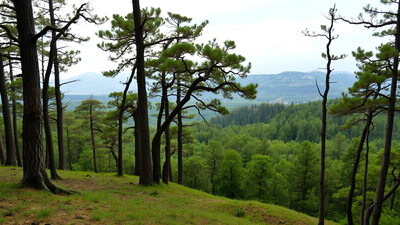
Across parts of Romania, particularly in the Buzau region and the foothills of the Carpathian Mountains, locals have long spoken of walking forests, clusters of trees that seem to shift their position year after year, leaning further downhill or subtly rearranging themselves over time. The movement is far too slow to see happening in real time, but stretched across several seasons, entire groves visibly tilt in the same direction, almost as if the trees themselves had decided to relocate. The phenomenon sounds like folklore, and for generations it was treated as one, but the real explanation lies in a slow, steady geological process called soil creep, one that scientists have only recently begun to measure with real precision using the trees themselves as a kind of natural record keeper.
What is soil creep: The hidden force moving Romanian hillsides one millimetre at a time
Soil creep describes the extremely slow, gravity driven downhill movement of the uppermost layer of earth on a slope, distinct from faster, more dramatic events like landslides, snow avalanches or rockfalls. In many Romanian valleys, the ground beneath the surface is a mix of clay, sand and mineral rich underground springs, a combination that makes the terrain especially prone to this kind of gradual shift. When rain soaks into this soil, water fills the tiny gaps between individual particles, softening the earth and making it more slippery than usual. Once a hillside has loosened enough, its entire top layer begins to slide, sometimes moving just a few millimetres in an entire year, a pace so gradual it is essentially invisible on any single day.
How trees end up moving with the land
Trees rooted in this shifting layer of soil get carried along with it rather than being left behind. As the ground beneath a tree slowly slides downhill, its trunk tilts a little more each year in the direction of that movement, and because the roots stay partly anchored in place even as the surrounding soil moves, the tree does not topple over; it simply leans further and further as the years pass. Over a period of many years, an entire cluster of trees on a creeping slope can end up visibly displaced from where it originally stood, giving the unmistakable impression that the forest itself has quietly walked some distance downhill.
Reading the story hidden inside tree rings
Because trees essentially record their own history year by year, scientists have found a clever way to measure soil creep by studying the internal structure of tree trunks rather than simply watching from the outside. According to a study published in the journal Catena, researchers examined more than a hundred tree ring samples taken from Norway spruce trees growing on a creeping slope in the Balea glacial valley of the Fagaras Mountains, part of Romania’s Southern Carpathians. As a tree trunk gets pushed sideways by moving soil, it responds by growing extra wood on one side to compensate and stay upright, producing a lopsided or pistol shaped base that is clearly visible once a cross-section of the trunk is examined. By counting and measuring these uneven growth rings across many trees, the researchers were able to reconstruct decades of soil movement, identifying a rough pattern of creep episodes recurring roughly every seventeen years on average.
What speeds the movement up and what slows it down
The same study found that soil creep in this region is influenced by a combination of factors working together rather than any single cause. Steep slopes, certain types of underlying rock, heavy rainfall and repeated cycles of freezing and thawing all appeared to make the ground more likely to shift, while construction activity on the slope, in this case related to Romania’s well known Transfagarasan mountain highway, was found to have measurably sped up the creep process even further. Underground mineral springs found across many of these hillsides add another layer to the problem, since they keep the soil consistently damp even during drier months, providing a steady source of lubrication that helps the ground continue gliding downhill even when rainfall itself is limited.
Why this slow moving mystery matters
Unlike a landslide, soil creep rarely causes sudden destruction or poses any immediate danger, which is exactly why it has historically received far less scientific attention despite being remarkably common across mountainous regions. Yet understanding it still matters, since areas experiencing active creep are often the same slopes that eventually give way to more serious landslides if conditions worsen, meaning a forest of steadily leaning trees can serve as an early, natural warning sign long before any dramatic collapse occurs. For the villagers who have watched these hillsides for generations, the walking forest has always carried a certain sense of mystery, but the science now paints a clearer picture, the land itself is quietly and continuously on the move, and the forest is simply going along for the ride, one imperceptible millimetre at a time.


