
4 burnt alive in car, 7 die fleeing on foot in deadly Spain wildfire

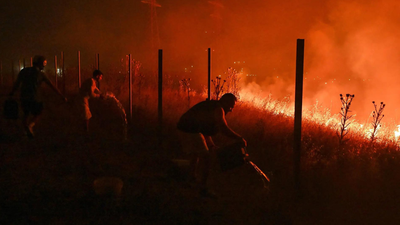
At least 12 people were killed after a wildfire swept through southern Spain overnight into Friday, authorities said, making it one of the country’s deadliest wildfires on record as soaring temperatures continued to grip large parts of the nation.The wildfire broke out in a hamlet in a semi-arid area near the Sierra de Los Filabres mountains. While authorities have not confirmed the cause, they said callers who reported the incident suggested a fallen power line may have sparked the blaze, which quickly spread into a nearby forest.Antonio Sanz, head of emergencies in Spain’s Andalusia region, said residents of Bedar had been advised either to evacuate through a designated route or remain indoors, depending on their proximity to the advancing wildfire.Sanz said four people, who appeared to be British as their car had a right-hand drive steering wheel, were found dead inside one vehicle. Seven others were found dead after apparently abandoning their vehicles and attempting to flee on foot.“In situations like this, it is essential that we all follow the routes indicated,” he was quoted as saying by AP. “Unfortunately in this instance a decision was taken to use another route that wasn’t the one recommended for evacuation. Looking for another way out via a dry riverbed turned out to be a trap,” he added.Spain has long grappled with devastating wildfires. According to the European Forest Fire Information System, last year’s fire season scorched more than 393,000 hectares (about 1,520 square miles), an area nearly twice the size of London, and claimed four lives.Strong winds, soaring temperatures and prolonged dry conditions often allow small fires to escalate into large, uncontrolled wildfires.In June, Spain endured several days of record-breaking heat, with more than 1,000 excess deaths attributed to extreme temperatures.Europe remains the world’s fastest-warming continent, with temperatures rising at twice the global average since the 1980s, according to the European Union’s Copernicus Climate Change Service. Parts of Western Europe are currently experiencing their third heatwave in six weeks, while 2025 was the third-hottest year on record globally, bringing a series of intense heatwaves across the continent.


