
Why Donald Trump cosying up to Xi may leave India out in cold?

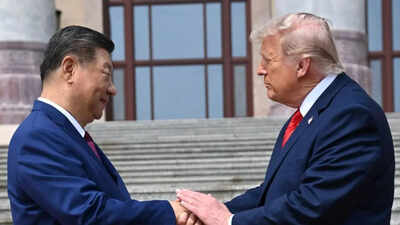
NEW DELHI: As Donald Trump is in Beijing for his first China visit as US President in nine years, the optics were striking. The visit came after months of tariff tensions, strategic posturing and sharp rhetoric between Washington and Beijing. Yet, as Trump exchanged warm words with Xi Jinping, calling him a “great leader” and a “friend”, it became increasingly clear that the world’s two largest powers were exploring a more stable equation. For India, that possibility might be both reassuring and unsettling. New Delhi has spent the past few years carefully balancing improving ties with both Washington and Beijing. Relations with China are slowly thawing after years of border tensions, while India and the US continue to deepen trade and strategic cooperation. But if the US and China move from rivalry to accommodation, India risks losing the strategic leverage that comes from being the crucial balancing power in Asia.
Trade ties
India occupies a unique geopolitical position. It is simultaneously a strategic partner of the US and an increasingly important economic player for China. Recent months have seen signs of a reset in India-China ties. New Delhi has relaxed restrictions on select Chinese investments, including in electronics and solar sectors, while both sides are cautiously moving toward stabilising border relations. At the same time, India-US economic ties remain robust. India’s exports to the US rose to $87.3 billion in 2025-26, while imports climbed to $52.9 billion. Even as the trade surplus narrowed, Washington remains India’s most important Western economic partner. This dual engagement has allowed India to pursue strategic autonomy, maintaining partnerships with competing global powers without fully aligning with either side.
Why warming US-China ties worry India?
The problem for New Delhi is that its geopolitical value rises when Washington and Beijing are locked in competition. For years, the US viewed India as a strategic counterweight to China in the Indo-Pacific. That logic powered the revival of the Quadrilateral Security Dialogue (QUAD) involving India, the US, Japan and Australia. But if the US and China begin stabilising ties, India’s importance in American strategic calculations could diminish. A US-China understanding on trade, tariffs and supply chains may reduce Washington’s urgency to invest heavily in India as an alternative manufacturing and geopolitical hub. The concern becomes sharper because India and China are direct economic competitors. If tariffs on Chinese goods ease or supply chains normalise, global investors could prefer China’s mature infrastructure and manufacturing ecosystem over India’s emerging capabilities.The anxiety is particularly visible in the semiconductor sector. Experts have warned that India must rapidly scale up its domestic chip design capabilities as competition from China intensifies. The concern has deepened after the US lifted restrictions on exports of Electronic Design Automation (EDA) software to Chinese firms, a move that could significantly strengthen China’s semiconductor ecosystem. For India, which is positioning itself as an alternative global electronics and chip manufacturing hub, improved US-China technology cooperation could widen the gap in advanced manufacturing capabilities and reduce India’s competitive advantage.
The Quad question
Trump’s unpredictability adds another layer of uncertainty. During his first term, he aggressively pushed the Quad framework as a counterweight to China. But in his second term, the grouping appears to have drifted into strategic ambiguity. There has been little movement on a leaders’ summit, and recent US strategic documents barely reference the Quad. Despite grand promises between 2021 and 2024 on maritime security, infrastructure and emerging technologies, the grouping has struggled to translate rhetoric into concrete outcomes. For India, this matters because the QUAD was never just a diplomatic platform — it was insurance against Chinese dominance in the Indo-Pacific. If Washington quietly deprioritises the grouping while simultaneously improving ties with Beijing, New Delhi could find itself strategically exposed.
China-Pak factor
Even as India-China relations improve, core tensions remain unresolved. Recently, India publicly criticised China for shielding Pakistan-based terrorist infrastructure after Beijing acknowledged providing support to Pakistan during Operation Sindoor. This highlights a hard reality that China may improve economic engagement with India while continuing to support Pakistan strategically. A warmer US-China relationship could also leave India more isolated on sensitive security issues, especially if Washington avoids confronting Beijing directly.
Why Taiwan is crucial
Taiwan may appear geographically distant from India, but its future has enormous implications for New Delhi. During the summit, Xi warned Trump that mishandling Taiwan could lead to “conflict” between the two powers.“The Taiwan question is the most important issue in China-US relations,” Xi said, according to remarks published by Chinese state media shortly after the start of the talks. “If mishandled, the two nations could collide or even come into conflict, pushing the entire China-US relationship into a highly perilous situation,” he added. For India, any crisis in the Taiwan Strait would be economically devastating. Taiwan sits at the centre of critical global semiconductor and technology supply chains. A conflict involving China and the US could disrupt Asian trade networks and severely impact India’s economy.According to Bloomberg Economics, war over Taiwan could cost nearly $10 trillion to the world, roughly 10% of global GDP, far exceeding the economic damage caused by the Ukraine war, the Covid-19 pandemic, or the Global Financial Crisis. Beyond economics lies the larger strategic concern. If China succeeds in asserting dominance over Taiwan, it could accelerate the emergence of a China-centric Asian order. India’s long-term ambition depends on a multipolar Asia where no single power dominates the region. Chinese hegemony in the Indo-Pacific would fundamentally weaken India’s strategic space.
Why ‘balancing’ act works better for India
India’s ideal scenario is not a complete breakdown in US-China ties, but neither is it a close partnership between them. New Delhi benefits most when Washington and Beijing compete, cooperate selectively, and continue balancing each other. That environment allows India to maximise its strategic autonomy, working with the US on defence and Indo-Pacific security while simultaneously engaging China through platforms like Brics and Shanghai Cooperation Organisation. China backing India’s Brics chairmanship this year, and India supporting China for 2027, reflects this pragmatic balancing approach.
What can India do next?
As US-China dynamics evolve, India may need to diversify its geopolitical bets. Strengthening ties with the European Union, Association of Southeast Asian Nations and middle powers in the Indo-Pacific could help reduce overdependence on either Washington or Beijing. India’s challenge now is not simply managing China or strengthening ties with the US. It is preparing for a world where the two superpowers may decide they need each other more than they need India.


