
Types Of Tears: What are tears? Are the emotional sobs and tears from chopping onions the same?

Have you ever chopped onions and felt those stinging tears, only to ugly-cry later over a sad movie?Tears might seem just simple solutions of salt and water from your eyes, but they’re way more interesting. They’re your body’s Army knife, handling a lot of things from taking care of the eyes to emotions.Tears are produced by our body almost non-stop, forming an invisible layer over the eyes, but sometimes they flood out in response to joy, pain, or even laughter.So are the tears produced at all occasions the same?Let’s break down
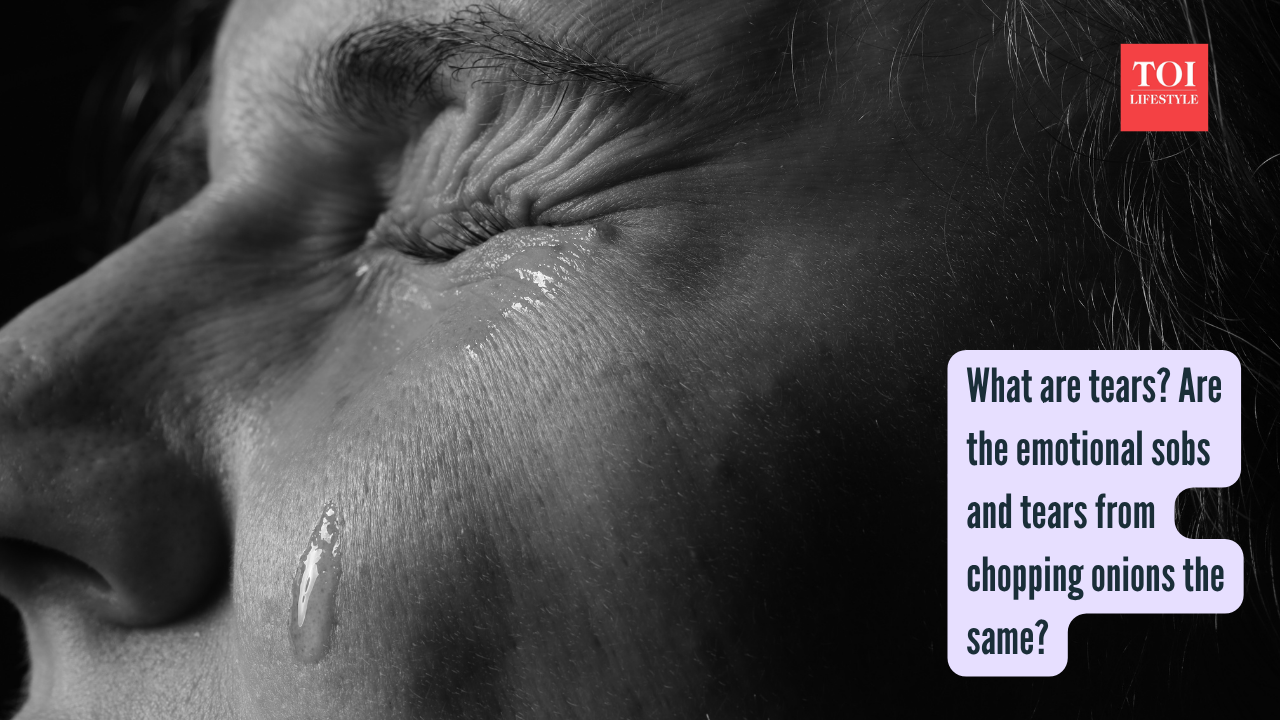
Representative Image
There are three types of tears
Humans make three main tears: basal, reflex, and emotional. Basal ones constantly coat our eyes, with proteins like lysozyme to fight bacteria and lipids to stop drying. Reflex tears gush out from irritants like onions or smoke, and are mostly water to flush threats out of the eyes almost instantly.Emotional tears come into play during strong feelings, like sadness, joy, anger and are unique to us. They flow slower but carry stress hormones like ACTH and painkillers like enkephalin, possibly dumping emotional baggage. All come out via the same ducts, but chemistry sets them apart.
How tears are made
Tears start in lacrimal glands above your eyes, triggered by nerves. According to the Smithsonian, reflex tears drain out from corneal sensors after spotting irritants, like onion gas vapor and irritates like tear gas. The trigeminal nerve instructs the glands to flood.Emotional tears route through the limbic system or brain’s emotion hub, activating parasympathetic nerves with acetylcholine, in simpler words, using the brain’s “rest and relax” chemical messenger to trigger calming body responses.In this case, no irritant is needed, feelings alone do it. Basal tears hum along via accessory glands for steady lube. All mix water, salts, but extras vary by the type.
So are emotional tears and onion tears same
Onion tears, are reflex tears or are basic rinsers with high water, low proteins, no hormones. According to the Cleveland Eyeclinic, emotional tears have more, around 24% higher protein, plus prolactin, ACTH for stress, and Leu-enkephalin as natural opioids. Studies by William Frey found emotional ones relieve tension by excreting buildup.Even sad and emotional ones are different from each other, in 2013, American photographer Rose-Lynn Fisher used an electron microscope to capture the structure of 100 different human tears.Microscopically, dried reflex tears form spiky crystals, emotional ones swirl with organics from hormones. Both sting a bit, but emotions add face flushing and sobs though brain links.


