
This air fryer trick makes perfect poached eggs without boiling water

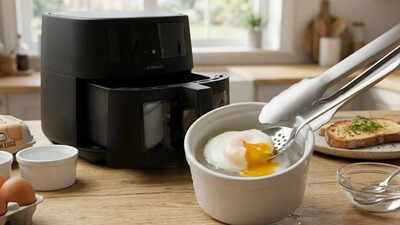
Poached eggs have long been viewed as the ultimate test of a person’s patience in their own home kitchen; you start by meticulously stirring water so it’s at a steady simmer before adding some white vinegar to help keep the egg whites from spreading apart during cooking. Luckily, with the advent of convection technology, making a poached egg in an air fryer can take much less time than ever before by using a small ovenproof dish (ramekin) filled with water inside your air fryer instead of using a traditional pot of water. An air fryer provides a consistent, hot and dry cooking environment that will allow you to make perfectly poached eggs without creating any mess or risking losing any of the egg white due to dispersion.
How an air fryer convection creates perfect poached eggs without boiling
Egg poaching through conventional means usually requires a low simmering temperature to properly cook the eggs without sacrificing the tenderness of the protein. The air fryer uses heated moving air to rapidly circulate the vessel located in the ramekin and creates a localised steam chamber. This steam chamber creates an even distribution of heat to the egg. In the same way that a frying pan gives off heat from just the bottom of the pan, the convection currents generated from an air fryer allow the convection currents from the air fryer to surround the ramekin. As a result of convection via warm air, the egg whites will set up as a coagulated protein envelope while the yolk remains insulated and liquid. The even ambient temperature of the steam chamber significantly reduces the risk of rubbery textures for rubbery eggs, such as those cooked in the microwave, from occurring.
How to make the perfect poached egg with your air fryer
If you want to create restaurant-quality poached eggs with your air fryer, follow these quick and simple steps to help you with consistency of cooking, temperature management and texture:Preparing the cooking vessel – Spray the inside of a small oven-safe ramekin (or silicone mould) with cooking oil. This allows the cooked egg to easily slide out of the vessel after cooking.The water buffer – Use 2-3 tablespoons of water in the cooking vessel where the egg will be cooked; this mitigates the direct heat, preventing the egg from overcooking during air-frying.Crack open a fresh egg – Carefully crack a freshly opened egg (taken directly from the refrigerator) into the cooking vessel containing the water; be cautious not to break the yolk.Temperature setting for air fryer – Place the cooking vessel in the air fryer. Set the temperature setting on your air fryer to 180 degree Celcius/360 degrees Fahrenheit.Cooking time of egg – Cook eggs approximately 6-7 minutes if you desire a runny yolk and 8-9 minutes for jammy, medium-set yolks.Serving cooked egg – Use a spoon to gently lift out the cooked egg from the water; serve immediately.
Essential equipment and temperature calibration
Using the correct tools is critical in this hack – you must have an oven-proof ceramic ramekin or a food-safe silicone mould that can withstand heat. Precision is very important because if you set your air fryer to the right temperature, you will have enough heat energy to quickly heat the water to cook the egg white before overcooking the egg yolk. If it is set too low, the egg will be undercooked and slimy; if it is set too high, the egg yolk will become solid. A good tip for professionals is to preheat the unit for approximately 2 minutes to ensure that your cooking cycle begins with a stable, accurate temperature.
Timing is everything: The secret to a silky, runny yolk
The most critical variable in the hack is time – usually between 6 and 9 minutes, depending on the wattage of your air fryer. Air fryers produce significant amounts of residual heat even after your timer goes off, which is why you must remove the ramekins quickly with tongs. You should also use a slotted spoon to lift the egg out of its water bath immediately after using tongs to stop the cooking process right away; this will prevent any additional heat from cooking your perfectly runny yolk into a hard-boiled yolk, which will destroy the silkiness that comes from having a perfect cooking experience.


