
Parakeets flying near your home: Science reveals it’s a good sign of change in the local environment

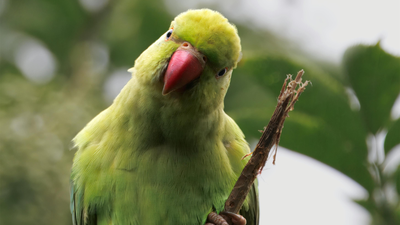
Parakeets fluttering in and out of people’s houses, gardens and urban parks are becoming a regular occurrence in many places. However, experts suggest that the bright green parakeets might actually provide information on climate change, biodiversity, urban ecology, habitat shifts and the state of the environment. In fact, according to the research done on ring-necked parakeets and some other invasive species of birds, changes in temperature, available food and vegetation cover play a crucial role in the settlement patterns of these birds. Thus, parakeets have become an environmental indicator, showing the effect humans have on their surroundings.
Parakeets are adapting quickly to urban environments
Parakeets, especially the ring-necked parakeet Psittacula krameri, are quite successful in urban environments all around Europe as well as parts of Asia. Specialists see the adaptability of these birds as an important factor in understanding changes in the environment.According to scientific findings of the British Trust for Ornithology (BTO), ring-necked parakeets find a warm urban habitat and abundant access to resources such as bird feeders, fruit-bearing trees, and park vegetation. The spreading of these birds has happened in parallel with climate change.British Trust for Ornithology claims,“The species has been able to benefit from milder winters and supplementary feeding in gardens.”The specialists point out that due to the urban heat island effect, the environment stays warmer than its surrounding countryside, which is beneficial for tropical origin birds such as parakeets.The Liebeniz Institute for Research and Evolution and Biodiversity, along with other research institutes, conducted research showing that urban birds quickly adapted their behaviours, eating habits, and nesting preferences to the changes in ecosystems.
What Parakeets can tell us about biodiversity and climate change
Scientists increasingly use bird populations as bioindicators, meaning their behaviour helps track the health of ecosystems. A sudden increase or decline in parakeet populations may point towards environmental disruption.Research published in Global Change Biology found that shifting bird distributions are strongly linked to climate-driven habitat changes. As temperatures rise, species expand into areas that were previously unsuitable.Parakeets are especially noticeable because they are vocal, social and highly visible. Their movement into suburban and residential spaces may suggest changes in native tree cover, altered predator populations or shifts in seasonal weather patterns.A study on ‘A state-of-the-art review on birds as indicators of biodiversity: Advances, challenges, and future directions,’ explained in a university statement:“Birds are often one of the clearest indicators that environmental conditions are changing.”Ecologists also warn that while parakeets can signal thriving green spaces, they may compete with native birds for nesting sites and food resources. This has led researchers to closely monitor their population growth across urban Britain.
Why are people noticing more Parakeets near homes
Several environmental factors contribute to an increase in parakeet sightings in the vicinity of human settlements. Increased milder weather conditions, the widespread introduction of ornamental trees and bird feeding activities are creating perfect habitats within the city environment.As observed by RSPB, ring-necked parakeets have become naturalised residents of several areas in the United Kingdom, such as London and south-east England.Parakeets have been noted to be more easily noticed by people than the gradual changes in the environment around them. Their loud sounds, flocking nature and bright colours make them very easy to spot.Although their presence may add colour to the neighbourhood, scientists say that parakeets have become living environmental indicators. Their presence is an indication of the response of wildlife to urbanisation, changing climates and ecosystems.


