
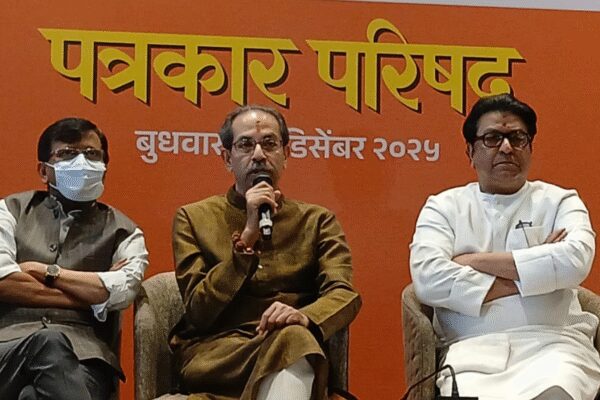
‘Those who can’t bear what’s happening in BJP can join us’: After 20 years, Uddhav & Raj Thackeray reunite ahead of BMC polls
Uddhav & Raj Thackeray reunite ahead of BMC polls MUMBAI: The long-awaited political reunion of the Thackeray brothers came after 20 years, with the two joining hands ahead of the BMC polls on Wednesday.Shiv Sena (Uddhav Balasaheb Thackeray) and the Maharashtra Navnirman Sena (MNS) announced an alliance for the BMC and other civic body elections,…










![The image is used for representation purpose only (AI image) “For every dog bite, death or injury caused to children or elderly, we are likely going to fix heavy compensation by state, for not doing anything. Also, liability and accountability on those who are saying we are feedings dogs. Do it, take them to your house. Why should dogs be littering around, biting, scaring people?” – Justice Vikram Nath (SC judge on 13 January order)“Fear is a primitive cognitive response. Law exists precisely to prevent fear from governing outcomes. Fear should not become policy.” – Maneka Gandhi (Environmentalist and former Minister of Women and Child Development of India)The stray dog debate has pawed its way back into the headlines. For some, stray dogs are the familiar neighbourhood faces with their tails wagging, providing a sense of security. For others, they are a constant source of anxiety, loitering near residential areas or blocking narrow pathways, making daily routines like walking to the bus stop, delivering food or letting children play outside stressful.After the January hearings, the Supreme Court made one thing clear: public safety cannot be compromised in schools, hospitals and other communal spaces. The order holds local authorities accountable for ensuring that children, the elderly and other vulnerable citizens are protected from dog bites, while also reminding feeders and residents to manage their interactions responsibly.Experts warn that removing dogs from their familiar territories without addressing root causes, such as improper waste management, lack of sterilisation, and inconsistent vaccination, may create more problems than it solves. Community dogs are territorial; displacing them can lead to aggressive behaviour, unvaccinated newcomers moving in and even higher risks of bites. “Relocating dogs is unscientific, inhumane, and unsustainable. Directions to remove community dogs from places such as schools, hospitals, railway stations, and public spaces are deeply concerning,” warns Keren Nazareth, senior director, Humane World for Animals, India..January 13 Supreme Court order: What did the bench direct? A three-judge bench of the Supreme Court led by Justices Vikram Nath, Sandeep Mehta and NV Anjaria revisited the issue of stray dogs in Delhi-NCR following a spike in dog bite incidents and public safety concerns. The bench emphasised that human safety, particularly in schools, hospitals, railway stations and other public spaces, must be prioritised. It further stressed that people who feed dogs should manage their interactions responsibly.“Do it, take them to your house. Why should dogs be littering around, biting, scaring people?” Justice Nath observed during the hearing. Justice Mehta, agreeing with his view, said, “Who should be held accountable when dogs attack a 9-year-old? The organisation that is feeding them? You want us to shut our eyes to the problem.” “Who will owe responsibility when stray dog attacks someone? Stray dog can’t be in possession of anyone. If you want [a pet], take license,” Justice Mehta added..The bench also addressed the failures of local authorities in implementing the Animal Birth Control (Dogs) Rules, 2001. They observed that sterilisation, vaccination and monitoring programmes were inconsistently applied, creating gaps that left both humans and dogs at risk.In the court’s view, the state bore primary responsibility for human safety, and authorities who allowed lapses could face strict legal consequences. The judges cautioned that unplanned removal of dogs from familiar territories could create a territorial vacuum, attracting unvaccinated or aggressive newcomers, ultimately increasing bite risks.The bench also flagged widespread non-compliance by civic bodies, observing that people were dying not only due to dog bites but also because of road accidents caused by stray animals.Short-term fixes or long-term vision?A key concern raised by animal welfare groups and legal experts is that the Supreme Court’s recent steps may be focused more on delivering immediate signs of safety than on building lasting solutions.While the court has rightly stressed the need to protect vulnerable citizens, critics argue that without fixing deeper issues, these interventions may ease public anxiety only for the moment, not in the long run.Animal rights advocate Maneka Gandhi has been among those urging the court to look beyond immediate reactions and focus on deeper causes. She argues that lasting solutions cannot come from short-term measures alone and must be rooted in scientific understanding and stronger institutions. Gandhi has also warned that decisions taken out of fear can distract from the real reasons why dog bite incidents happen in the first place.“The Court has judged outcomes without examining causes refusing to ask why incidents occurred despite due process demanding causal inquiry even in the gravest human crimes. Road accidents, governance lapses, waste mismanagement, and enforcement failures have been rhetorically pinned on animals – allowing institutional failure to escape accountability,” Gandhi said..According to her, only evidence-based policies, backed by consistent implementation on the ground, can lead to sustainable outcomes rather than repeated, reactive interventions.Vandana Anchalia, founder of the Kannan Animal Welfare Foundation, believes the current approach misses the core of the problem. She argues that quick, visible actions may create a sense that something is being done, but they fail to address the real issue on the ground.“I wouldn’t even call this a short-term solution. It’s optics. An illusion of action. The only strategy that actually works—ethically, scientifically, and in the long run—is high-coverage ABC with vaccination, backed by proper monitoring and accountability. Anything else is not policy. It’s performative governance, and the consequences will be borne by the most vulnerable citizens,” she said.. Saniya Kinjal Varma, founder of the Theo’s Haven Foundation, says the Supreme Court’s latest order does little to address the stray dog issue, either immediately or over time. With an estimated 62 million community dogs in India, she believes quick fixes simply cannot work.“Removal-based approaches are ineffective, and anyone who has spent time on the ground or understands dog behaviour will attest to this. Mass relocation leads to overcrowded shelters, rapid spread of zoonotic diseases affecting both animals and humans, and immense suffering. It ignores decades of scientific evidence. The only strategy proven to work is consistent Animal Birth Control combined with mass anti-rabies vaccination. This approach reduces population growth, lowers aggression, and is the only realistic pathway for India to aim to become rabies-free,” she said.Rupali Jain, a lawyer with The Guild Advocates, says the debate often falls into broad generalisations, setting dog lovers against those who see them as a threat. She points out that the behaviour of dogs depends largely on their environment: well-fed and cared-for animals are far less likely to be aggressive.“Ultimately, this is about co-existence,” Jain says. She warns that policies are hard to enforce consistently and after a few years, when a serious case occurs then we are back to square one.. Not everyone shares the similar perspective. A local house cook Sangeeta from Noida, who once cared for and fed stray dogs, describes how a dog bite three years ago changed her relationship with animals entirely. She now experiences anxiety whenever she travels for work, particularly to areas where dogs are present.“I used to feed dogs with milk and treat them like part of the neighbourhood. But after I was bitten, I can’t trust them anymore. Whenever I go to places with dogs, I feel scared and followed. I’ve even refused jobs in certain areas because I can’t risk being around them,” she said.Public safety vs unfair punishment: Can removal solve the problem?Animal welfare experts caution that simply removing stray dogs from public spaces may not achieve the intended goal of safety and could create new risks. Keren Nazareth explaining the dilemma said, “These spaces are the only territories these dogs know. Removing them will cause distress and create a territorial vacuum, leading to an influx of unsterilized, unvaccinated, unfriendly dogs, and even rodents, putting public health in risk. Free-roaming dogs should not be inside hospitals; there is no dispute there, and neither should rodents, which can make hospital wards unsanitary, jeopardizing patients’ health and recovery.” Maneka Gandhi argues that focusing on removing stray dogs from public spaces addresses only the visible symptoms, not the deeper causes of human-animal conflict.“The Court has entertained mass sheltering — an impractical, inhumane, corruption-prone, and scientifically discredited approach — while ignoring that the same authorities failed at simpler lawful programs like vaccination and sterilisation,” she said. Vandana Anchalia echoes this concern from a ground-level perspective. She explains, “Public safety should absolutely come first—but removal is not safety, it’s displacement. Dogs don’t randomly appear in schools and hospitals. They are there because of human failures: open garbage, poor waste contracts, irregular sterilisation, and zero on-ground management. Removing the dogs without fixing these conditions doesn’t make people safer—it resets the problem every few weeks.” Saniya Kinjal Varma explains that displacing dogs does not resolve the underlying issues and can make the situation worse.“In a country with 62 million community dogs, removing them from public places only creates a vacuum. These new animals are unfamiliar with the local people, may not be vaccinated or sterilised, and may be aggressive or rabid. It punishes dogs for human administrative failure and does nothing to address the root causes.”.Rupali Jain argues, “Definitely, removing the dogs will not serve any purpose, considering the fact that dogs are territorial animal, who marks their territory. Removing a dog from its natural habitat, from where he has born and grew up, wont serve any purpose, because tomorrow some other dog will come and start residing in that territory.”A delivery worker in Noida explains how stray dogs affect his work and sense of safety: “I try to avoid streets where I know dogs gather. Sometimes I have to take longer routes to avoid dogs chasing me or barking aggressively. Removing dogs from schools or hospitals might make those areas safer, but I’ve seen them in narrow lanes gathering in large number.”He adds that many who advocate strongly for stray dogs have never had to never deliver food during odd hours or experience the fear and anxiety of being chased or bitten.Balancing safety with compassion: What are the solutions? Experts emphasise that lasting public safety does not come from removing or harming dogs, but from building informed and responsible communities.Saniya Kinjal Varma emphasises the role of education and community engagement in ensuring safety. “Education is the foundation of safety. Public awareness is essential. Sterilised and vaccinated dog colonies consistently show reduced populations and significantly lower aggression levels. When people understand animal behaviour, learn how to approach dogs, avoid provoking fear responses, and coexist responsibly, incidents decrease naturally,” she said. Maneka Gandhi emphasise that managing stray dogs is not about moral judgment or assigning blame, it is a complex, science-driven public health challenge.“Community dog management is not a moral debate. It is a scientific and public-health problem involving: veterinary epidemiology, animal behaviour science, urban ecology, waste-management systems, vaccination coverage modelling,” Gandhi points out.While experts stress science-driven approaches and public education as solutions, those working on the ground caution that implementation is key. Policies and court directives can only protect people if they are executed efficiently and consistently. An anonymous security guard for a housing co-operative society explains: “I understand what the Supreme Court is trying to say, and on paper it sounds reasonable. No one is saying dogs should be. The problem is implementation. On the ground, authorities rarely act quickly, and residents are often told to ‘adjust’. Until there is a clear system to keep dogs away from sensitive areas without endless delays or arguments, this balance will remain more theoretical than real.”.What the numbers reveal? According to World Atlas data, India ranks seventh globally in terms of the total number of dogs. Government data collected under the National Rabies Control Programme (NRCP) by the National Centre for Disease Control shows how this plays out on the ground. In 2024 alone, India reported over 3.7 million dog bite cases and 54 suspected human rabies deaths..State-wise figures between 2022 and 2024 point to a steady rise in reported dog bite cases across the country. However, in 2025, the overall number of reported cases fell sharply to around 4.29 lakh.Among the states reporting the highest numbers in 2025 were Maharashtra with 56,538 cases, Gujarat with 53,942 and Tamil Nadu with 48,931..Parliamentary responses reveal that while dog population control is legally the responsibility of states and local bodies, central funding for sterilisation remains limited. Over the last five years, the Animal Welfare Board of India has released relatively small sums for dog sterilisation and vaccination, with annual allocations often amounting to only a few crore rupees nationwide. The Centre has also acknowledged that it does not maintain state-wise data on how much individual state governments spend on these programmes..At the same time, government spending has increasingly focused on managing the health impact of dog bites. Between 2020–21 and 2024–25, the number of approved anti-rabies vaccine doses rose from around 25 lakh to over 80 lakh.. ConclusionThe debate around stray dogs and public safety ultimately exposes a deeper governance gap rather than a simple conflict between humans and animals. Residents who live with daily fear are not asking for cruelty, but for protection. As one resident put it earlier, the problem is not compassion, but the absence of systems that work consistently on the ground. “I know many people love animals, but for people like me, stray dogs are a daily source of fear. I was bitten a few years ago and since then even walking to the gate or taking my child out feels stressful,” the resident recalled. Animal welfare practitioners argue that this breakdown has less to do with flawed policy and more with weak execution. Karen, who has worked closely with local governments, points out that the Animal Birth Control (ABC) framework has rarely been implemented in the way it was designed.Crucially, Karen stresses that safety does not have to become an “us versus them” battle. She explains that community-led approaches work best when they include everyone—not just animal lovers, but also residents who are afraid of dogs. When such people are heard and involved in decisions, trust slowly builds and tensions reduce.About the AuthorPriyanshi RastogiPriyanshi Rastogi is a journalist with The Times of India. She primarily covers national and international news, along with business affairs. Her work focuses on the latest political events, in-depth explainers, features, offbeat articles and viral social media trending stories.Read MoreEnd of ArticleFollow Us On Social MediaVideos‘Amazing In A Bad Way’: Trump Aide Peter Navarro Targets India Over US Power Costs For AI ServicesHindu Petrol Pump Worker Crushed To Death Over Fuel Payment Dispute In Bangladesh‘Helped Infiltrators For Vote Bank’: PM Modi Slams Congress In Poll-Bound AssamNSA Ajit Doval Stresses Balance Between Change And Preserving Culture At Raibaar-7 Event‘BJP Won By Betrayal’: Uddhav Thackeray’s First Reaction On Mumbai Civic Poll ResultsShashi Tharoor Sees Hope Amid Iran Silence, Warns Of Uncertainty As Protests Slow Under BlackoutPM Modi Targets Mamata, Declares ‘Asli Poribortan’ In Malda, Says Bengal Needs BJP For Development‘Protecting Rohingyas And Bangladeshis’: BJP MP Sambit Patra Slams Bengal CM Mamata BanerjeePM Modi Flags Off India’s First Vande Bharat Sleeper Train Between Howrah-Guwahati In BengalEurope Looks East As Italian Envoy Bartoli Calls India Key Partner Amid Global Chaos And Trade Wars123Photostories‘Agatha Christie’s Seven Dials’: More mystery thrillers based on books to watch on OTTBigg Boss Tamil 9: From seventh entrant to finalist—Sabarinathan’s emotional and eventful journey inside the houseTime management mistakes students don’t realise they’re making‘Dhurandhar Part 2’: Look back at Ranveer Singh, Aditya Dhar’s film’s most chilling 26/11 scene ahead of sequel releaseTaarak Mehta Ka Ooltah Chashmah’s Munmun Dutta opens up about her bond with Dilip Joshi, calls Amit Bhatt aka Champak chacha her bestieWinter Special: How to make Choco Lava Cake for midnight munching‘Dhurandar’ OTT release: Decoding Ranveer Singh, Akhshaye Khanna and others’ looks ahead of the film’s digital debut10 fiber-rich broccoli dishes for a filling dinnerFrom a luxurious house worth Rs 2.5 crore in Mumbai to car collection- Sunil Grover’s lavish lifestyleWinter Special: How to make Spinach Rice for dinner123Hot PicksMaharashtra Election ResultsBudget 2026Gold rate todayBank holiday todayVande Bharat sleeperPublic holidays January 2026Bank Holidays JanuaryTop TrendingGracie HuntTravis KelceU19 World CupRyan O’ReillyRoger FedererMaharashtra Civic Poll WinnersChloe KimRoger Federer Net WorthAlex Oxlade and Perrie Edwards Net WorthAndre Agassi and Steffi Graf Net Worth](https://vknewstoday.in/wp-content/uploads/2026/01/1768721432_photo-600x400.jpg "The image is used for representation purpose only (AI image) “For every dog bite, death or injury caused to children or elderly, we are likely going to fix heavy compensation by state, for not doing anything. Also, liability and accountability on those who are saying we are feedings dogs. Do it, take them to your house. Why should dogs be littering around, biting, scaring people?” – Justice Vikram Nath (SC judge on 13 January order)“Fear is a primitive cognitive response. Law exists precisely to prevent fear from governing outcomes. Fear should not become policy.” – Maneka Gandhi (Environmentalist and former Minister of Women and Child Development of India)The stray dog debate has pawed its way back into the headlines. For some, stray dogs are the familiar neighbourhood faces with their tails wagging, providing a sense of security. For others, they are a constant source of anxiety, loitering near residential areas or blocking narrow pathways, making daily routines like walking to the bus stop, delivering food or letting children play outside stressful.After the January hearings, the Supreme Court made one thing clear: public safety cannot be compromised in schools, hospitals and other communal spaces. The order holds local authorities accountable for ensuring that children, the elderly and other vulnerable citizens are protected from dog bites, while also reminding feeders and residents to manage their interactions responsibly.Experts warn that removing dogs from their familiar territories without addressing root causes, such as improper waste management, lack of sterilisation, and inconsistent vaccination, may create more problems than it solves. Community dogs are territorial; displacing them can lead to aggressive behaviour, unvaccinated newcomers moving in and even higher risks of bites. “Relocating dogs is unscientific, inhumane, and unsustainable. Directions to remove community dogs from places such as schools, hospitals, railway stations, and public spaces are deeply concerning,” warns Keren Nazareth, senior director, Humane World for Animals, India..January 13 Supreme Court order: What did the bench direct? A three-judge bench of the Supreme Court led by Justices Vikram Nath, Sandeep Mehta and NV Anjaria revisited the issue of stray dogs in Delhi-NCR following a spike in dog bite incidents and public safety concerns. The bench emphasised that human safety, particularly in schools, hospitals, railway stations and other public spaces, must be prioritised. It further stressed that people who feed dogs should manage their interactions responsibly.“Do it, take them to your house. Why should dogs be littering around, biting, scaring people?” Justice Nath observed during the hearing. Justice Mehta, agreeing with his view, said, “Who should be held accountable when dogs attack a 9-year-old? The organisation that is feeding them? You want us to shut our eyes to the problem.” “Who will owe responsibility when stray dog attacks someone? Stray dog can’t be in possession of anyone. If you want [a pet], take license,” Justice Mehta added..The bench also addressed the failures of local authorities in implementing the Animal Birth Control (Dogs) Rules, 2001. They observed that sterilisation, vaccination and monitoring programmes were inconsistently applied, creating gaps that left both humans and dogs at risk.In the court’s view, the state bore primary responsibility for human safety, and authorities who allowed lapses could face strict legal consequences. The judges cautioned that unplanned removal of dogs from familiar territories could create a territorial vacuum, attracting unvaccinated or aggressive newcomers, ultimately increasing bite risks.The bench also flagged widespread non-compliance by civic bodies, observing that people were dying not only due to dog bites but also because of road accidents caused by stray animals.Short-term fixes or long-term vision?A key concern raised by animal welfare groups and legal experts is that the Supreme Court’s recent steps may be focused more on delivering immediate signs of safety than on building lasting solutions.While the court has rightly stressed the need to protect vulnerable citizens, critics argue that without fixing deeper issues, these interventions may ease public anxiety only for the moment, not in the long run.Animal rights advocate Maneka Gandhi has been among those urging the court to look beyond immediate reactions and focus on deeper causes. She argues that lasting solutions cannot come from short-term measures alone and must be rooted in scientific understanding and stronger institutions. Gandhi has also warned that decisions taken out of fear can distract from the real reasons why dog bite incidents happen in the first place.“The Court has judged outcomes without examining causes refusing to ask why incidents occurred despite due process demanding causal inquiry even in the gravest human crimes. Road accidents, governance lapses, waste mismanagement, and enforcement failures have been rhetorically pinned on animals – allowing institutional failure to escape accountability,” Gandhi said..According to her, only evidence-based policies, backed by consistent implementation on the ground, can lead to sustainable outcomes rather than repeated, reactive interventions.Vandana Anchalia, founder of the Kannan Animal Welfare Foundation, believes the current approach misses the core of the problem. She argues that quick, visible actions may create a sense that something is being done, but they fail to address the real issue on the ground.“I wouldn’t even call this a short-term solution. It’s optics. An illusion of action. The only strategy that actually works—ethically, scientifically, and in the long run—is high-coverage ABC with vaccination, backed by proper monitoring and accountability. Anything else is not policy. It’s performative governance, and the consequences will be borne by the most vulnerable citizens,” she said.. Saniya Kinjal Varma, founder of the Theo’s Haven Foundation, says the Supreme Court’s latest order does little to address the stray dog issue, either immediately or over time. With an estimated 62 million community dogs in India, she believes quick fixes simply cannot work.“Removal-based approaches are ineffective, and anyone who has spent time on the ground or understands dog behaviour will attest to this. Mass relocation leads to overcrowded shelters, rapid spread of zoonotic diseases affecting both animals and humans, and immense suffering. It ignores decades of scientific evidence. The only strategy proven to work is consistent Animal Birth Control combined with mass anti-rabies vaccination. This approach reduces population growth, lowers aggression, and is the only realistic pathway for India to aim to become rabies-free,” she said.Rupali Jain, a lawyer with The Guild Advocates, says the debate often falls into broad generalisations, setting dog lovers against those who see them as a threat. She points out that the behaviour of dogs depends largely on their environment: well-fed and cared-for animals are far less likely to be aggressive.“Ultimately, this is about co-existence,” Jain says. She warns that policies are hard to enforce consistently and after a few years, when a serious case occurs then we are back to square one.. Not everyone shares the similar perspective. A local house cook Sangeeta from Noida, who once cared for and fed stray dogs, describes how a dog bite three years ago changed her relationship with animals entirely. She now experiences anxiety whenever she travels for work, particularly to areas where dogs are present.“I used to feed dogs with milk and treat them like part of the neighbourhood. But after I was bitten, I can’t trust them anymore. Whenever I go to places with dogs, I feel scared and followed. I’ve even refused jobs in certain areas because I can’t risk being around them,” she said.Public safety vs unfair punishment: Can removal solve the problem?Animal welfare experts caution that simply removing stray dogs from public spaces may not achieve the intended goal of safety and could create new risks. Keren Nazareth explaining the dilemma said, “These spaces are the only territories these dogs know. Removing them will cause distress and create a territorial vacuum, leading to an influx of unsterilized, unvaccinated, unfriendly dogs, and even rodents, putting public health in risk. Free-roaming dogs should not be inside hospitals; there is no dispute there, and neither should rodents, which can make hospital wards unsanitary, jeopardizing patients’ health and recovery.” Maneka Gandhi argues that focusing on removing stray dogs from public spaces addresses only the visible symptoms, not the deeper causes of human-animal conflict.“The Court has entertained mass sheltering — an impractical, inhumane, corruption-prone, and scientifically discredited approach — while ignoring that the same authorities failed at simpler lawful programs like vaccination and sterilisation,” she said. Vandana Anchalia echoes this concern from a ground-level perspective. She explains, “Public safety should absolutely come first—but removal is not safety, it’s displacement. Dogs don’t randomly appear in schools and hospitals. They are there because of human failures: open garbage, poor waste contracts, irregular sterilisation, and zero on-ground management. Removing the dogs without fixing these conditions doesn’t make people safer—it resets the problem every few weeks.” Saniya Kinjal Varma explains that displacing dogs does not resolve the underlying issues and can make the situation worse.“In a country with 62 million community dogs, removing them from public places only creates a vacuum. These new animals are unfamiliar with the local people, may not be vaccinated or sterilised, and may be aggressive or rabid. It punishes dogs for human administrative failure and does nothing to address the root causes.”.Rupali Jain argues, “Definitely, removing the dogs will not serve any purpose, considering the fact that dogs are territorial animal, who marks their territory. Removing a dog from its natural habitat, from where he has born and grew up, wont serve any purpose, because tomorrow some other dog will come and start residing in that territory.”A delivery worker in Noida explains how stray dogs affect his work and sense of safety: “I try to avoid streets where I know dogs gather. Sometimes I have to take longer routes to avoid dogs chasing me or barking aggressively. Removing dogs from schools or hospitals might make those areas safer, but I’ve seen them in narrow lanes gathering in large number.”He adds that many who advocate strongly for stray dogs have never had to never deliver food during odd hours or experience the fear and anxiety of being chased or bitten.Balancing safety with compassion: What are the solutions? Experts emphasise that lasting public safety does not come from removing or harming dogs, but from building informed and responsible communities.Saniya Kinjal Varma emphasises the role of education and community engagement in ensuring safety. “Education is the foundation of safety. Public awareness is essential. Sterilised and vaccinated dog colonies consistently show reduced populations and significantly lower aggression levels. When people understand animal behaviour, learn how to approach dogs, avoid provoking fear responses, and coexist responsibly, incidents decrease naturally,” she said. Maneka Gandhi emphasise that managing stray dogs is not about moral judgment or assigning blame, it is a complex, science-driven public health challenge.“Community dog management is not a moral debate. It is a scientific and public-health problem involving: veterinary epidemiology, animal behaviour science, urban ecology, waste-management systems, vaccination coverage modelling,” Gandhi points out.While experts stress science-driven approaches and public education as solutions, those working on the ground caution that implementation is key. Policies and court directives can only protect people if they are executed efficiently and consistently. An anonymous security guard for a housing co-operative society explains: “I understand what the Supreme Court is trying to say, and on paper it sounds reasonable. No one is saying dogs should be. The problem is implementation. On the ground, authorities rarely act quickly, and residents are often told to ‘adjust’. Until there is a clear system to keep dogs away from sensitive areas without endless delays or arguments, this balance will remain more theoretical than real.”.What the numbers reveal? According to World Atlas data, India ranks seventh globally in terms of the total number of dogs. Government data collected under the National Rabies Control Programme (NRCP) by the National Centre for Disease Control shows how this plays out on the ground. In 2024 alone, India reported over 3.7 million dog bite cases and 54 suspected human rabies deaths..State-wise figures between 2022 and 2024 point to a steady rise in reported dog bite cases across the country. However, in 2025, the overall number of reported cases fell sharply to around 4.29 lakh.Among the states reporting the highest numbers in 2025 were Maharashtra with 56,538 cases, Gujarat with 53,942 and Tamil Nadu with 48,931..Parliamentary responses reveal that while dog population control is legally the responsibility of states and local bodies, central funding for sterilisation remains limited. Over the last five years, the Animal Welfare Board of India has released relatively small sums for dog sterilisation and vaccination, with annual allocations often amounting to only a few crore rupees nationwide. The Centre has also acknowledged that it does not maintain state-wise data on how much individual state governments spend on these programmes..At the same time, government spending has increasingly focused on managing the health impact of dog bites. Between 2020–21 and 2024–25, the number of approved anti-rabies vaccine doses rose from around 25 lakh to over 80 lakh.. ConclusionThe debate around stray dogs and public safety ultimately exposes a deeper governance gap rather than a simple conflict between humans and animals. Residents who live with daily fear are not asking for cruelty, but for protection. As one resident put it earlier, the problem is not compassion, but the absence of systems that work consistently on the ground. “I know many people love animals, but for people like me, stray dogs are a daily source of fear. I was bitten a few years ago and since then even walking to the gate or taking my child out feels stressful,” the resident recalled. Animal welfare practitioners argue that this breakdown has less to do with flawed policy and more with weak execution. Karen, who has worked closely with local governments, points out that the Animal Birth Control (ABC) framework has rarely been implemented in the way it was designed.Crucially, Karen stresses that safety does not have to become an “us versus them” battle. She explains that community-led approaches work best when they include everyone—not just animal lovers, but also residents who are afraid of dogs. When such people are heard and involved in decisions, trust slowly builds and tensions reduce.About the AuthorPriyanshi RastogiPriyanshi Rastogi is a journalist with The Times of India. She primarily covers national and international news, along with business affairs. Her work focuses on the latest political events, in-depth explainers, features, offbeat articles and viral social media trending stories.Read MoreEnd of ArticleFollow Us On Social MediaVideos‘Amazing In A Bad Way’: Trump Aide Peter Navarro Targets India Over US Power Costs For AI ServicesHindu Petrol Pump Worker Crushed To Death Over Fuel Payment Dispute In Bangladesh‘Helped Infiltrators For Vote Bank’: PM Modi Slams Congress In Poll-Bound AssamNSA Ajit Doval Stresses Balance Between Change And Preserving Culture At Raibaar-7 Event‘BJP Won By Betrayal’: Uddhav Thackeray’s First Reaction On Mumbai Civic Poll ResultsShashi Tharoor Sees Hope Amid Iran Silence, Warns Of Uncertainty As Protests Slow Under BlackoutPM Modi Targets Mamata, Declares ‘Asli Poribortan’ In Malda, Says Bengal Needs BJP For Development‘Protecting Rohingyas And Bangladeshis’: BJP MP Sambit Patra Slams Bengal CM Mamata BanerjeePM Modi Flags Off India’s First Vande Bharat Sleeper Train Between Howrah-Guwahati In BengalEurope Looks East As Italian Envoy Bartoli Calls India Key Partner Amid Global Chaos And Trade Wars123Photostories‘Agatha Christie’s Seven Dials’: More mystery thrillers based on books to watch on OTTBigg Boss Tamil 9: From seventh entrant to finalist—Sabarinathan’s emotional and eventful journey inside the houseTime management mistakes students don’t realise they’re making‘Dhurandhar Part 2’: Look back at Ranveer Singh, Aditya Dhar’s film’s most chilling 26/11 scene ahead of sequel releaseTaarak Mehta Ka Ooltah Chashmah’s Munmun Dutta opens up about her bond with Dilip Joshi, calls Amit Bhatt aka Champak chacha her bestieWinter Special: How to make Choco Lava Cake for midnight munching‘Dhurandar’ OTT release: Decoding Ranveer Singh, Akhshaye Khanna and others’ looks ahead of the film’s digital debut10 fiber-rich broccoli dishes for a filling dinnerFrom a luxurious house worth Rs 2.5 crore in Mumbai to car collection- Sunil Grover’s lavish lifestyleWinter Special: How to make Spinach Rice for dinner123Hot PicksMaharashtra Election ResultsBudget 2026Gold rate todayBank holiday todayVande Bharat sleeperPublic holidays January 2026Bank Holidays JanuaryTop TrendingGracie HuntTravis KelceU19 World CupRyan O’ReillyRoger FedererMaharashtra Civic Poll WinnersChloe KimRoger Federer Net WorthAlex Oxlade and Perrie Edwards Net WorthAndre Agassi and Steffi Graf Net Worth")