
. New Delhi: The Central Govt Health Scheme (CGHS) has seen strong expansion in five years, with 468 hospitals empanelled nationwide in 2025, far outpacing the 42 hospitals that exited the scheme during the same period. Official data tabled in Parliament showed that despite a rise in exits this year, the overall network has grown sharply, expanding treatment options for lakhs of govt employees and pensioners across the country.A year-wise analysis highlights steady growth with intermittent churn. In 2021, CGHS empanelled 266 hospitals, while 22 exited. Following year saw 275 additions and 20 exits. Expansion accelerated in 2023, when 398 hospitals were empanelled, though exits also rose to 23. In 2024, 363 hospitals joined the network and 13 exited, marking relative stability. The year 2025 stands out for both record empanelment and highest exit count so far — yet still delivers largest net gain in five years..Much of the expansion has come from large, high-demand states. Delhi, which probably is home to the highest number of CGHS beneficiaries, added 189 hospitals in 2025, reflecting both rising CGHS usage and the capital’s dense private healthcare market. UP empanelled 62 hospitals, Rajasthan 31, Haryana 38, Maharashtra 30 and Bengal 42. These additions have significantly widened access, particularly in urban centres where CGHS footfall is heavy.At the same time, exits have been concentrated in a handful of large states. UP recorded 15 exits in 2025, which was around a third of the national number, followed by Karnataka (6), Maharashtra (5) and Delhi (3). Over the past five years, cumulative exits have reached 20 in UP, 19 in Karnataka, 18 in Maharashtra and 11 in Delhi. Beneficiaries say even limited exits can cause disruption, forcing patients to change hospitals mid-treatment, repeat diagnostic tests or travel farther for care — a particular burden for pensioners and those with chronic illnesses.Hospital groups argue that growth in empanelment does not automatically translate into stability. “The numbers show expansion, but retention depends on how smoothly hospitals are paid and how disputes are resolved,” said Association of Heathcare Providers-India member Dr C M Bhagat. He pointed out that while the recent revision of CGHS package rates on Oct 3, effective October 13, 2025, is a step forward, hospitals continue to flag delayed reimbursements and deductions as key reasons for exiting.The health ministry has said CGHS wellness centres are opened based on demand and that cashless treatment is already available to pensioners and other priority groups at empanelled hospitals. As CGHS usage grows in major cities, experts say the challenge ahead is clear: ensuring that rapid expansion is matched by hospital retention and continuity of care, so that beneficiaries experience not just a larger network, but a more reliable one.About the AuthorAnuja JaiswalAnuja Jaiswal is a Senior Assistant Editor at The Times of India, with an impressive 18-year career in narrative journalism. She specializes in health and heritage reporting, expertly simplifying complex health information to make it engaging and understandable for readers. Her deep dives into heritage topics are well-researched, resulting in captivating narratives that resonate with her audience. Over the years, she has worked in Chandigarh, Chhattisgarh and West UP, gaining diverse on-ground experience that shapes her storytelling.Read MoreEnd of ArticleFollow Us On Social MediaVideosIndian Army Displays Turkish Yiiha Drone Used By Pakistan During Operation SindoorPM Modi Arrives In Jordan, Receives Warm Welcome By Indian Diaspora In AmmanUS Starts Mandatory Social Media Checks For H-1B Visas Leaving Indian Professionals Most ExposedBJP’s Succession Script Repeats: Why Nitin Nabin Is Working President, And Not Nadda’s ReplacementEnd Of MGNREGA? What VB–G Ram G Means For Rural Workers, Farmers And Viksit Bharat PlanFrom Missiles To Torpedoes, DRDO Outlines India’s Big Defence Push For Near-Term Battlefield EdgePM Modi Begins Jordan, Ethiopia, Oman Tour To Boost Ancient Ties, Expand India’s Global South RoleIndian Diaspora Members Prepare Cultural Performances Ahead Of PM Modi’s Jordan VisitFrom Power Cuts To 500 GW Grid, India Emerges As Global Data Centre Hub Under Modi: Piyush GoyalCong’s ‘Modi Teri Kabr Khudegi’ Slogan Sparks Uproar, NDA Seeks Apology As Parliament Grinds To Halt123PhotostoriesFrom Chimpanzees to Rats: 5 animals who are smarter than you think!TV actors who married young: From Karanvir Bohra to Vivian DsenaLongest running Hindi TV shows: Taarak Mehta Kaa Ooltah Chasmah’ to ‘Balika Vadhu’Dear Comrade, Pelli Choopulu and Arjun Reddy; Breakthrough performances that redefined the Telugu lover boyDhurandhar, Chhaava, Mom; Challenging roles played by Akshaye Khanna5 adorable pink animals stealing the wildlife spotlight5 beautiful Romeo and Juliet quotes that will steal your hearts‘Damini’, ‘OMG! Oh My God’, ‘Prem Rog’: Bollywood movies that sparked social change and redefined mainstream storytelling5 pet fish that change colour and why it happens6 Traditional egg curries from different parts of the country123Hot Picksilia TopuriaCorona RemediesJetBlue flight VenezuelaGold rate todaySilver rate todayPublic Holidays NovemberBank Holidays NovemberTop TrendingJosh AllenAuston MatthewsVanessa BryantLeBron JamesBukayo Saka and Tolami Benson Net WorthConnor McDavidTomi LahrenAdolis GarciaDeante Ayton MomBrock McGillis


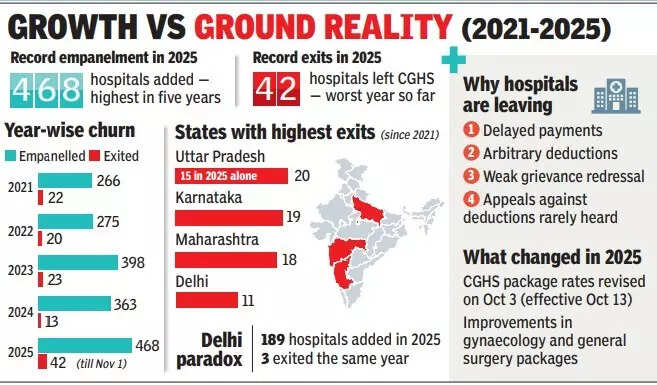
New Delhi: The Central Govt Health Scheme (CGHS) has seen strong expansion in five years, with 468 hospitals empanelled nationwide in 2025, far outpacing the 42 hospitals that exited the scheme during the same period. Official data tabled in Parliament showed that despite a rise in exits this year, the overall network has grown sharply, expanding treatment options for lakhs of govt employees and pensioners across the country.A year-wise analysis highlights steady growth with intermittent churn. In 2021, CGHS empanelled 266 hospitals, while 22 exited. Following year saw 275 additions and 20 exits. Expansion accelerated in 2023, when 398 hospitals were empanelled, though exits also rose to 23. In 2024, 363 hospitals joined the network and 13 exited, marking relative stability. The year 2025 stands out for both record empanelment and highest exit count so far — yet still delivers largest net gain in five years.
.
Much of the expansion has come from large, high-demand states. Delhi, which probably is home to the highest number of CGHS beneficiaries, added 189 hospitals in 2025, reflecting both rising CGHS usage and the capital’s dense private healthcare market. UP empanelled 62 hospitals, Rajasthan 31, Haryana 38, Maharashtra 30 and Bengal 42. These additions have significantly widened access, particularly in urban centres where CGHS footfall is heavy.At the same time, exits have been concentrated in a handful of large states. UP recorded 15 exits in 2025, which was around a third of the national number, followed by Karnataka (6), Maharashtra (5) and Delhi (3). Over the past five years, cumulative exits have reached 20 in UP, 19 in Karnataka, 18 in Maharashtra and 11 in Delhi. Beneficiaries say even limited exits can cause disruption, forcing patients to change hospitals mid-treatment, repeat diagnostic tests or travel farther for care — a particular burden for pensioners and those with chronic illnesses.Hospital groups argue that growth in empanelment does not automatically translate into stability. “The numbers show expansion, but retention depends on how smoothly hospitals are paid and how disputes are resolved,” said Association of Heathcare Providers-India member Dr C M Bhagat. He pointed out that while the recent revision of CGHS package rates on Oct 3, effective October 13, 2025, is a step forward, hospitals continue to flag delayed reimbursements and deductions as key reasons for exiting.The health ministry has said CGHS wellness centres are opened based on demand and that cashless treatment is already available to pensioners and other priority groups at empanelled hospitals. As CGHS usage grows in major cities, experts say the challenge ahead is clear: ensuring that rapid expansion is matched by hospital retention and continuity of care, so that beneficiaries experience not just a larger network, but a more reliable one.


