
NEW DELHI: Nearly two years after the NEET-UG 2024 paper leak controversy and following the unprecedented cancellation of NEET-UG 2026, central govt is examining a hybrid examination model under which question papers could be digitally transmitted to centres and printed locally under secure conditions. Officials said this is being considered a safer alternative because conducting a fully online exam for 23 lakh candidates remains difficult due to infrastructure and logistical challenges.A senior health ministry official said discussions on possible reforms in NEET are expected in coming days between health ministry, National Medical Commission (NMC) and National Testing Agency (NTA), including whether parts of the examination process can be digitised.Officials said the proposed “computer-assisted secure paper-based test”, recommended by Radhakrishnan Committee, is emerging as a possible middle path between fully offline and fully computer-based examinations. Under the proposal, encrypted question papers would be sent to confidential servers at exam centres or regional hubs shortly before the exam and printed locally using high-speed secure printers.“The idea is to reduce manual handling points during transportation and storage of question papers, which are considered vulnerable stages,” an official said, adding that printing exam papers closer to examination time could reduce risks of leaks.According to officials, the hybrid system could retain advantages of a single-day, single-paper offline examination — avoiding controversies over normalisation and varying difficulty levels across shifts — while continuing to allow a large number of centres, including those in smaller towns and rural areas, to host the exam.Another senior official said shifting NEET fully online was difficult because of the exam’s sheer scale and complications linked to multiple-shift testing. “India currently lacks infrastructure to conduct a single-day computer-based exam for nearly 25 lakh students. At best, only 1 to 1.5 lakh candidates can be accommodated daily. Multiple shifts would bring into play issues of normalisation, fairness and comparisons across sessions,” the official said.The official added that many NEET aspirants from smaller towns and rural areas may not be equally familiar with computer-based testing. Unlike offline exams conducted in schools across districts, online tests require specialised centres, stable internet, uninterrupted electricity and technical manpower.Officials said a fully online system could also significantly reduce the number of centres and force many students to travel to larger cities. Cyber-security risks, server failures and technical disruptions are also issues to be considered. Any transition, they said, would require months of preparation, including infrastructure expansion, mock tests and student familiarisation exercises.The hybrid system, however, would still require pilot testing, infrastructure assessment and detailed operational protocols before rollout. “These are still discussions and nothing has been finalised yet. But after repeated controversies in recent years, there is broad agreement that reforms are needed,” an official said.The Radhakrishnan Committee was constituted after NEET-UG 2024 controversy to recommend reforms for strengthening examination security and transparency.About the AuthorAnuja JaiswalAnuja Jaiswal is a Senior Assistant Editor at The Times of India, with an impressive 18-year career in narrative journalism. She specializes in health and heritage reporting, expertly simplifying complex health information to make it engaging and understandable for readers. Her deep dives into heritage topics are well-researched, resulting in captivating narratives that resonate with her audience. Over the years, she has worked in Chandigarh, Chhattisgarh and West UP, gaining diverse on-ground experience that shapes her storytelling.Read MoreEnd of ArticleFollow Us On Social MediaVideosVijay Targets NEET Again, Says Medical Admissions Should Depend On Class 12 MarksCongress Claims Assam FIR Row Is Linked To Questions Over Himanta Sarma Assets | WatchCBI Arrests Five In NEET-UG 2026 Paper Leak Case As Probe Expands Nationwide | WatchEx-Army Chief Naravane Backs People-To-People Ties To Improve India Pak RelationsAir India Cuts 29 International Routes As West Asia War Drives Up Fuel Costs And DisruptionsVijay Reverses Astrologer Appointment; PM Modi Orders Nearly 50% Convoy | Headlines@9EPS Removes Rebel Leaders Backing Vijay Government As AIADMK Internal Crisis DeepensPostmortem Reveals Massive Blood Clot In Lungs Caused Prateek Yadav’s Death | WatchHimanta Biswa Sarma Announces UCC Bill For Assam As State Moves Towards Uniform Civil LawNEET UG 2026 Cancellation Sparks Rajasthan Political Storm As BJP And Congress Clash Over Leak123PhotostoriesTara Sutaria’s Cannes debut look is giving ‘Breakfast at Tiffany’s’ vibe, but make it Bollywood editionTop US states with most lightning strikesAlia Bhatt stuns in an icy blue gown at Cannes 2026; fashion fans say, “Elsa who?”Inside 15 years of Prince William and Catherine, Princess of Wales’s most talked-about royal looksFigs are more powerful than you think: Here’s what happens when you eat them regularly and how to eat it properlyStop throwing away mango peel: 6 delicious ways to use them in your kitchen5 weird things people do in love and why, as per psychologyWhy these 5 vegetable DIY remedies are harmful for your skin8 Indian states where women can travel free on government buses; West Bengal becomes the latest to join the list5 deadliest insects on the planet: Small creatures with a massive global impact123Hot PicksCBSE class 12 resultUS Iran warPrateek YadavHaryana election resultForeign outflowNEET exam cancelledTamil Nadu assemblyTop TrendingNashik AstrologerTamil Nadu NewsIPL Points TablePM Internship SchemeIPL Match TodayHimanta Biswa SarmaIPL Orange Cap 2026Aparna YadavAir India FlightsPrateek Yadav

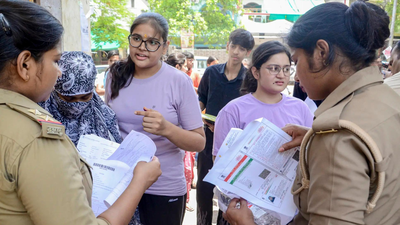
NEW DELHI: Nearly two years after the NEET-UG 2024 paper leak controversy and following the unprecedented cancellation of NEET-UG 2026, central govt is examining a hybrid examination model under which question papers could be digitally transmitted to centres and printed locally under secure conditions. Officials said this is being considered a safer alternative because conducting a fully online exam for 23 lakh candidates remains difficult due to infrastructure and logistical challenges.A senior health ministry official said discussions on possible reforms in NEET are expected in coming days between health ministry, National Medical Commission (NMC) and National Testing Agency (NTA), including whether parts of the examination process can be digitised.
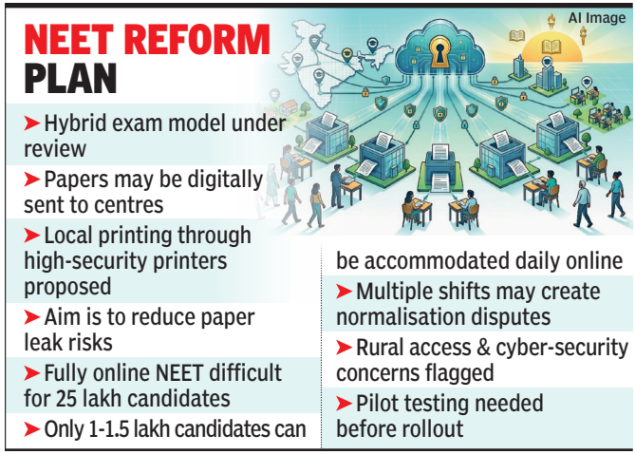
Officials said the proposed “computer-assisted secure paper-based test”, recommended by Radhakrishnan Committee, is emerging as a possible middle path between fully offline and fully computer-based examinations. Under the proposal, encrypted question papers would be sent to confidential servers at exam centres or regional hubs shortly before the exam and printed locally using high-speed secure printers.“The idea is to reduce manual handling points during transportation and storage of question papers, which are considered vulnerable stages,” an official said, adding that printing exam papers closer to examination time could reduce risks of leaks.According to officials, the hybrid system could retain advantages of a single-day, single-paper offline examination — avoiding controversies over normalisation and varying difficulty levels across shifts — while continuing to allow a large number of centres, including those in smaller towns and rural areas, to host the exam.Another senior official said shifting NEET fully online was difficult because of the exam’s sheer scale and complications linked to multiple-shift testing. “India currently lacks infrastructure to conduct a single-day computer-based exam for nearly 25 lakh students. At best, only 1 to 1.5 lakh candidates can be accommodated daily. Multiple shifts would bring into play issues of normalisation, fairness and comparisons across sessions,” the official said.The official added that many NEET aspirants from smaller towns and rural areas may not be equally familiar with computer-based testing. Unlike offline exams conducted in schools across districts, online tests require specialised centres, stable internet, uninterrupted electricity and technical manpower.Officials said a fully online system could also significantly reduce the number of centres and force many students to travel to larger cities. Cyber-security risks, server failures and technical disruptions are also issues to be considered. Any transition, they said, would require months of preparation, including infrastructure expansion, mock tests and student familiarisation exercises.The hybrid system, however, would still require pilot testing, infrastructure assessment and detailed operational protocols before rollout. “These are still discussions and nothing has been finalised yet. But after repeated controversies in recent years, there is broad agreement that reforms are needed,” an official said.The Radhakrishnan Committee was constituted after NEET-UG 2024 controversy to recommend reforms for strengthening examination security and transparency.


