
NEW DELHI: IT minister Ashwini Vaishnaw has pushed back on IMF’s comment of the country being a secondary AI power, positioning itself as a front-rank AI nation by focusing less on headline-grabbing large models and more on large-scale deployment.At a panel discussion at the World Economic Forum annual meeting in Davos, Vaishnaw challenged the view that India sits in a secondary tier of AI powers. “Actually, clearly in the first group,” he said, arguing that the country is simultaneously building capability across all five layers of the AI stack – applications, models, chips, infrastructure and energy.The minister said the real economic value of AI did not lie in building ever-larger models but in enterprise-level deployment. “ROI (return on investment) doesn’t come from creating a very large model; 95% of the work can happen with models which are 20 billion or 50 billion parameters,” he said, adding that India has a bouquet of such models deployed across sectors to improve productivity and efficiency.He also questioned the assumption that ownership of large frontier models translates into geopolitical leverage. “Does creating a large model give you geopolitical power? I don’t think so,” he said, noting that such models can be switched off and may even become financially unsustainable. “The economics of this fifth industrial revolution is going to come from ROI – deploying the lowest cost solution to get the highest possible return.”A key constraint, he said, is access to compute. To address this, India has empanelled around 38,000 GPUs under a public-private partnership model to create a common national compute facility. The system is govt-enabled and subsidised, allowing students, researchers and startups to access compute at roughly one-third of global costs.Outlining India’s broader approach, the minister said the focus is on four pillars: a shared compute facility, a free bouquet of practical AI models, large-scale skilling with a target of training 10 million people, and helping the IT services industry pivot towards AI-driven productivity.On regulation, he stressed the need for a techno-legal framework rather than laws alone. “Detecting deep fakes with the accuracy which can be taken to a court and be properly judicially checked” is essential, he said, adding that India is developing tools to mitigate bias and ensure proper unlearning before enterprise deployment.End of ArticleFollow Us On Social MediaVideos“Makes No Sense…” Ex-US Army Officer Slams Trump Over India-US RelationsUK, EU FTAs to Unlock New Export Opportunities for Assam Tea: Himanta Sarma’Rupture In World Order’: EU Blasts Trump Over ‘Bullying’; Danish MP Fires Shock Message For US PresOperation Prahar: Punjab Police Raid Locations Linked to 60 Foreign GangstersIndia Will Surpass Japan To Become 3rd Largest Economy: Gita Gopinath At World Economic Forum 2026Democracy Took Roots In India In 600 BC, Long Before The World: CEC Gyanesh KumarExplained: Why India-EU ‘Mother Of All Deals’ Matters As Trade Talks Enter Final High Stakes PhasePakistan Defence Minister Khawaja Asif Inaugurates Fake Pizza Hut Outlet, Trolled on Social Media’Influencers, AI And Deepfakes’: Indian Army Exposes Pakistan’s Digital War During Operation SindoorIndus Waters Flashpoint: Pakistan Cries Crisis At UN As India Hardens Terror Stance Post Pahalgam123Photostories’Dhurandhar 2 – The Revenge’: A quick recap of Part 1 before Ranveer Singh’s teaser dropsFrom ‘Naagzilla’ to ‘The Odyssey’: The much-awaited fantasy movies releasing in 2026How to make Dhaba-Style Amritsari Paneer Bhurji for dinner at homeNot just the Beckhams: 5 famous family feuds that shocked the worldUnseen gems: Rare photos of Rajesh KhannaLaughter Chefs Season 3 to bring major changes: OG Arjun Bijlani, Ankita Lokhande–Vicky Jain return as Team Kaanta vs Churi endsJapanese Ambassador relishes biryani with bare hands: 6 times global leaders have shown love for Indian food10 Asian cities with the longest commute time to work2 Indian chicken dishes among top 17 in the worldDaily practices you can do for planetary balance123Hot PicksSilver price todayBudget 2026Karnataka DGP ScandalGold price predictionNitin NabinPublic holidays January 2026Bank Holidays JanuaryTop TrendingMatthew StaffordTravis KelceDonald Trump PlaneUdaipur Car AccidentJonathan KumingaCandace OwensDonna KelceJohn Harbaughs WifeKlay ThompsonsAshwini Vaishnaw
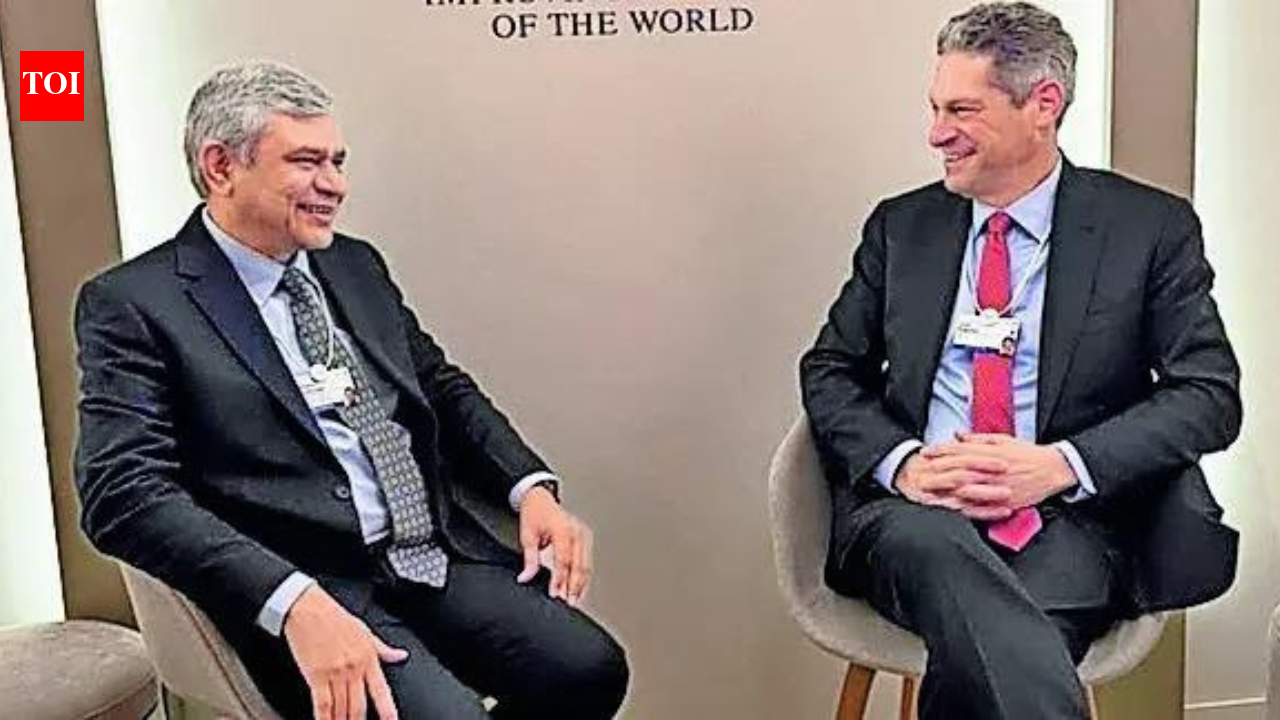
NEW DELHI: IT minister Ashwini Vaishnaw has pushed back on IMF’s comment of the country being a secondary AI power, positioning itself as a front-rank AI nation by focusing less on headline-grabbing large models and more on large-scale deployment.At a panel discussion at the World Economic Forum annual meeting in Davos, Vaishnaw challenged the view that India sits in a secondary tier of AI powers. “Actually, clearly in the first group,” he said, arguing that the country is simultaneously building capability across all five layers of the AI stack – applications, models, chips, infrastructure and energy.The minister said the real economic value of AI did not lie in building ever-larger models but in enterprise-level deployment. “ROI (return on investment) doesn’t come from creating a very large model; 95% of the work can happen with models which are 20 billion or 50 billion parameters,” he said, adding that India has a bouquet of such models deployed across sectors to improve productivity and efficiency.He also questioned the assumption that ownership of large frontier models translates into geopolitical leverage. “Does creating a large model give you geopolitical power? I don’t think so,” he said, noting that such models can be switched off and may even become financially unsustainable. “The economics of this fifth industrial revolution is going to come from ROI – deploying the lowest cost solution to get the highest possible return.“A key constraint, he said, is access to compute. To address this, India has empanelled around 38,000 GPUs under a public-private partnership model to create a common national compute facility. The system is govt-enabled and subsidised, allowing students, researchers and startups to access compute at roughly one-third of global costs.Outlining India’s broader approach, the minister said the focus is on four pillars: a shared compute facility, a free bouquet of practical AI models, large-scale skilling with a target of training 10 million people, and helping the IT services industry pivot towards AI-driven productivity.On regulation, he stressed the need for a techno-legal framework rather than laws alone. “Detecting deep fakes with the accuracy which can be taken to a court and be properly judicially checked” is essential, he said, adding that India is developing tools to mitigate bias and ensure proper unlearning before enterprise deployment.


