
India’s big nuclear leap: How Stage 2 criticality at Kalpakkam will power the road to energy security

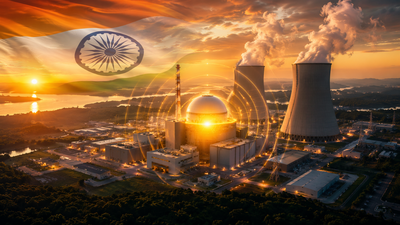
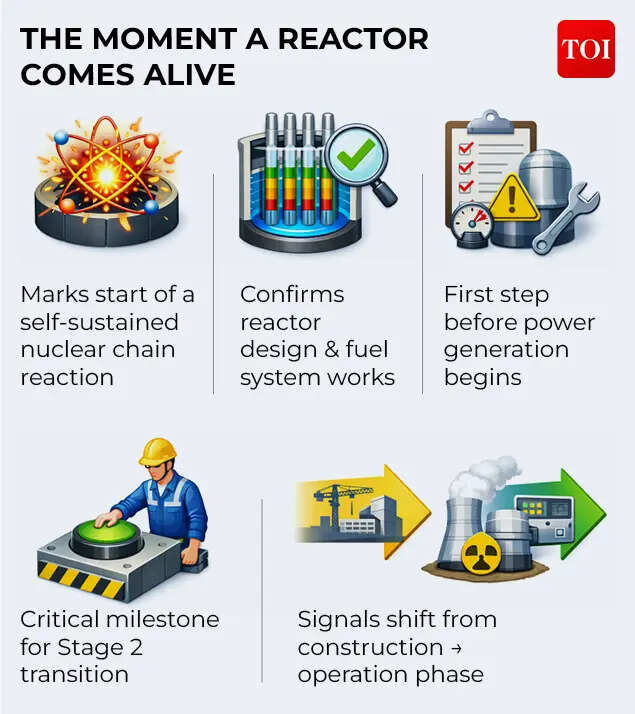
‘No power is as costly as no power’ – Homi Jehangir Bhabha, the father of India’s nuclear programme, had once famously said. Several decades later, India’s nuclear energy ambitions have entered a decisive phase.On April 6, the Prototype Fast Breeder Reactor (PFBR) at Kalpakkam in Tamil Nadu achieved criticality, achieving a sustained nuclear chain reaction for the first time. The 500 MWe reactor, built by Bharatiya Nabhikiya Vidyut Nigam Limited, marks India’s formal entry into Stage 2 of its three-stage nuclear programme. What makes India’s achievement even more remarkable is that it is the second country after Russia to operate a commercial fast breeder reactor. This milestone comes at a time when India’s overall power system has reached 520.51 GW of installed capacity as of January, which in itself is a result of a decade of rapid expansion across conventional and renewable sources. Stage 2, therefore, sits within a much larger transformation of India’s energy architecture.Nuclear energy, attained through controlled splitting of atoms, is used to generate electricity. It is widely recognised as a dependable and clean source of energy that does not produce any greenhouse gases. For India, which is among the world’s largest and fastest-growing economies, the importance of energy self-reliance cannot be overstated. As it moves towards its goal of becoming a developed country, nuclear energy is a cornerstone in India’s Atmairbharta push. It also assumes particular significance in an increasingly unpredictable global environment where economic warfare has become a weapon.What is India’s nuclear energy programme? What are the expansion plans and how does nuclear energy help India build self-reliance and energy security?
India’s civil nuclear energy plans: Where we stand & expansion roadmap
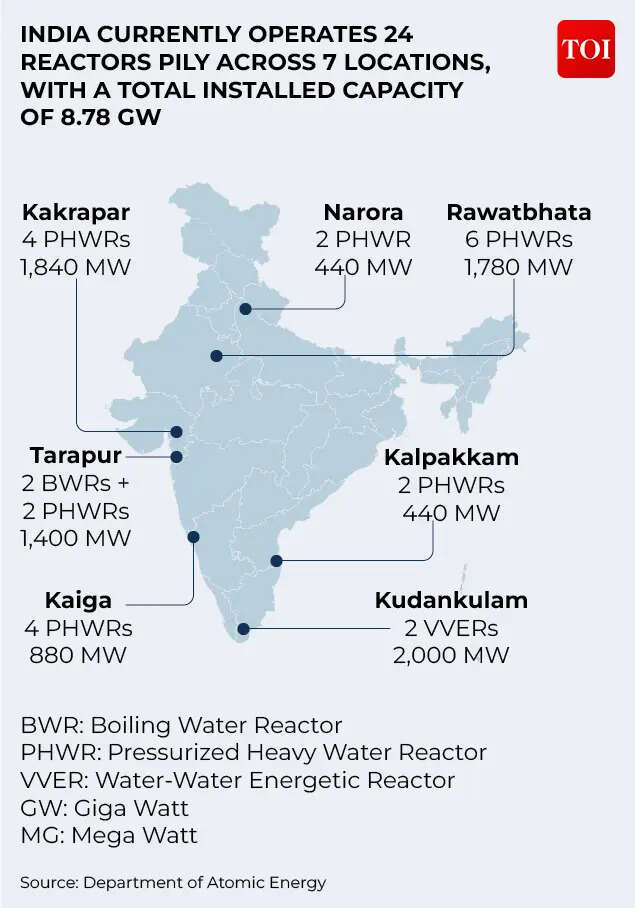
Nuclear energy remains a small but strategic part of India’s electricity mix. India’s nuclear capacity stands at 8.78 GW, contributing 3.1% of total electricity generation in 2024–25, with output of 56,681 million units. This is modest compared to the country’s total installed capacity of 520.51 GW, where renewables and coal dominate. However, expansion plans are significant.
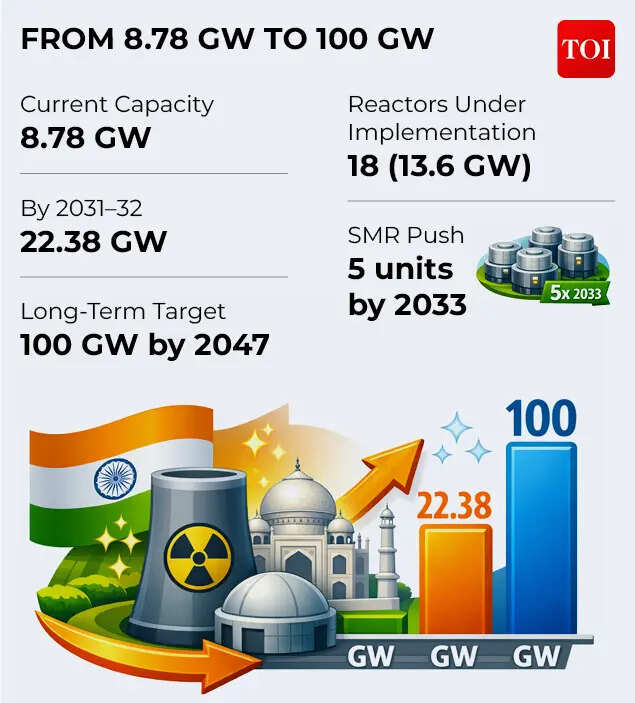
India aims to scale capacity to 22.38 GW by 2031–32, supported by an implementation pipeline of 18 reactors totalling 13.6 GW. Beyond this, the Nuclear Energy Mission targets 100 GW by 2047, positioning nuclear as a major pillar of India’s long-term energy transition.As Vikas Gaba, partner and national head – power and utilities, KPMG in India, says, this scale-up is aligned with “Viksit Bharat 2047 and the national Net-Zero 2070 commitment,” with nuclear power expected to play a materially larger role in the future energy system.This expansion aligns with rising electricity demand, which saw India meet a peak of 242.49 GW in FY 2025–26, while power shortages fell sharply to 0.03%, down from 4.2% a decade ago.As Gaba notes, nuclear is positioned as a “critical pillar” in India’s long-term clean energy transition.
Importance of Stage 2 & the road to Stage 3
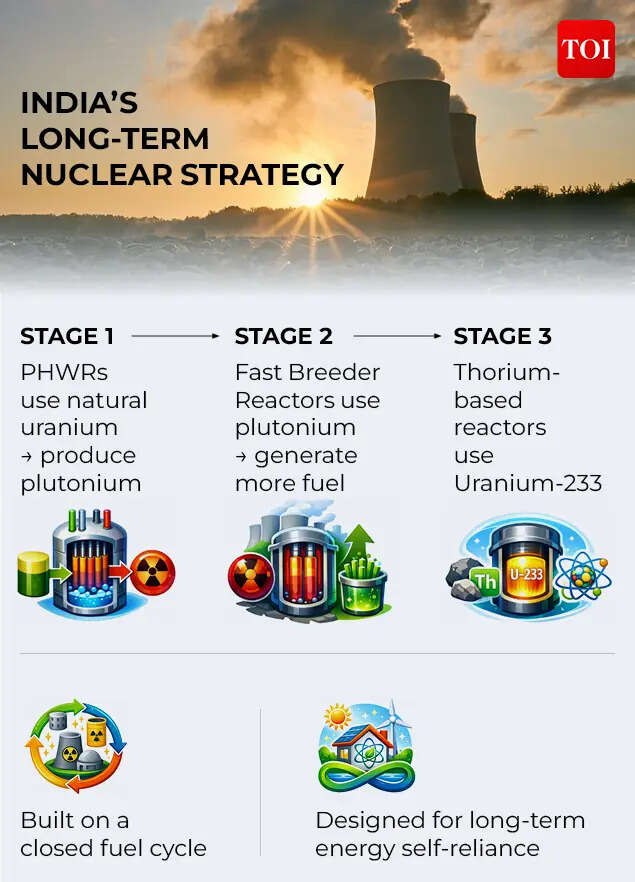
India’s three-stage nuclear programme, designed by Homi Jehangir Bhabha way back in 1954, is rooted in resource optimisation.Stage 1 generates plutonium from uranium. Stage 2, now operational, uses that plutonium in Fast Breeder Reactors to create more fuel than consumed. The PFBR converts Uranium-238 into Plutonium-239, expanding fissile material availability.Crucially, it lays the foundation for Stage 3, where Thorium-232 will be converted into Uranium-233 for large-scale thorium-based power generation.
What makes India’s nuclear journey different
India doesn’t have much uranium. Unlike France or China, which scaled nuclear rapidly using imported uranium, India’s approach is slower but structurally differentiated, prioritising domestic resource leverage, closed fuel cycles, and strategic autonomy over near‑term capacity maximisation.Importantly, Somesh Kumar, partner, power & utilities GPS leader, EY India, says, India’s differentiation lies in “a three-stage closed fuel-cycle pathway intended to convert limited domestic uranium and large thorium reserves into long-term energy security.”Amit Kumar, partner and energy and renewables industry leader at Grant Thornton Bharat, notes, “Although India has the 8th largest installed base of nuclear power capacity, the contribution to electricity generated is only 3% of annual production. With recent policy reforms and engineering advances, India is on a path to emerge as a significant nuclear energy player.”
Nuclear in India’s evolving energy mix
India’s energy mix today reflects both scale and transition. Coal continues to dominate total energy supply, rising to 5,52,315 Ktoe in FY 2024–25, while renewable capacity has surged to 2,29,346 MW, growing at a CAGR of over 10%. On peak days, renewables have already met over 51.5% of electricity demand, signalling rapid structural change. At the same time, overall energy demand continues to rise. Total Primary Energy Supply grew 2.95% year-on-year, while Total Final Consumption increased over 30% since FY16, reflecting expanding industrial and economic activity.
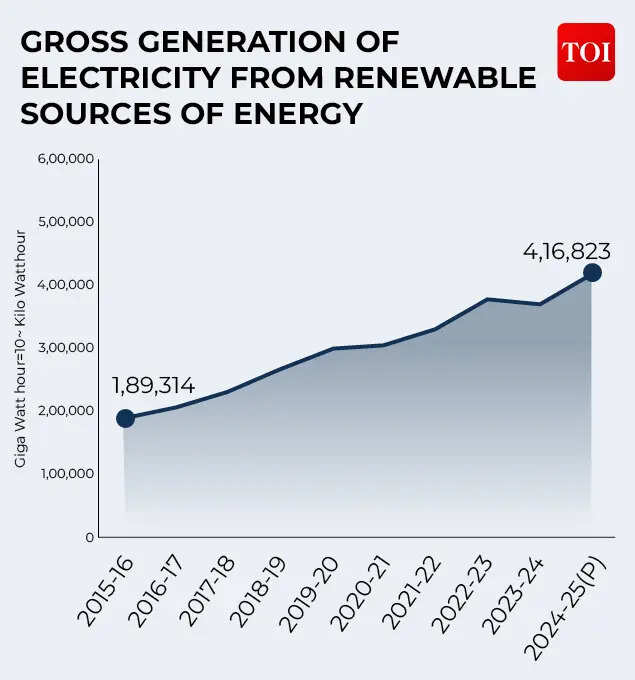
In this context, nuclear power’s role is distinct. It provides stable, round-the-clock baseload power in a system increasingly dominated by variable renewables.As Somesh Kumar highlights, nuclear delivers “reliable 24×7 clean baseload power,” complementing intermittent sources like solar and wind.
Energy access, demand growth, and why nuclear matters
India’s power sector has moved from scarcity to adequacy.Over 18,374 villages have been electrified, and 2.86 crore households connected, supported by investments of Rs 1.85 lakh crore. Per capita electricity consumption has risen to 1,460 kWh (FY25), up over 50% from a decade ago.With rising consumption, the projected peak demand is expected to reach 458 GW by 2032 under the National Electricity Plan. This creates the need for not just more power, but more reliable power.Nuclear fits this requirement by providing a consistent supply independent of weather or fuel price volatility, supporting industrial growth, digital infrastructure, and urban demand centres.
The investment cycle: Nuclear as a long-term capital play
India’s power sector is entering a massive investment phase. With over Rs 50 lakh crore investment opportunities projected through 2032 across generation, transmission, and storage, nuclear forms a key long-term component of this ecosystem.The Nuclear Energy Mission allocates Rs 20,000 crore for SMRs, but the broader scale-up to 100 GW will require sustained capital deployment.
As Somesh Kumar notes, nuclear’s value lies in reducing dependence on fossil-based reliability resources in a system that will require trillions in investment for the net-zero transition.
Policy push: Role of the SHANTI Act, 2025
In India’s quest for nuclear energy expansion, the Sustainable Harnessing and Advancement of Nuclear Energy for Transforming India (SHANTI) Act, 2025 emerges as an institutional backbone. The SHANTI Act 2025 consolidates and modernises India’s nuclear legal architecture, aligning it with current expansion goals. It allows limited private sector participation in areas such as plant operations, equipment manufacturing, and parts of the fuel value chain, while retaining sovereign control over critical functions like enrichment, reprocessing, and waste management.The legislation also strengthens regulatory oversight by granting statutory status to the Atomic Energy Regulatory Board and introducing structured licensing and a graded liability framework.This creates a more predictable and structured environment for scaling nuclear capacity, while maintaining safety and strategic control. In this context, the broader policy ecosystem complements technological milestones such as the PFBR’s criticality, enabling the next phase of growth.This policy framework aligns nuclear expansion with India’s broader goals of energy security, clean energy transition, and long-term economic growth.Debashish Mishra, partner, chief growth officer, Deloitte South Asia, says that the SHANTI Bill clarifies a few important aspects like insurance, liability. “This has been the demand because post-Fukushima, foreign companies are scared to touch any investment in nuclear without capping their liability. It also covers small modular reactors which are important for data centers,” he tells TOI.However, Amit Kumar of Grant Thornton Bharat sees two critical gaps, domestic capability and capacity building, and faster approval cycles for foreign direct investment in nuclear power. He believes that to fully capitalise on recent reforms, India must prioritise localisation of nuclear manufacturing.
Role in self-reliance, energy security & economic benefits
India’s nuclear strategy is fundamentally about reducing vulnerability. While fossil fuels—especially coal and imported hydrocarbons—continue to dominate energy supply, nuclear energy offers a pathway to reduce long-term exposure to global fuel volatility.Its advantages include low fuel volume requirements, long operating cycles, and the ability to build a domestic fuel cycle. Over time, thorium-based systems could further strengthen self-reliance.Experts say expanding nuclear power can provide substantial economic benefits by displacing imported fossil fuels used for baseload power. Over time, avoided fuel imports, reducing carbon exposure, and stable long‑term tariffs can end up improving India’s trade balance while at the same time supporting competitive, low‑carbon industrial growth.
Amit Kumar of Grant Thornton Bharat explains that energy consumption today depends on imported fuel, except for electricity which is largely generated from indigenous resources. Increasing electrification of sources of energy consumption (cooking, transportation) and increased production of electricity from non-fossil indigenous resources will be two drivers of India’s energy security, he believes. “In an increasingly volatile global energy environment, greater nuclear penetration can significantly reduce reliance on fossil fuels, thereby lowering exposure to fuel‑price volatility and import dependence,” he tells TOI.“Beyond fuel security, nuclear power enhances grid stability in a renewable‑heavy system by providing firm, carbon‑free baseload power. Strategically, India’s indigenous reactor program and advanced reactor focus reinforce long‑term self‑reliance and technological leadership,” he adds.Somesh Kumar of EY India is of the view that the stronger economic case for nuclear power is system-level: Niti Aayog estimates that India’s Net Zero power transition could require $14.23 trillion in cumulative investment by 2070, which means the country will need not just more clean energy, but more firm and reliable clean energy. Nuclear’s economic value lies in reducing reliance on fossil-based reliability resources over time. Its strongest substitution case is in the power sector, especially against coal-based baseload generation in the medium-to-long term and gas-based generation during periods of LNG stress; Niti’s power outlook is telling on this point, as it sees no new gas-based generation investment and existing gas plants being gradually retired by 2050. In other words, nuclear’s most effective role is not to replace every hydrocarbon everywhere, but to displace the most import-risk and carbon-intensive parts of the electricity stack while supporting a more stable clean-power system, says Somesh Kumar.In fact, according to Sambitosh Mohapatra, Partner, PwC India India’s unique fuel strategy supports grid stability, limits exposure to geopolitical energy shocks, and anchors energy independence as renewable penetration and electrification rise.“Civil nuclear power enhances India’s energy security by providing firm, low‑carbon baseload power while reducing dependence on imported coal, LNG, and volatile global fuel markets. The fast‑breeder pathway enables recycling of spent fuel and gradual reduction in uranium import intensity. Over the long term, India’s vast thorium reserves—among the largest globally—offer the prospect of near‑permanent domestic fuel availability under Stage‑3 reactors,” he tells TOI.From a fuel security perspective, nuclear power has a distinct advantage. It requires very small quantities of fuel, sourced under long‑term arrangements and usable over extended operating cycles. According to Vikas Gaba of KPMG, economically, nuclear expansion enables substitution of import‑intensive and fuel‑price‑exposed conventional sources. Nuclear power is particularly effective in replacing:
- Coal‑based baseload generation in large, continuous‑load applications
- Gas and LNG‑based power, where fuel costs are linked to volatile international markets
- Diesel‑based captive generation for industrial and strategic facilities
Gaba lists heavy industries, railways, urban power systems, emerging digital infrastructure, and manufacturing corridors as key beneficiary sectors.India’s nuclear strategy is also closely linked to long-term energy security. The three-stage programme is designed to reduce dependence on imported uranium by building a domestic fuel cycle centred on thorium. With one of the largest thorium reserves globally, this approach aims to ensure sustained energy availability over the long term.At present, India also participates in cross-border electricity trade with neighbouring countries through regional grid connectivity. While nuclear energy is currently focused on domestic supply, expansion of stable baseload capacity could strengthen India’s role in regional energy cooperation over time.
Execution challenges: Scale, cost, and timelines
Despite strong fundamentals, execution remains the key challenge.Nuclear projects are characterised by long gestation periods, high capital requirements, and complex regulatory frameworks. Technologies like Fast Breeder Reactors add additional layers of technical complexity.The transition to Stage 3, based on thorium, remains a long-term objective dependent on the successful scaling of Stage 2 technologies. Execution, rather than intent, will determine the pace of progress.India’s power system has expanded rapidly, adding over 52,537 MW capacity in FY26 alone, including 39,657 MW from renewables, but nuclear projects operate on longer timelines and higher capital intensity.As Somesh Kumar of EY points out, the next phase depends on building a “credible build-finance-regulate model at scale.”
The bottom line
India’s nuclear milestone at Kalpakkam is not an isolated event—it is part of a broader transformation of the country’s energy system.From 520.51 GW installed capacity to rising demand, expanding renewables, and declining power shortages, the system is becoming larger, more reliable, and more complex.In that system, nuclear energy is evolving from a marginal contributor to a strategic pillar—one that provides stability, supports clean energy goals, and strengthens long-term energy security.As Somesh Kumar of EY sums up: the next phase of India’s nuclear journey will be decided less by ambition and more by whether India can build a credible build-finance-regulate model at scale.The ambition is clear. The scale is unprecedented. The outcome will depend on execution.


