
India prioritizes peace and dialogue but will not compromise on national sovereignty and security, stated Defence Minister Rajnath Singh. He highlighted India’s growing role as a reliable partner, driven by economic strength, technological advancement, and a principled foreign policy. Reforms in defence procurement and modernization are crucial for future security and national destiny. NEW DELHI: India believes in peace and dialogue, but it does not “compromise” when it comes to the sovereignty and security of the nation, defence minister Rajnath Singh said here on Friday.Speaking at the Chanakya Defence Dialogue, Rajnath said, “India’s economic growth, technological capabilities and principled foreign policy have made it a voice of balance and responsibility in the changing global environment, with countries across the Indo-Pacific and the Global South viewing us as a reliable partner.”Emphasizing that a stable India contributes to a stable global economy. the minister said that through Atmanirbharta, the Centre is building a defence industrial ecosystem that encourages innovation, supports industry and reduces external dependencies. He asserted that India is shaping global discussions with a sense of responsibility, strategic autonomy, and confidence rooted in civilisational values.India has earned global trust due to path-breaking reforms, and its consistent stand for respect of the sovereignty of nations and rules-based order, he said. “We are strengthening border and maritime infrastructure to support security and connectivity. We are modernising our forces through new platforms, technologies, and structures,” the minister said.“We are reforming procurement processes to ensure speed, transparency, and accountability,” the minister said, adding India is investing in start-ups, “deep-tech capabilities, and research and development that will shape the battlefields of the future,” Singh said.He emphasised that the geopolitical uncertainty and challenges such as terrorism, cross-border support to extremist elements, attempts to alter the status quo, maritime pressures, and even information warfare require constant vigilance & clarity of purpose, with reforms becoming a strategic necessity more than a choice. “Reforms strengthen the adaptability of institutions, enhance the agility of the armed forces, and give the nation the confidence to shape its own destiny,” he said, while enumerating the steps taken by the Modi govt to build a ‘Sashakt, Surakshit and Viksit Bharat’.Singh said the contribution of the armed forces goes far beyond defending the borders. “Our armed forces bring stability where it is needed most. They support civil authorities in times of disaster. They safeguard our maritime interests. They strengthen our international partnerships through joint exercises and peacekeeping. Their professionalism builds confidence — not only within India, but also among our friends around the world. That’s why reform and modernisation in the armed forces are not just administrative tasks; they are investments in India’s long-term future,” he said.The minister added that the contribution of the armed forces goes far beyond defending the borders. “Our armed forces bring stability where it is needed most. They support civil authorities in times of disaster. They safeguard our maritime interests. They strengthen our international partnerships through joint exercises and peacekeeping. Their professionalism builds confidence – not only within India, but also among our friends around the world. That’s why reform and modernisation in the Armed Forces are not just administrative tasks; they are investments in India’s long-term future,” he said.’At the event, Chief of Defence Staff (CDS) General Anil Chauhan said new domains such as cyberspace and space, as well as cognitive warfare, challenge traditional concepts of borders and sovereignty, making them “functionally porous.” The CDS cited ‘Operation Sindoor” as an example, demonstrating how modern weapons can target an adversary’s entire natural, network, economic, and information spaces. He emphasised that these trends will continue to shape the future of warfare. Chauhan pointed out that these trends are evident in conflicts like Eastern Europe and West Asia, where borders are being redefined. He also mentioned claims over sovereign territories, such as Greenland, as examples of diluted sovereignty.End of ArticleFollow Us On Social MediaVideosCyclone Ditwah Approaches India: Tamil Nadu, Puducherry, Andhra Pradesh Brace For Impact’Op Sindoor Was Just A Glimpse Of Future Theatre Commands’: Air Marshal Ashutosh DixitPM Modi Unveils World’s Tallest Bronze Statue Of Lord Ram In South GoaIndia Says US Trade Deal Is ‘Only Matter Of Time’ As Tariffs Reshape Bilateral Trade NegotiationsPM Modi Joins Over 1 Lakh Devotees In Mass Bhagwat Gita Recitation At Udupi EventIndia’s Updated Quake Map Warns Entire Himalayan Arc Faces Major Risk, Forcing Urgent Safety Reforms’They Are Ours, We’ll Prove It’: Pakistani Leader’s Absurd Claim On ‘Gujarat, Haryana, Rajasthan’Cyclone Ditwah Intensifies, Monsoon Fury Slams Sri Lanka With At Least 56 Dead And Dozens MissingViral Video: Stage Crashes During UP Wedding As BJP Leaders Gather To Greet Bride & GroomIndia-Russia Summit Dates Out As PM Modi, Putin Review S-400, Su-57 And Global Security Challenges123PhotostoriesRebellious lovers who break every rule to define love in Bollywood moviesAnkita Lokhande reveals she is returning to Laughter Chefs season 3; Krushna Abhishek says ‘We will celebrate Christmas with our Bhauji’4 simple exercises that can help relieve foot pain from diabetic neuropathyGirija Oak Godbole: Surprising facts about the ‘blue saree girl’ you didn’t knowFrom Pythons to Koalas: 5 sleepyhead animals that nap their way through most of the day2 effective drinks to control blood sugar naturally and how to make them at homeRanbir Kapoor, Alia Bhatt to Randeep Hooda: Actors who disappeared with their rolesFrom Saraayah to Sipaara: A look at 2025 Bollywood baby names and their meanings5 countries with zero airports, yet travellers make it in for the experienceSobhita Dhulipala to Shanaya Kapoor: 5 breathtaking celeb looks of the day123Hot PicksDelhi AQI TodayNew Labour CodeWorld NewsGold rate todaySilver rate todayPublic Holidays NovemberBank Holidays NovemberTop TrendingSaquon BarkleyLaMelo BallDonald TrumpDana WhiteAyesha CurryFuzzy ZoellerJammie BookerMarcus FolignoCalgary FlamesVanessa Bryant
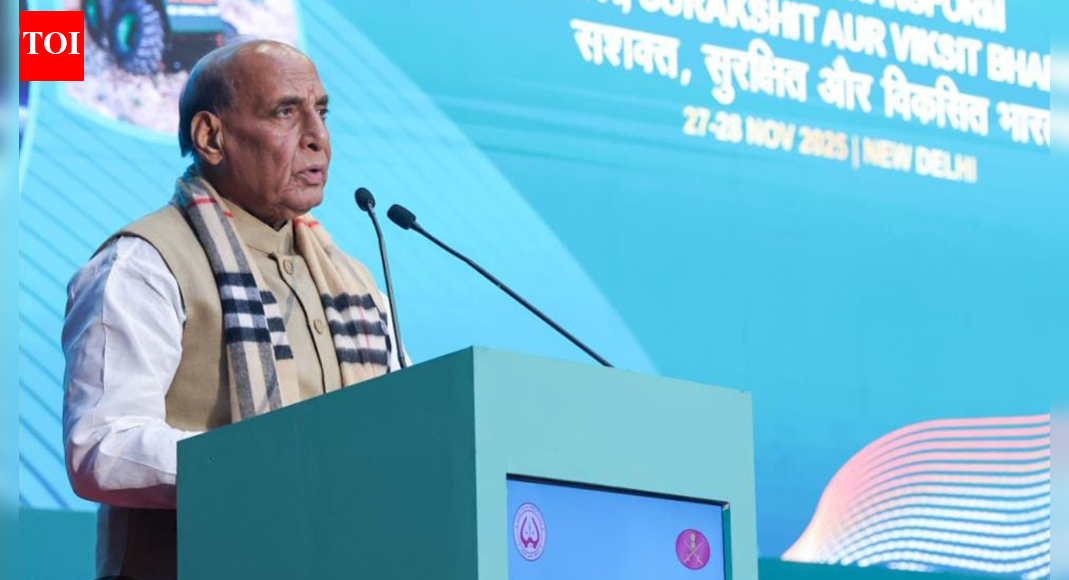
NEW DELHI: India believes in peace and dialogue, but it does not “compromise” when it comes to the sovereignty and security of the nation, defence minister Rajnath Singh said here on Friday.Speaking at the Chanakya Defence Dialogue, Rajnath said, “India’s economic growth, technological capabilities and principled foreign policy have made it a voice of balance and responsibility in the changing global environment, with countries across the Indo-Pacific and the Global South viewing us as a reliable partner.”Emphasizing that a stable India contributes to a stable global economy. the minister said that through Atmanirbharta, the Centre is building a defence industrial ecosystem that encourages innovation, supports industry and reduces external dependencies. He asserted that India is shaping global discussions with a sense of responsibility, strategic autonomy, and confidence rooted in civilisational values.India has earned global trust due to path-breaking reforms, and its consistent stand for respect of the sovereignty of nations and rules-based order, he said. “We are strengthening border and maritime infrastructure to support security and connectivity. We are modernising our forces through new platforms, technologies, and structures,” the minister said.“We are reforming procurement processes to ensure speed, transparency, and accountability,” the minister said, adding India is investing in start-ups, “deep-tech capabilities, and research and development that will shape the battlefields of the future,” Singh said.He emphasised that the geopolitical uncertainty and challenges such as terrorism, cross-border support to extremist elements, attempts to alter the status quo, maritime pressures, and even information warfare require constant vigilance & clarity of purpose, with reforms becoming a strategic necessity more than a choice. “Reforms strengthen the adaptability of institutions, enhance the agility of the armed forces, and give the nation the confidence to shape its own destiny,” he said, while enumerating the steps taken by the Modi govt to build a ‘Sashakt, Surakshit and Viksit Bharat’.Singh said the contribution of the armed forces goes far beyond defending the borders. “Our armed forces bring stability where it is needed most. They support civil authorities in times of disaster. They safeguard our maritime interests. They strengthen our international partnerships through joint exercises and peacekeeping. Their professionalism builds confidence — not only within India, but also among our friends around the world. That’s why reform and modernisation in the armed forces are not just administrative tasks; they are investments in India’s long-term future,” he said.The minister added that the contribution of the armed forces goes far beyond defending the borders. “Our armed forces bring stability where it is needed most. They support civil authorities in times of disaster. They safeguard our maritime interests. They strengthen our international partnerships through joint exercises and peacekeeping. Their professionalism builds confidence – not only within India, but also among our friends around the world. That’s why reform and modernisation in the Armed Forces are not just administrative tasks; they are investments in India’s long-term future,” he said.’At the event, Chief of Defence Staff (CDS) General Anil Chauhan said new domains such as cyberspace and space, as well as cognitive warfare, challenge traditional concepts of borders and sovereignty, making them “functionally porous.” The CDS cited ‘Operation Sindoor” as an example, demonstrating how modern weapons can target an adversary’s entire natural, network, economic, and information spaces. He emphasised that these trends will continue to shape the future of warfare. Chauhan pointed out that these trends are evident in conflicts like Eastern Europe and West Asia, where borders are being redefined. He also mentioned claims over sovereign territories, such as Greenland, as examples of diluted sovereignty.


