
In 1938, Otto Hahn and Fritz Strassmann found one strange element in uranium residue and accidentally opened the atomic age


The uranium experiment that went wrong triggered the discovery of nuclear fission. Image credit – Wikimedia
While conducting some meticulous experiments in Berlin towards the end of 1938, two chemists, Otto Hahn and Fritz Strassman, saw something that defied the scientific laws of the period. Following their bombardment of uranium with neutrons, they analyzed the remaining reaction products and discovered barium, which is much lighter than uranium.This discovery marked the first step towards understanding nuclear fission, a phenomenon where the nucleus of an atom breaks down into smaller pieces and produces tremendous energy. Initially, it appeared to be a mistake in chemistry. However, this discovery went on to become one of the most vital scientific discoveries of the century and heralded the atomic era.An unusual product that led to an era-defining discoveryOtto and Fritz had been studying the behavior of uranium under neutron bombardment. The expectation of scientists in those times was that the product would always be an element heavier than uranium.According to the Department of Energy’s Office of Scientific and Technical Information, the scientists found that the residue could not be accounted for by any conventional radioactive decay nor could it be produced by the formation of any other heavy element. The surprising discovery of barium was an indicator that an extraordinary phenomenon was taking place within the structure of the uranium atom.Similarly, the American Chemical Society also identifies the event of December 1938 as being significant because of the residue that indicated the breaking up of uranium nuclei into fragments.Discovery of Nuclear FissionAs a result of this strange occurrence, physicists arrived at the conclusion that a uranium nucleus could be broken up into two equal fragments. Along with the release of energy, neutrons were also produced from such a process. These neutrons turned out to have great significance as stated by the Department of Energy since they could produce another fission reaction. This is what formed the basis of chain reactions.According to the historical archive of the DOE, this paved the way for comprehension on how vast quantities of energy could be liberated from the nuclei of atoms. The discovery did not take long before crossing the threshold between chemistry and physics. The experiment in Berlin, which started as the identification of some residues, ended up becoming a new approach to interpreting matter and energy.
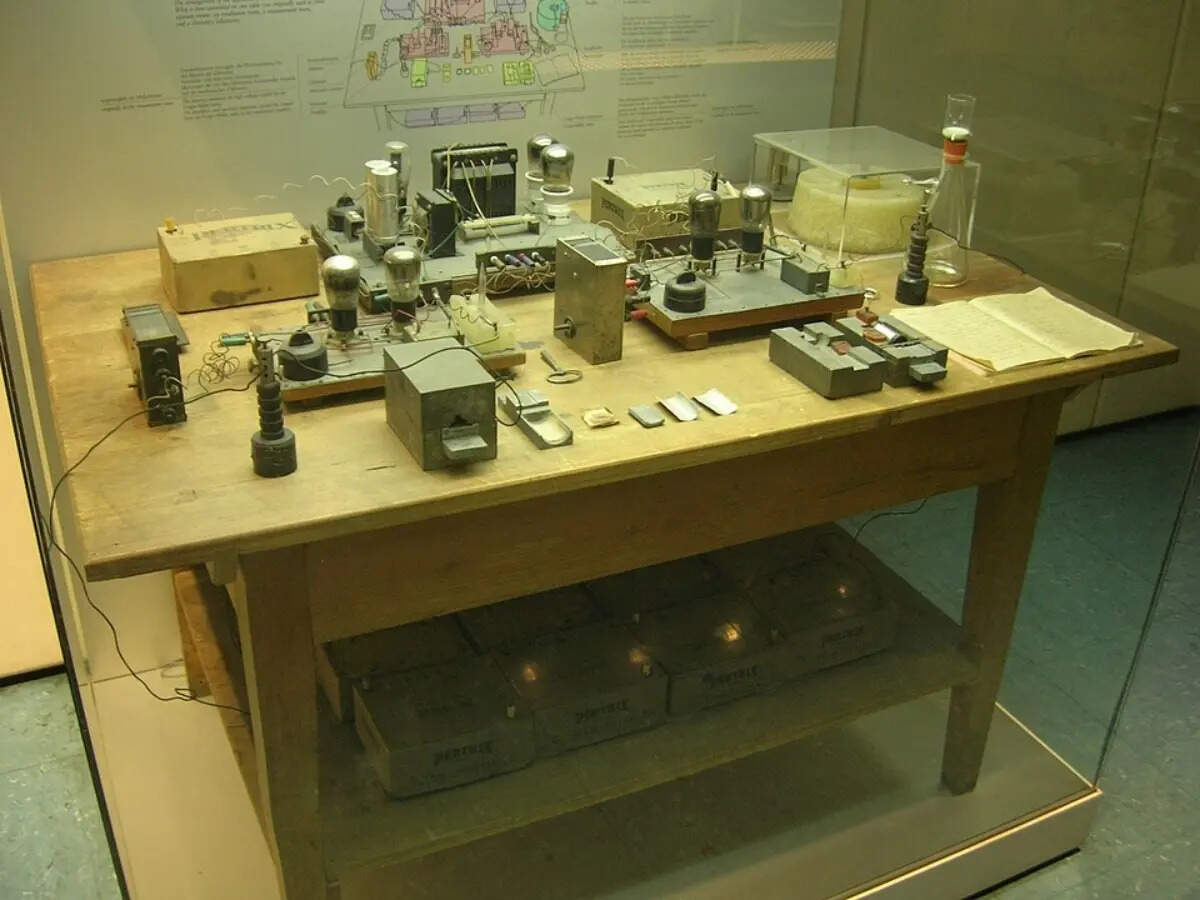
Two Chemists in Berlin noticed barium where it should not exist. Image credit – Wikimedia
The significance of barium in the discoveryBarium turned out to be the critical element since it challenged the scientific knowledge that existed at the time. Scientists thought that the uranium atom would produce slightly heavier radioactive atoms due to the effect of neutrons. However, the findings showed an atom that had significantly lower atomic mass.According to the American Chemical Society, the contradiction led to a review of the whole experiment. Once the scientists acknowledged the chemical proof, the only conclusion was that the uranium atom had split apart.This discovery forever changed the field of nuclear science. No longer did atoms represent almost immutable elements but something more dynamic that can undergo significant transformations.An insight gained at an extremely significant moment in historyThe very timing of this discovery enhanced its historical significance. Hahn and Strassmann performed their experiments in Berlin shortly before the outbreak of World War II. With the situation becoming increasingly unstable politically in Europe, discoveries in science that held military potential immediately became relevant.It is often noted by historians that this discovery of nuclear fission did not come in a form of some explosive revelation or a loud announcement. It was a result of thorough chemistry work. However, its implications have quickly spilled into other spheres.The DOE historical archives note that once the concept of chain reactions became clear, the immense possibilities offered by nuclear energy were quickly realized by both the governments and scientists.Relevance of the 1938 experiment to historyThis 1938 experiment has historical value, because it demonstrates how one tiny detail in the lab can change the course of world events. It is important to remember that the discovery did not start with a theory about splitting atoms.Present-day historians also consider this discovery to be an example of observation leading to revolution in science. The chemists had believed the facts they discovered despite contradicting what was known then.Nuclear fission is currently impacting several fields such as energy generation, medicine, security matters, and scientific studies. Nuclear fission can trace its origin to the barium residues observed in Berlin, Germany, in 1938. The history of nuclear fission started when two scientists sought to find out why there were traces of another element when it shouldn’t exist there at all.


