
Hidden underground ‘city’ built by ants discovered in Brazil after shocking concrete test | World News

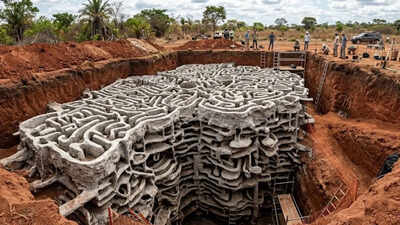
In Brazil’s vast Cerrado region, Professor Luiz Carlos Forti and his team made a scientific breakthrough. They poured ten tons of cement into an giant, deserted leaf-cutter ant nest. Over the course of ten days, this liquid concrete filled a complex network that reached 26 feet deep. After excavation, it revealed a massive ‘subterranean structure’ that redefines what we know about biological engineering. This extensive structure once housed millions of ants and included a sophisticated spatial organisation with foraging tunnels, fungus gardens, and ventilation shafts. By studying this cast, scientists discovered how these insects moved 40 tons of soil to build an urban environment as complex and efficient as human civil engineering marvels.
Inside the Atta laevigata nest: How ants built a complex underground network
As noted in research published on Research Gate, researchers uncovered an Atta laevigata nest sprawling over 500 square feet and plunging down 8 meters. They poured cement to capture the colony’s spatial layout, revealing numerous chambers with specific purposes. The ants had built oval ‘fungus chambers’ for growing their main food source. There were also areas for waste, known as ‘refuse chambers.’ Their tunnels weren’t just dug randomly; these pathways acted as highways, improving leaf transport and keeping oxygen circulating throughout the nest’s depths.
How ants build collapse-proof underground tunnels using soil engineering
As noted in the Insects Journal, creating this massive ant city required a collaborative effort from the colony, much like humans building the Great Wall of China. Studies show these ants transported about 40 tons of soil to the surface. Their construction skills in the Geotechnical properties of soil are impressive. The tunnels, crafted with precision, resist the heavy weight above, preventing any structural collapses even when they dig deep. Consequently, the queen and her brood remain safe and secure in the lowest levels of their home.
How convection currents keep the colony cool
Scientific analysis published in the Brazilian Journal of Biology of the cement casts shows that the nest was designed with a natural thermo-regulatory ventilation. The placement of tunnels allows for a ‘chimney effect,’ where heat generated by the fungus chambers and the millions of ants triggers a convection current, pulling fresh oxygen in from the surface. Furthermore, the waste chambers were strategically placed at the periphery or bottom of the nest to prevent the spread of parasites and pathogens to the main colony.
Cement casting beats traditional excavation
The use of cement as a medium for casting nests is an established casting methodology used to preserve the negative space of tunnels. During a study in Brazil, scientists prepared a mix weighing between 3,500 and 10,000 kilograms, depending on the nest’s size. They added water so it could flow into even the smallest passages before solidifying. When it hardens, it reveals a detailed map of the nest, providing insights into its structure that can’t be achieved by just digging it up.


